
Beyond Centrality: Redefining User Influence through Community Labels and Markov Chains
Evaluating User Community Influence in Online Social Networks
This paper introduces a novel User Community Influence (UCI) model to identify influential members in Online Social Networks (OSNs). By combining interpersonal structure with a new "community label" concept, the authors leverage a Markov-chain-based propagation mechanism to achieve superior influence ranking and information spread.
TL;DR
In the era of viral marketing, identifying the "true" influencers within a niche community is more complex than just counting followers. This paper proposes a User Community Influence (UCI) model that moves beyond simple graph metrics. By integrating Attribute Similarity and a novel Community Label concept into a Markov Chain propagation framework, the researchers provide a more "rational" and "efficient" way to rank users in Online Social Networks (OSNs).
Background: The Limits of Structural Centrality
Historically, we have relied on three pillars of network analysis to find influencers:
- Degree Centrality: Who has the most connections?
- Closeness Centrality: Who is "closest" to everyone else?
- Betweenness Centrality: Who acts as the vital bridge between groups?
While useful, these metrics are often too blunt. In a professional community (like the arXiv dataset used in this study), having 100 random connections is less influential than having 10 connections who are leaders in your specific field. Furthermore, traditional metrics suffer from high duplication rates, making it hard to distinguish between top-tier users.
The Core Insight: The UCI Model
The authors argue that influence is a product of three distinct factors:
- Quantity: The number of friends (similar to PageRank's in-links).
- Quality: Not all friends are equal. The "Influence Ability" () is calculated based on how many attributes and common neighbors two users share.
- Community Label: This is the "secret sauce." The model calculates a "Community Label" ()—the attributes shared by the majority. Users whose personal attributes align more closely with the community's identity are granted more weight.
Methodology & Architecture
The solution follows a rigorous framework from factor analysis to propagation:
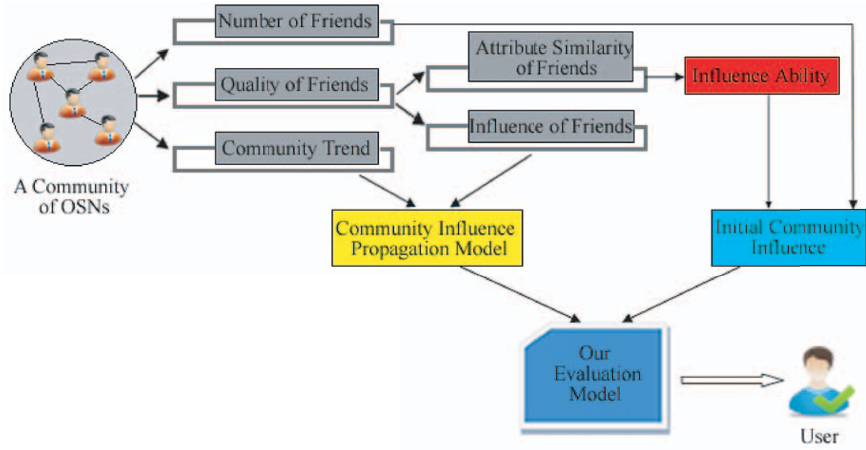
The model treats influence as a dynamic flow. Using a Markov Chain representation, they define a transition matrix where the probability of influence moving from user to is weighted by their mutual Influence Ability and the recipient's similarity to the community label.
The final influence value is the stationary distribution of this Markov process:
Experimental Validation
The researchers utilized the arXiv HEP-TH (High Energy Physics Theory) dataset to test their model against traditional SOTA centrality measures.
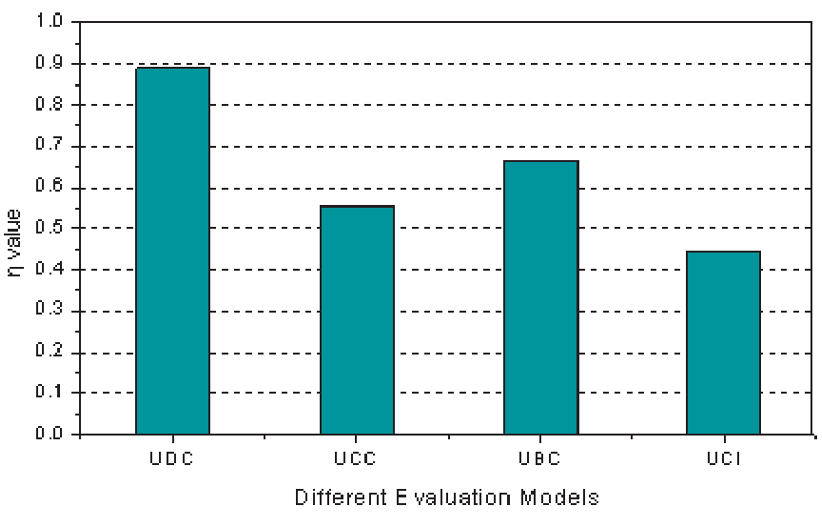
1. Efficiency: Breaking the Ties
A major issue with metrics like Degree Centrality is that many users end up with the same score. The UCI model significantly reduces this "Percentage of Duplication," providing a much finer-grained ranking of influential users.
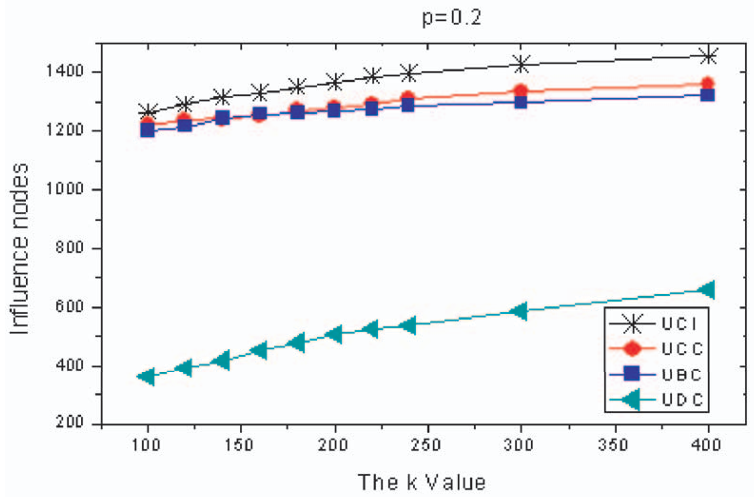
2. Rationality: Maximum Spread
Using the Independent Cascade (IC) Model, they simulated how information spreads if you start with the Top-K users identified by each method. The results (shown below) verify that UCI-selected seeds consistently reach a larger portion of the network.
Critical Analysis & Future Outlook
The UCI model represents a shift from topology-only analysis to topology + identity analysis. By proving that "Attribute Similarity" and "Community Matching" are better predictors of influence than raw connection counts, the authors provide a powerful tool for targeted marketing.
Limitations: Currently, the model treats all attributes with equal weight. In reality, a "shared interest in Physics" might be more influential than a "shared interest in Coffee" within a scientific community. Future iterations should incorporate weighted attributes to further refine the Influence Ability calculation.
Conclusion
This paper effectively demonstrates that influence is not just about where you are in a network, but who you are in relation to your peers. The UCI model's success on the arXiv dataset suggests it is a robust candidate for modern social media algorithms and viral strategy planning.