
ISO 31,000 and System Dynamics: Securing the Future of Remote Education Under Crisis
Evaluation, Analysis, and Treatment of Educational Risks in Migration of Presential Teaching for Remote
This study applies the ISO 31,000 risk management framework to assist a private Higher Education Institution (HEI) in Brazil during its emergency transition from presential to remote teaching due to COVID-19. By integrating System Dynamics and the Mosler Method, the researchers identified, quantified, and mitigated critical operational and financial risks to ensure institutional continuity.
TL;DR
When COVID-19 forced universities to go remote overnight, the risk wasn't just technical—it was existential. This paper details how a Brazilian Higher Education Institution (HEI) used ISO 31,000, System Dynamics, and the Mosler Method to transform a potential mass student exodus into a successful digital migration, maintaining high student satisfaction and low dropout rates (<10%).
Background & Positioning
Unlike purely theoretical risk papers, this work serves as an operational blueprint. It positions risk management not as a bureaucratic hurdle, but as a strategic tool for "Business Continuity." By applying industrial-grade standards to the academic world, the authors bridge the gap between abstract crisis management and measurable institutional success.
The Core Challenge: The "Revenue at Risk" Loop
The authors identify a critical pain point for private HEIs: Revenue Volatility. In a presential model, revenue is tied to physical presence. The transition to remote learning introduced three specific "High" risks:
- Student Rejection: Fear that students would not accept the remote format.
- Infrastructure Failure: Virtual Learning Environments (VLE) crashing under the load of thousands of simultaneous users.
- Pricing Pressure: Students demanding "Distance Learning" (DL) prices for what was intended to be "Remote Presential" teaching.
Methodology: Systems Thinking Meets Quantitative Scoring
The research moves beyond simple lists by using two sophisticated tools:
1. System Dynamics Modeling
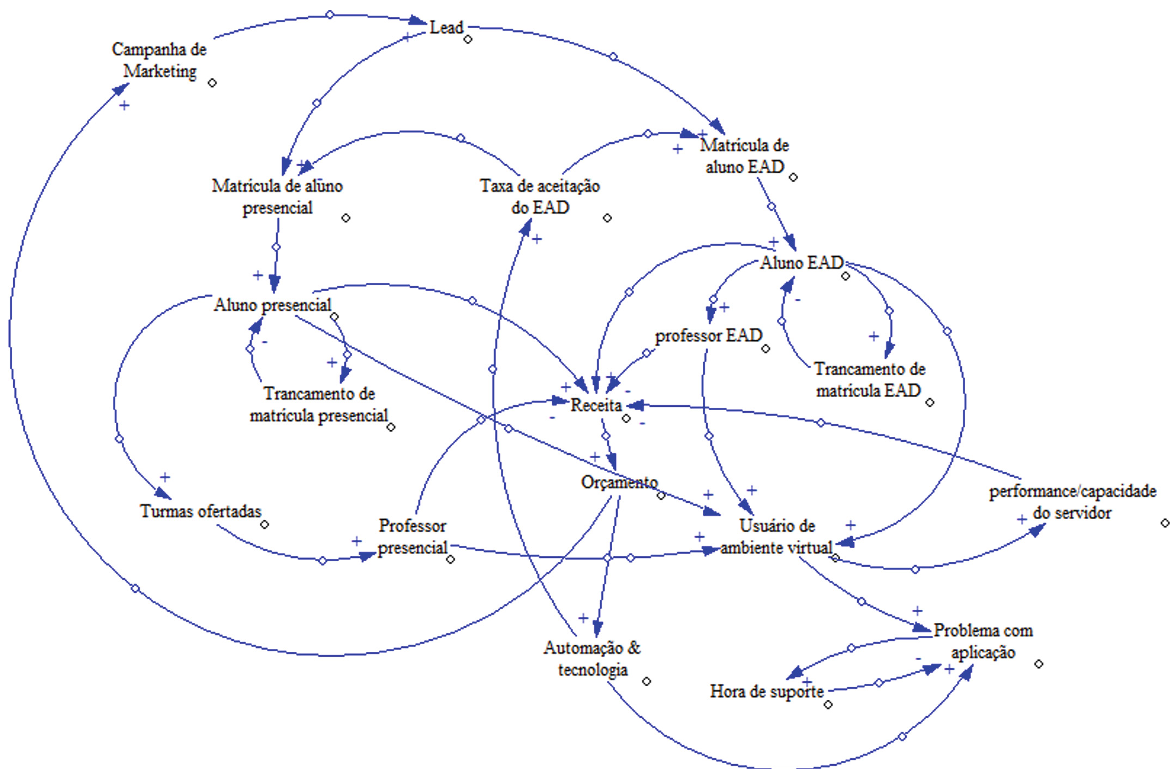
Using Vensim, the authors mapped the HEI as a complex system. They visualized how "Revenue" (Receita) acts as a convergence point for variables like student acceptance, infrastructure investment, and marketing communication. This helped them see that technical failure (IT) would directly trigger financial failure.
2. The Mosler Method
To move from "intuition" to "action," they used the Mosler Method. This quantitative approach scores risks based on:
- Function (F) and Substitution (S): The impact on the core business.
- Vulnerability (V) and Aggression (A): The likelihood and severity of the threat.
This allowed the contingency group to prioritize "Student Rejection" as a High-priority risk, leading to targeted "Social Contract" communications.
Experiments & Real-World Results
The implementation wasn't just about software; it was about people and perception.
SOTA Comparison: Retention Success
While many institutions struggled with massive dropouts, this HEI's structured approach resulted in:
- Dropout Rate: Kept below 10%.
- Student Adaptation: 80% of students reported successful transition.
- System Performance: Migration to the Canvas Student VLE resulted in 82% satisfaction.
Critical Findings: The "Productivity Indifference"
Interestingly, while satisfaction was high (65%), students remained "indifferent" regarding their own motivation and productivity. This reveals a key insight for future research: digital platforms solve the access problem, but the psychological engagement of remote learners remains an unsolved frontier.
Critical Insight & Conclusion
This paper proves that the "Inductive Bias" of a structured framework like ISO 31,000 is superior to ad-hoc crisis response. By treating the university as a dynamic system rather than a static building, the institution was able to pivot its value proposition.
Takeaway: The success of digital transformation relies less on the choice of software (Zoom vs. Canvas) and more on the Risk Treatment—addressing the student's psychological "social contract" and ensuring the administrative support doesn't feel "paralyzed" during the move.
Future Work: The authors suggest that for 2026 and beyond, risk management should be "permanently disseminated" across all departments to prepare for the next unexpected disruption, whether technological or environmental.