
More Than a Smile: Why Your Social Robot Needs a Dynamic Mouth
9978_Evaluation of Artificial Mouths in Social Robots.
This paper investigates the impact of LED-based artificial mouths on human perception of social robots. Through a controlled study with 79 participants, it evaluates four conditions—no mouth, static smile, wave-like mouth, and human-like mouth—to determine how mouth design influences anthropomorphism, animacy, and likeability.
TL;DR
Is a mouth necessary for a robot that doesn't "eat"? According to new research on the MBot social robot, the answer is a resounding yes. This study demonstrates that the presence and design of an LED-based mouth significantly alter how humans perceive a robot's emotions, safety, and "liveliness." A human-like moving mouth isn't just aesthetic; it’s a functional requirement for social acceptance.
Background: The Forgotten Facial Feature
In the world of Social Human-Robot Interaction (sHRI), we often obsess over big expressive eyes or fluid arm movements. However, the mouth is a powerhouse of social signaling. In humans, the McGurk Effect proves that our brains blend what we hear with what we see the mouth doing. When robots like Pepper or Keepon minimize or static-ize the mouth, they might be missing out on a vital channel for building trust.
The Experiment: Four Ways to Speak
Researchers at the Carlos III University of Madrid tested four specific "mouth conditions" using a matrix of 283 red LEDs on the MBot's face:
- No Mouth: The "functional" look.
- Static Smile: A fixed U-shape.
- Wave-like Mouth: A dynamic sinusoidal wave that changes with speech.
- Human-like Mouth: Two dynamic lips that open and close in sync with audio.
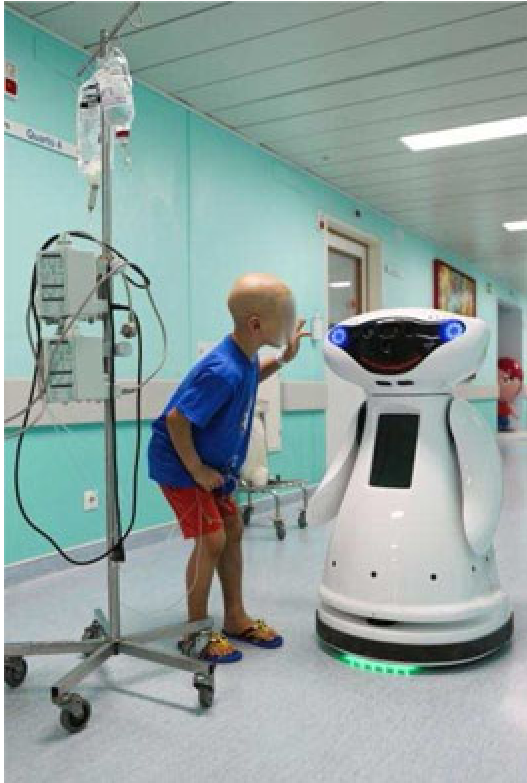 The hardware setup: 283 LEDs arranged to simulate various facial expressions on-the-fly.
Why Design Matters: The "Inert" vs. "Lively" Divide
The study’s findings provide a roadmap for robot designers:
1. The Silence of the Mouthless
Participants rated the mouthless robot as the most "inert" and "sad." Interestingly, even though the robot's voice was neutral, the mere absence of a mouth led users to project negative emotions onto the machine. This confirms that humans have a strong inductive bias: if it speaks but has no mouth, it feels "dead" or "unhappy."
2. The Danger of the "Wave"
Unexpectedly, the wave-like mouth—despite being dynamic—was perceived as dangerous. This likely stems from associations with "anxiety" or "glitchiness" found in animation tropes. This teaches us that not all movement is good movement; if the dynamics don't map to biological expectations, they create unease.
3. The Human-Like Gold Standard
The human-like mouth was the champion of the study. It was voted the most lively, the most liked, and the one participants were most looking forward to meeting.
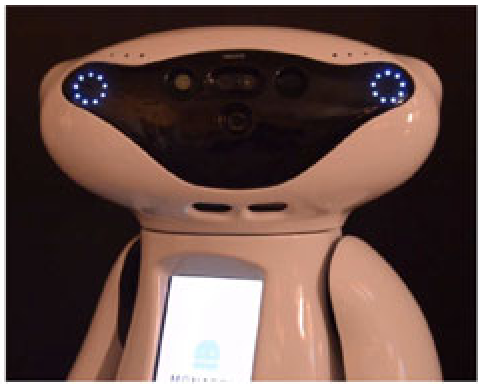 Clockwise from top-left: (a) No mouth, (b) Static smile, (c) Human-like, (d) Wave-like.
Focus and Attention
Beyond personality, does the mouth help us listen? The researchers measured how many details of the robot's story participants remembered. While not statistically definitive, the human-like mouth condition saw the highest baseline of correct answers. In educational or hospital settings—where MBot is destined to work—this slight edge in attention could be the difference between a child following medical advice or ignoring it.
Deep Insight: The First Impression Effect
A fascinating psychological nuance revealed in the data is the "First Impression" anchoring. Participants who first saw a "dangerous" (wave-like) mouth were more forgiving of it later, while those who started with a "friendly" mouth were much harsher when switched to the wave-like or mouthless versions. In sHRI, your robot’s "boot-up" facial configuration might define its entire relationship with the user.
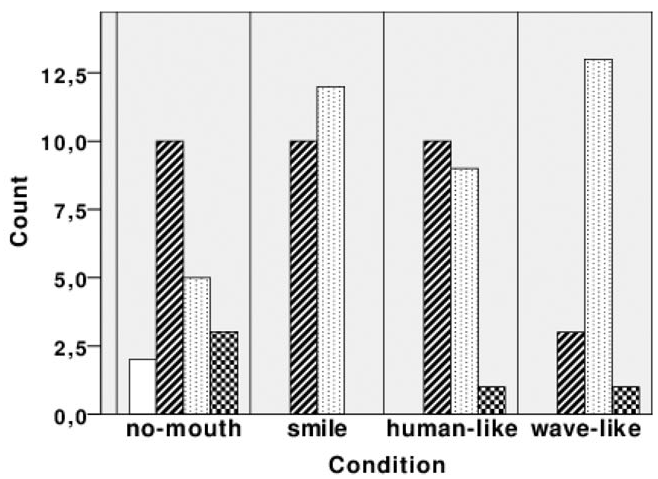 Comparative rankings for lifelikeness and preference across the four groups.
Conclusion: Designing for Trust
The takeaway for the robotics industry is clear: anthropomorphism in the mouth area is a "safe bet." If you want a robot to be perceived as a living, friendly entity:
- Don't skip the mouth.
- Sync it to the audio.
- Keep it biological. Avoid abstract shapes like waves unless you specifically want to signal "danger" or "error."
As we move robots into pediatric wards and public squares, these small LED patterns are what bridge the gap between a cold machine and a social companion.