
Evaluating Learning Websites: Why Social Connectivity is the New Gold Standard
Evaluation of Learning Website: A Social Network Perspective
This paper proposes a social network perspective for evaluating learning websites, moving beyond traditional content-centric metrics. It introduces five social network elements—Click Rate, Network Centrality, Network Density, Network Intensity, and Subgroups—as objective evaluation indexes, validated through a case study of the "China English Learning Forum."
TL;DR
Evaluating a learning website by its loading speed or content accuracy is no longer enough. This paper argues that the true measure of an educational platform is the interactivity of its social network. By shifting from a "carrier-centric" to a "learner-centric" perspective using Social Network Analysis (SNA), the authors demonstrate that objective metrics like Degree Centrality can accurately predict subjective outcomes like learner loyalty and motivation.
The Problem: The "Empty Shell" Evaluation
For years, educators have evaluated websites based on technology (navigation, search functions) and development (click rates, update cycles). However, these metrics miss the "pulse" of the learning process. Learning doesn't happen in a vacuum; it occurs through interaction. If a website has perfect technical performance but zero community engagement, is it truly a "learning" website?
The authors argue that current methods ignore user behavior, failing to capture the dynamic relationship between learners that drives educational success.
Methodology: Mapping the Social Pulse
The researchers proposed a model based on five key social network pillars:
- Click Rate: The baseline for network formation.
- Network Centrality: Identifying "leaders" whose posts spark interaction.
- Network Density: Measuring the closeness of the community.
- Network Intensity: The frequency of interactions between specific individuals.
- Subgroups (Cliques): Small, high-affinity teams that drive deep learning.
Architecture of Interactivity
The study utilized Ucinet 6.0 to visualize these connections. Instead of just looking at raw traffic, they looked at who was talking to whom.
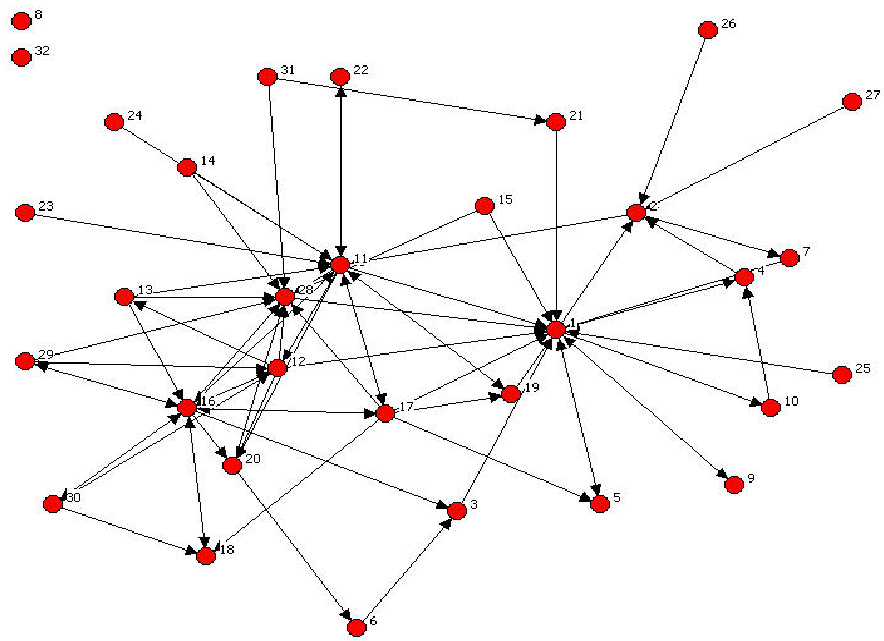 Fig 1. Community diagram illustrating the knit structure and central gathering points of an active forum.
By using social relation matrices, the researchers could mathematically define the "Out-degree" (sending help/knowledge) and "In-degree" (receiving attention) of each learner.
Key Results: Data Doesn't Lie
Through a study of the "China English Learning Forum," the authors compared SNA metrics with results from a Likert-scale questionnaire. The findings were striking:
- The Power of Centrality: Learners with high Degree Centrality reported significantly higher satisfaction and loyalty.
- Motivation Predictor: There is a high correlation (0.776) between a learner's position in the network and their motivation to participate.
- Stability: Highly centralized networks (where leaders are clearly visible) tend to have more stable and organized information management.
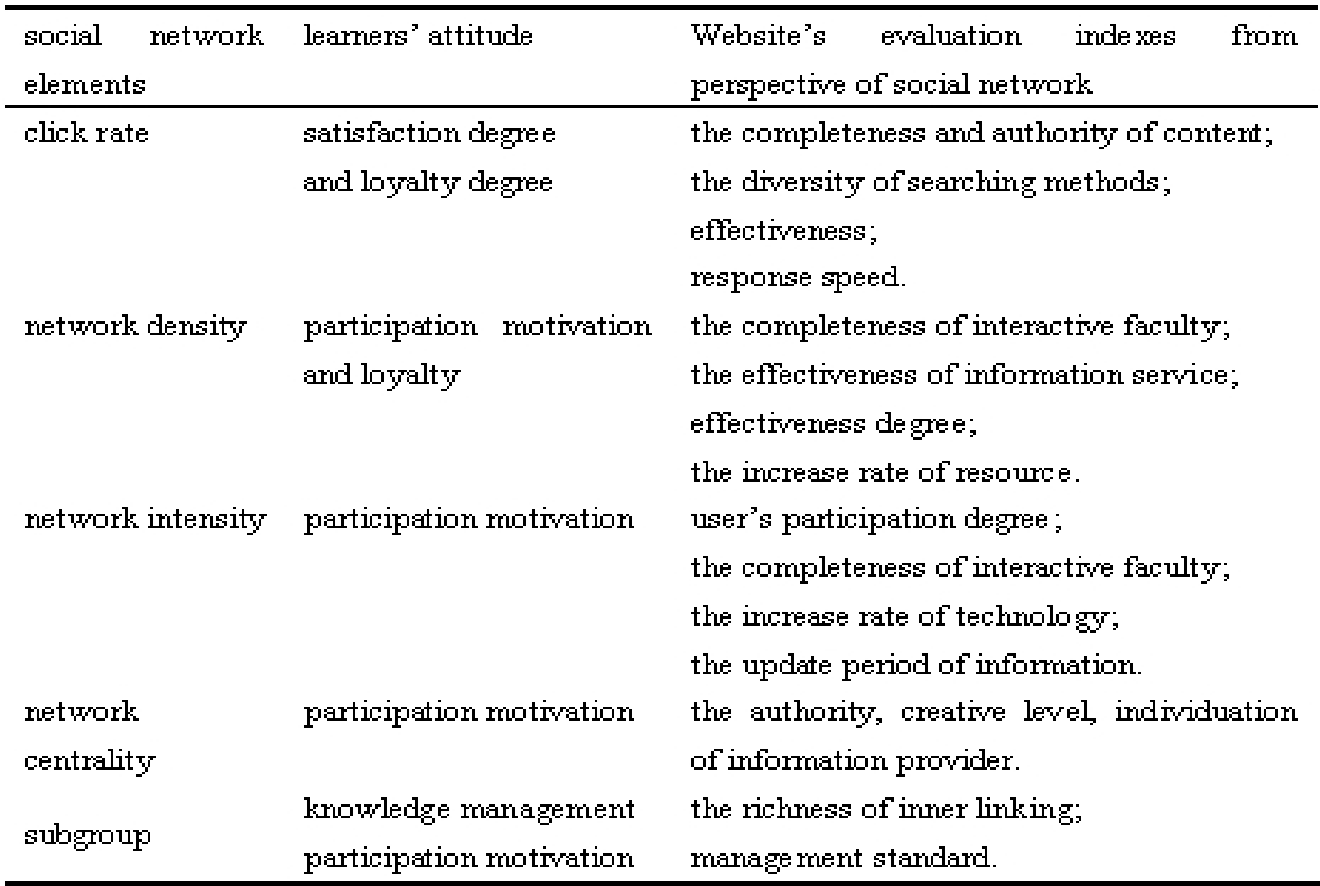 Table 1. Mapping objective social network elements to traditional subjective evaluation indexes.
Critical Analysis & Takeaways
The most profound insight from this work is the substitution of objective variables for subjective ones. Instead of asking users if they are satisfied (which is biased and slow to collect), we can analyze the forum's network density and centrality in real-time to gauge the "health" of the learning environment.
Limitations
- Sample Size: The specific analysis focused on a small subset of learners (41 participants over 3 days), which may not capture long-term community evolution.
- Context Dependency: The metrics might vary significantly between a language learning forum and a more solitary STEM-based problem-solving site.
Future Outlook
This research invites developers to build "socially-aware" dashboards for educators. Imagine an AI that alerts a teacher when "Network Density" is dropping or when a "Subgroup" is becoming too isolated. By focusing on the social graph rather than just the content graph, we can build learning platforms that truly foster human connection and academic growth.
Conclusion: A high-quality learning website is more than a digital textbook; it is a thriving ecosystem. If you want to measure success, stop looking at the page views and start looking at the connections.