
LOBO: Why Your "99% Accurate" Bot Classifier Probably Fails in the Wild
LOBO -Evaluation of Generalization Deficiencies in Twier Bot Classifiers
The paper introduces LOBO (Leave-One-Botnet-Out), a novel evaluation framework designed to measure the generalization capabilities of Twitter bot classifiers. By testing on 20 diverse bot classes and over 1.5 million accounts, the authors demonstrate that standard classifiers achieving over 97% accuracy on seen data often fail catastrophically (dropping to near 0% detection) when encountering previously unseen bot families.
TL;DR
Researchers from UCL and Boston University have exposed a fundamental flaw in how we evaluate Twitter bot classifiers. While most models claim nearly perfect accuracy, they suffer from a "generalization deficiency." Using a new evaluation framework called LOBO (Leave-One-Botnet-Out), the authors show that a classifier trained on millions of data points can still miss 99% of a new botnet's accounts. The silver lining? It only takes a handful of new samples to "fix" the model for a specific threat.
Context: The Academic Performance Paradox
In the world of online social networks (OSNs), bot detection is an arms race. Academics frequently publish papers claiming 95%+ accuracy in identifying malicious accounts. However, Twitter remains "infested" with bots. Why the disconnect?
The answer lies in Dataset Bias. If you train a model to recognize bots that tweet Star Wars quotes, it becomes a world-class "Star Wars Bot Expert," but it remains completely blind to a botnet designed to spam Amazon product links.
The "Leave-One-Botnet-Out" (LOBO) Insight
To quantify this, the authors aggregated one of the largest bot libraries in research history—over 1.5 million bots across 20 distinct classes (Star Wars bots, Bursty bots, Fake Followers, Honeypot bots, etc.).
They proposed the LOBO Test:
- Select one bot class (e.g., "Bursty Bots") as the Target.
- Train a classifier on all other bot classes and a control group of real users.
- Test the classifier on the Target class it has never seen before.
This methodology provides a realistic proxy for how a security system performs when a new, novel bot attack is launched tomorrow.
Methodology: Feature Engineering without the Graph
The authors deliberately avoided using "Social Graph" features (who follows whom) because they are computationally expensive and heavily rate-limited by Twitter's API. Instead, they focused on 30 lightweight features:
- User Features: Account age, friend-to-follower ratio, and "seconds active" (detecting accounts that tweet immediately upon creation then go dark).
- Tweet Features: Unique hashtag ratios, URL frequency, and Edit Distance (measuring how repetitive an account's tweets are).
- Source Features: The number of unique APIs/Apps used to post.
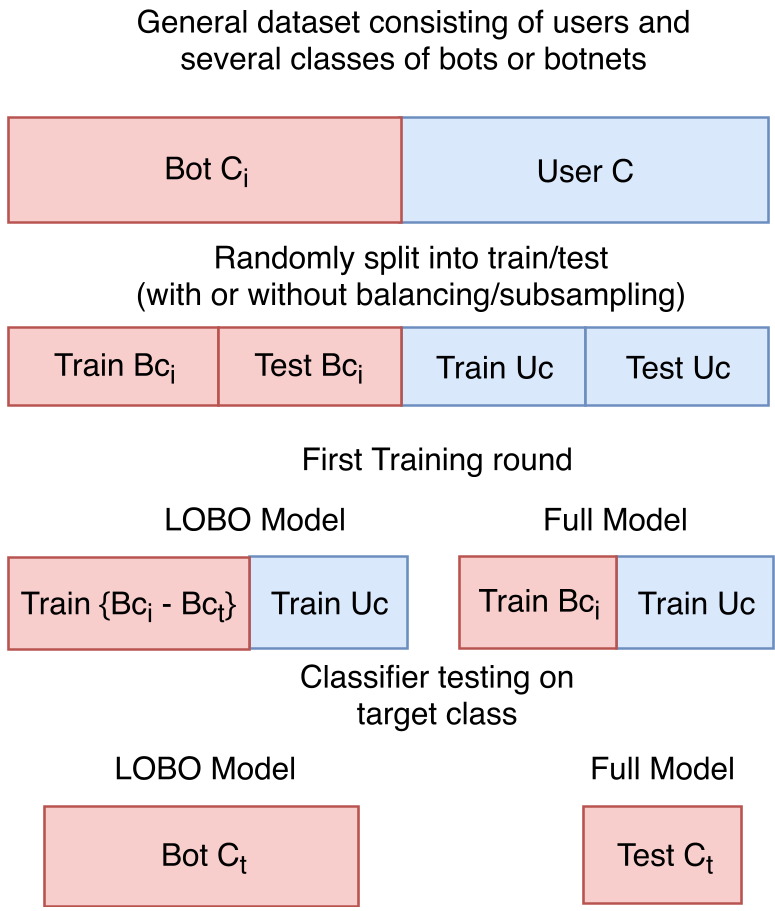 Figure 1: The LOBO test architecture — excluding a target class to evaluate generalization.
The Results: A Hard Reality Check
When evaluated using standard 70/30 splits (where the model "sees" a bit of everything), the LightGBM classifier achieved a stellar 97.8% accuracy.
However, the LOBO test painted a different picture:
- Average Unseen Accuracy: Dropped to 57.5%.
- Total Failures: Some classes, like "Social Spambots #2," had a detection rate of 0.71%. Essentially, the model classified them as human because it hadn't seen their specific "social-like" behavior before.
- The Problem with SOTA Tools: The authors tested Botometer, a popular industry tool. It failed significantly on several classes, labeling only 2.75% of Bursty Bots correctly.
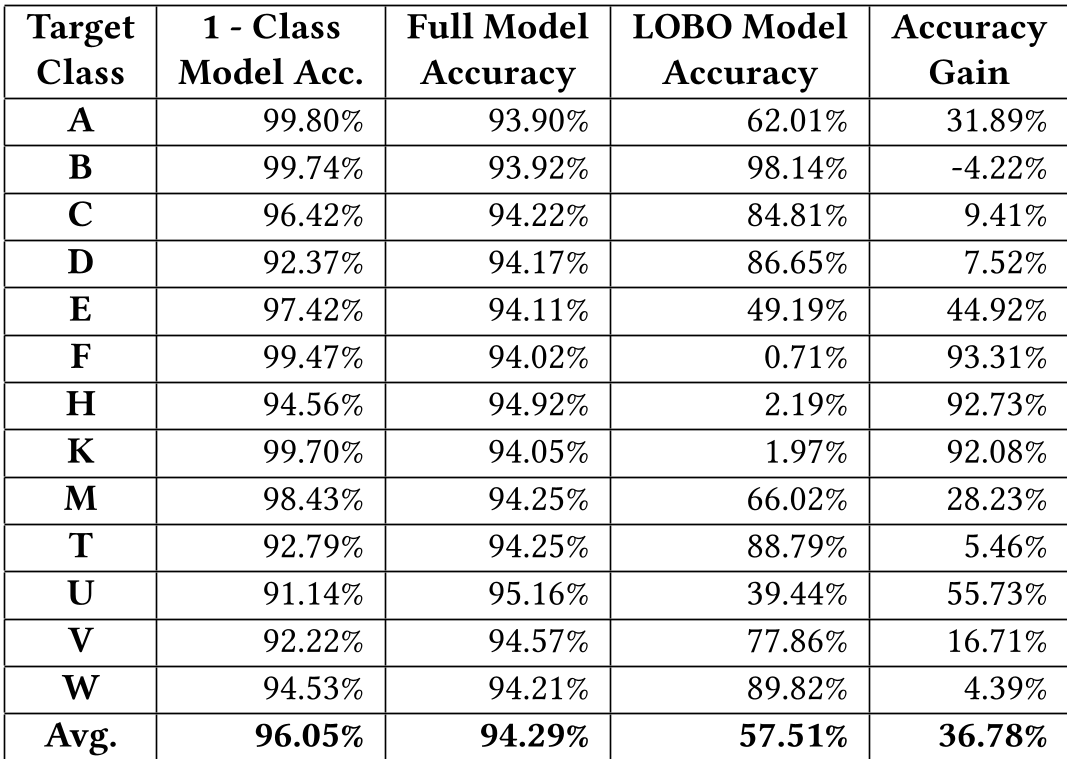 Table 1: Accuracy drop across various target classes when using LOBO.
The Silver Lining: Few-Shot Recovery
The study wasn't all bad news. The authors performed a "Learning Rate" experiment to see how much data is needed to "fix" a blind spot.
- For many botnets, adding just 2 to 16 samples to the training set caused accuracy to skyrocket from ~50% to over 90%.
- Visualizing the Gap: Using t-SNE plots, the authors showed that while some bots (Star Wars) cluster far from humans, others (Honeypot bots) overlap significantly, explaining why they are harder to detect without specific training examples.
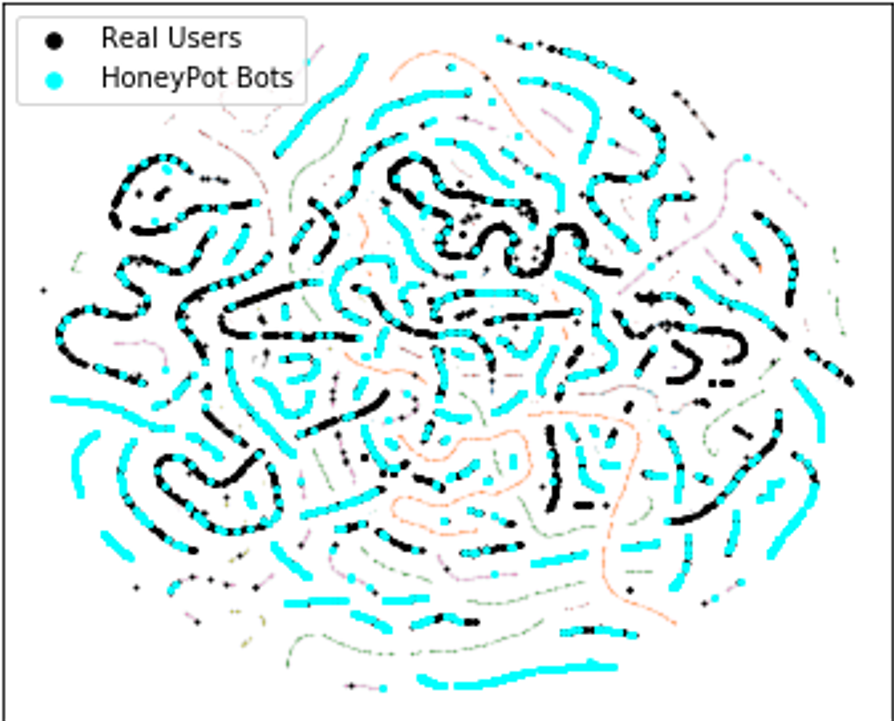 Figure 2: t-SNE visualization showing how "Honeypot Bots" (blue) blend in with real users (black).
Critical Insight & Conclusion
This paper serves as a critical warning: Accuracy is a vanity metric in adversarial machine learning.
The LOBO framework should become a standard for any security-focused classifier. The discovery that most botnets can be identified with extremely few samples (Few-shot learning) suggests that the future of bot detection lies in active learning systems—where human analysts identify a few "seeds" of a new botnet, and the machine immediately scales that knowledge to millions of accounts.
Limitations: The study relies on historical datasets which may not reflect the latest AI-generated (LLM) bots. Future work should investigate whether LOBO holds true when bots use generative models to vary their tweet content.