
Personalizing the Search: A Deep Dive into Social Ranking Functions
Evaluation of Personalized Social Ranking Functions of Information Retrieval
This paper provides a comprehensive evaluation of personalized social ranking functions in Information Retrieval (IR), focusing on how social annotations (folksonomies) can enhance search relevance. It identifies and compares various models including profile-based, topic-based, and affinity-based approaches, identifying SoPRa as the most balanced SOTA solution for social search.
TL;DR
The gap between "what we search" and "what we actually want" is narrowing through Social Information Retrieval. This paper evaluates the technical landscape of ranking functions that use social tags (folksonomies) to re-order search results. While SoPRa emerges as the most balanced algorithm, the study uncovers a fascinating phenomenon: the more active a user is, the harder it is for traditional profile-based models to satisfy them.
Problem & Motivation: The Personalization Gap
Standard search engines are often "blind" to the user. A query for "Python" might be for a programmer or a herpetologist. Existing IR systems attempt to fix this via query reformulation or post-filtering.
The authors argue that Social Bookmarking Systems (like the classic Delicious) provide a goldmine of user intent through tags. However, the research community lacked a unified comparison of how different mathematical formulations of these tags impact search precision and system latency.
Methodology: The Architecture of Social Ranking
The paper categorizes the "Social IR" arsenal into three primary methodologies:
1. Profile-Based Matching (Xu08 & SoPRa)
These methods use a linear combination of textual relevance and "interest matching."
- Xu08: Combines the cosine similarity of the user's tag vector () and document tags () with textual similarity.
- SoPRa: The "Social Personalized Ranking" function extends this by considering the entire social context surrounding both the user and the document.
 The SoPRa formula balances textual similarity, profile matching, and social context.
2. Topic-Based (LDA-P)
Instead of raw tags, this uses Latent Dirichlet Allocation to map users and documents into a "latent topic space." This aims to capture the meaning behind tags rather than just string matches.
3. Affinity-Based (Social Search)
Instead of looking at your tags, these models look at the tags of your friends or users with similar tastes.
Experiments & Results: The "Active User" Paradox
Using a massive Delicious dataset (9.6M bookmarks), the authors tested these functions across different user classes based on "profile length" (how many tags they have).
Key Findings:
- The Paradox: Counter-intuitively, as a user's profile length increases (from 5 to 30+ tags), the performance of Profile-Based methods actually decreases.
- The Interpretation: High-activity users have diverse, multi-faceted interests. A single profile vector becomes "noisy," leading to poor precision.
- Affinity Wins for Experts: For these "power users," Affinity-based/Social Search methods performed better because they leverage the collective intelligence of a social circle rather than a noisy personal history.
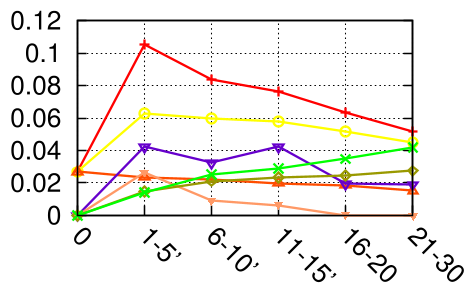 Performance Comparison: Note the downward trend for profile-based methods as profiles grow.
Final Insights & Comparative Analysis
The paper concludes with a critical trade-off matrix. While SoPRa is the versatile champion—boasting good complexity and the ability to handle the "Cold Start" problem (new users)—it is not perfect.
| Method | Performance | Complexity | Cold Start | Effectiveness for Power Users |
|---|---|---|---|---|
| SoPRa | High | $O( | p | + 2 |
| Social Search | Mid | $O( | q | \cdot |
Conclusion
The future of IR isn't just about indexing documents; it’s about indexing social relationships. The paper suggests that to fix the "Power User Paradox," we must blend SoPRa’s efficiency with Affinity-based social relative modeling. For developers and researchers, the takeaway is clear: Context is king, but social context is the crown.