
Decoding Social Echoes: Extracting Information Relationships via Propagation Forms
16724_Evaluation of Similarities of Propagation Forms on Social Network for Extracting Relationships of Information.
This paper proposes a novel method for identifying information relationships on social networks by analyzing the similarities in "propagation forms" (information flow patterns). Utilizing an Information Propagation Model, it identifies "similar" and "complementary" content based on overlapping transmission paths rather than traditional text-based NLP or user-access patterns.
TL;DR
How do you know if two social media posts are related if they don't share the same keywords? This paper shifts the focus from what is being said to how it travels through a network. By analyzing the "Propagation Form"—the specific paths a message takes across a social graph—the authors can identify similar and complementary content with high precision, overcoming the limitations of traditional text-based NLP and data-hungry Collaborative Filtering.
Background: Beyond the Keyword Trap
In the era of hyper-ephemeral social content, traditional search and recommendation engines are hitting a wall:
- NLP Limitations: Slang, emojis, and shifting vocabularies mean that two posts about the same event might not share a single common word.
- The Popularity Bias: Collaborative Filtering (CF) works great for viral videos but fails for "unpopular" but high-value content that hasn't been seen by enough people yet.
- The "Why" Gap: Just because two users clicked on the same link doesn't explain the semantic relationship between those links.
The authors propose that the social network acts as a filter. The way a message spreads (the "propagation form") reflects its inherent nature and its relationship to other information in the ecosystem.
Methodology: The Propagation Fingerprint
The core insight is simple yet profound: If two messages are related, they will likely be shared by the same people in similar patterns.
1. Defining Similarity
The authors define similarity based on "Duplicate Links." If Message A and Message B travel through the same nodes (users) and edges (sharing actions), they have a high similarity rate.
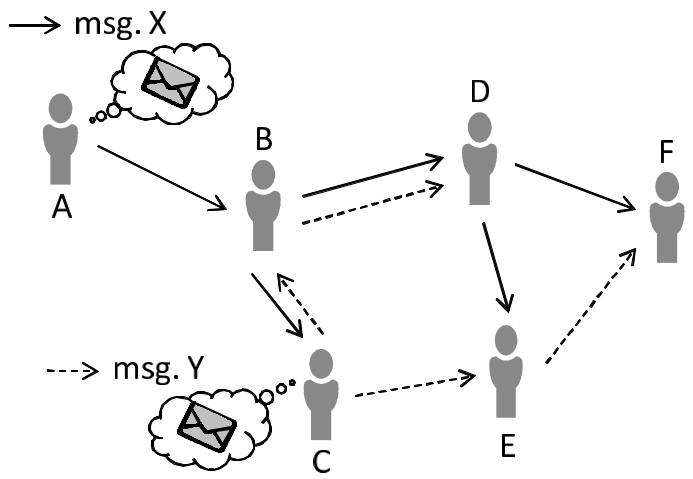 In the figure above, the overlaps between nodes (U) and directed edges (arrows) determine the similarity between message propagation paths.
2. Identifying Complementarity
Complementary relationships go a step further. It's not just about sharing the same users, but the direction of the flow.
- Similarity: High rate of shared links.
- Complementarity: High coincidence rate in propagation direction (e.g., User A always sends to User B for both messages).
Experimental Results: Proving the Intuition
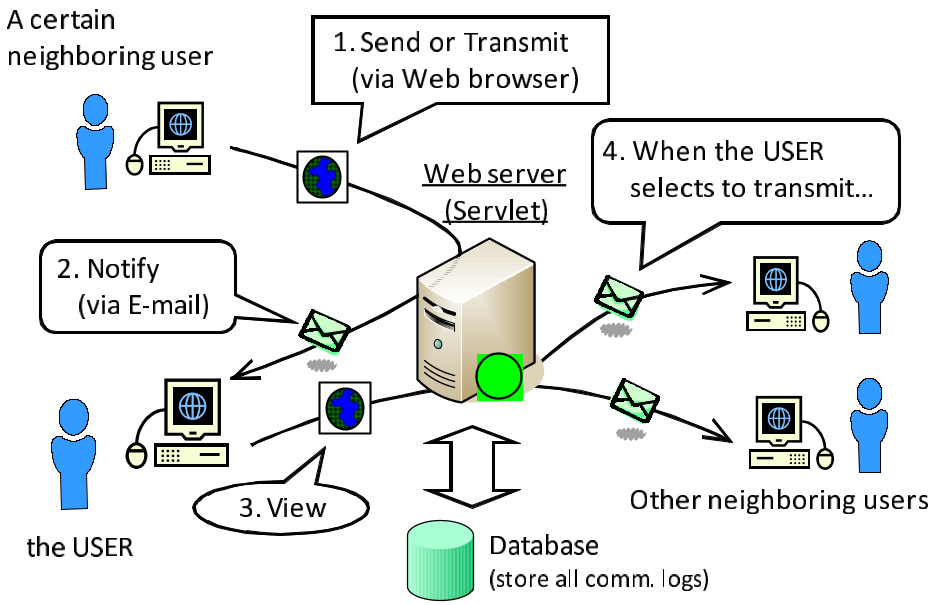
The researchers developed a custom communication support system using a Java Servlet/MySQL stack to track real-time message propagation among 32 students over 14 days.
Key Findings:
- Higher Accuracy than Random: Content pairs selected via propagation overlap were significantly more relevant than randomly selected pairs.
- Direction Matters: As shown in the data, pairs with a high coincidence in propagation direction (Directional Rate = 1) had a 60.9% rate of being genuinely complementary, compared to only 14.3% for those with lower directional alignment.
 The chart illustrates that higher path overlap leads to a significantly higher likelihood of topical similarity.
Critical Analysis & Future Outlook
Why this matters
This approach is media-agnostic. It doesn't care if the message is a text post, an image, or a video. By treating the social graph as the primary data source, it bypasses the "black box" of multimodal content understanding.
Limitations
- Scale: The current study utilized a small group (32 users). In the wild (e.g., Twitter), signal-to-noise ratios are much lower.
- Latency: You have to wait for a message to start propagating before you can identify its relationship to others, making it less effective for instantaneous "breaking news" ranking.
Conclusion
This work signals a shift toward "Structural Semantics"—understanding the meaning of information through its behavior in human networks. As we move away from keyword-heavy search toward intent-based discovery, propagation analysis will likely become a cornerstone of next-generation social algorithms.