
CLW: Deciphering the Trio of Social, Geography, and Location Attraction in POI Recommendation
Evaluation of Social, Geography, Location Effects for Point-of-Interest Recommendation
This paper introduces a unified Point-of-Interest (POI) recommendation framework that integrates user preferences, social influence, and location attraction. The core method, Customized Linear Weighting (CLW), dynamically adjusts feature weights for individual users while utilizing geographic influence for candidate filtering, achieving superior Precision and Recall compared to standard CF and classification models.
TL;DR
The paper introduces a unified framework for Point-of-Interest (POI) recommendation that moves beyond static models. By introducing Customized Linear Weighting (CLW), the system adapts to individual user behaviors—whether they are "social butterflies" influenced by friends or "explorers" seeking popular landmarks. Through personalized geographic filtering and multi-factor fusion, it achieves SOTA performance in accuracy and computational efficiency on the Gowalla dataset.
Problem & Motivation
Recommender systems in Location-Based Social Networks (LBSNs) are notoriously difficult due to the "curse of sparsity." In cities like New York, there are often twice as many locations as there are active users, making the user-item matrix incredibly thin.
The authors observed three critical insights that prior works often oversimplified:
- Social Variance: 65% of NYC users are never influenced by friends' check-ins, while 5% are highly dependent on them.
- Popularity Bias: Users fluctuate between seeking "hidden gems" and "tourist hot-spots."
- Mobility Constraints: A user’s "movement ability" (how far they are willing to travel) is highly individual.
Traditional models fail because they treat an antisocial explorer the same as a social homebody. This paper seeks to fix that by personalizing the weight of these influences.
Methodology: The CLW Framework
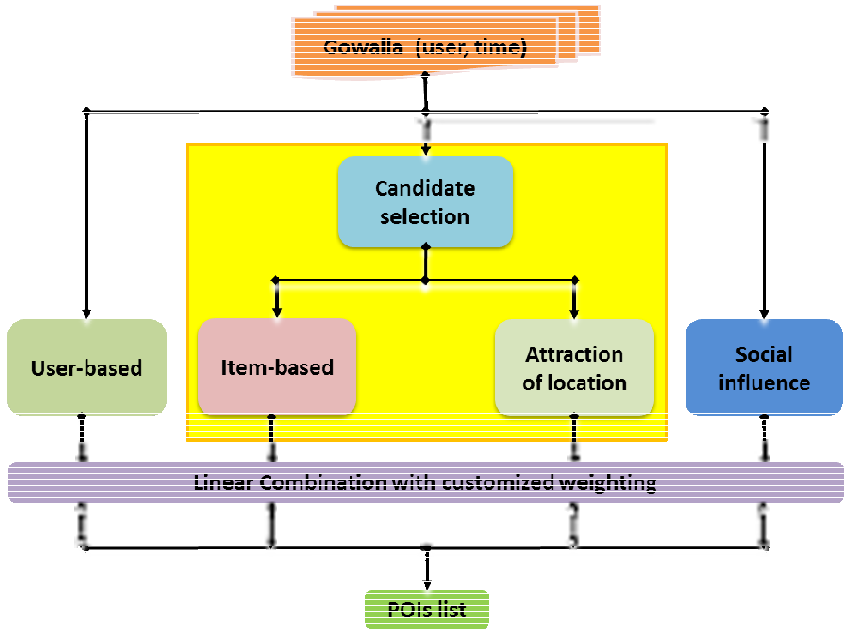
The proposed system architecture is a pipeline that moves from broad filtering to nuanced ranking.
1. Personalized Candidate Selection
Instead of calculating scores for every location in a city, the model uses a user's historical Average Movement Distance to create a geographic bounding box. This drastically reduces the search space without sacrificing relevant targets.
2. Multi-Factor Scoring (CLW)
The heart of the paper is the scoring function, which fuses four distinct signals:
- User-based CF: Opinions of similar users.
- Item-based CF: Similarity between POI characteristics.
- Social Influence: Weighted by
SocialDegree(u), ensuring friends' opinions only count for users who actually follow friends. - Location Attraction: A combination of global popularity and time-specific check-in probability , weighted by the user's specific preference for "busy" places.
Experiments & Results
The authors compared CLW against standard Collaborative Filtering and machine learning classifiers (Logistic Regression and libFM).
SOTA Performance
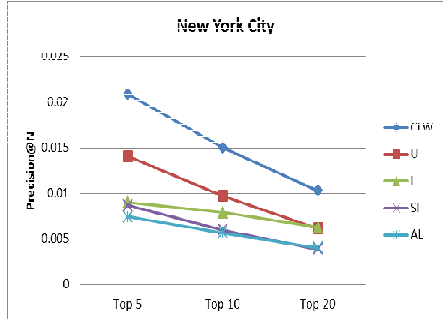
CLW consistently achieved the highest Precision@N and Recall@N. Interestingly, User-based CF performed better than Item-based CF, likely because the dataset provided more dense information on user behavior than on individual location metadata.
The Cold Start Resilience
For "Cold Start" users (those with fewer than 5 check-ins), the model pivots. While social and item-based methods fail due to lack of data, the Location Attraction (AL) factor proves highly effective. Cold start users are often visitors who naturally gravitate towards high-popularity landmarks, a nuance the CLW weights capture effectively.
Classification vs. Ranking
A key finding is that while models like libFM represent high classification accuracy (predicting if a user will visit), they often fail at the ranking task (predicting which user will like best). CLW sacrifices binary classification accuracy for superior top-N ranking relevance.
Critical Analysis & Conclusion
Takeaway
The primary contribution is the demonstration that weight personalization is as important as feature engineering. By quantifying a user's "Social Degree" and "Movement Ability," the model creates a bespoke recommendation logic for every individual.
Limitations
- Temporal Dynamics: While check-in hours are considered, the model doesn't fully account for sequential movement (e.g., the likelihood of visiting a bar after a restaurant).
- Linearity: The fusion is linear. Future iterations could benefit from non-linear deep learning architectures to capture more complex feature interactions.
Conclusion
This work provides a robust roadmap for practical POI systems, proving that geographical filtering combined with customized social/popularity weighting is the most efficient path to handling LBSN sparsity.