
Beyond the Winner's Score: A Holistic Framework for Crowdsourced Software Quality
Evaluation of software quality in the TopCoder crowdsourcing environment
The paper proposes a novel evaluation framework to assess software quality within the TopCoder crowdsourcing environment. It introduces a Gaussian Mixture Model (GMM) to quantify contest "Effort Level" and aggregates individual contest results into phase-level and project-level quality metrics.
TL;DR
While crowdsourcing platforms like TopCoder are famous for high-stakes coding competitions, the quality of the resulting full-scale software projects remains a black box. This paper introduces a comprehensive framework that moves beyond looking at individual scores by factoring in Effort Level (task difficulty) and Phase Consistency to evaluate the overall health of a crowdsourced project.
Executive Summary
The research addresses the gap between individual contest success and long-term project viability. By analyzing 1,688 contests across 62 projects, the authors demonstrate that project quality is a function of both raw performance (scores) and the inherent complexity of the tasks. Notably, they find that stability is key: projects with high variance in quality between phases (e.g., great design but poor coding) are prone to failure.
The Problem: The "Quality" Illusion in Crowdsourcing
In traditional software engineering, quality is measured by bug density and adherence to requirements. In crowdsourcing, practitioners often rely on "Rules of Thumb." Current research usually focuses on the What—who won and what was their score. However, a score of 95 on an easy task is not the same as a 95 on a complex architectural challenge.
The researchers identified two major hurdles:
- Lack of Difficulty Metrics: There was no standard way to quantify the effort required for a contest.
- Fragmented Perspective: Projects are split into phases (Conceptualization, Design, Development), but quality was rarely tracked across this entire lineage.
Methodology: Modeling Effort and Quality
The authors' approach is structured in three hierarchical layers:
1. Modeling Effort Level with GMM
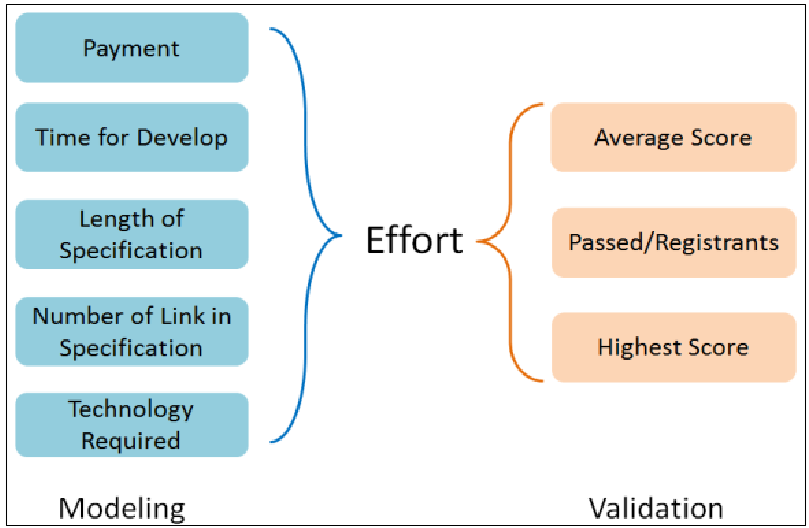
The authors argue that "Effort Level" can be predicted by intrinsic properties known before a contest starts: payment, development time, specification length, and the number of technologies used. Using a Gaussian Mixture Model (GMM), they clustered contests to calculate an effort value (), effectively normalizing the difficulty of different tasks.
2. Defining Phase and Project Quality
Quality isn't just the score (); it's a balance. The proposed metric for a contest () is: This ensures that high-effort tasks successfully completed are rewarded more than simple ones. These are then aggregated into Phase Quality and finally Project Quality, where weights are determined by the financial investment (payment) of each phase.
Experiments & Key Insights
The framework was validated using Bug Hunt data. Intuitively, a higher-quality project should require less "bug hunting" effort.
Performance Comparison
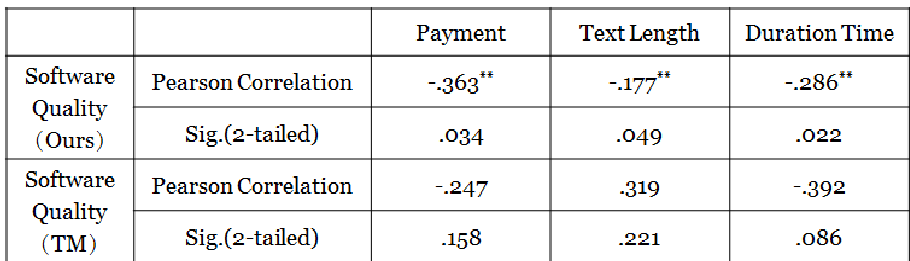
The authors compared their model against the "Traditional Method" (TM), which only considers the highest score. Their findings (Table III) show that their metric has a much stronger correlation with reduced bug-fixing costs and duration than the traditional approach.
The Stability Discovery
By plotting the quality of various projects (like Omicron-breeding vs. EPA Android App), the researchers discovered a critical trend: High-quality projects exhibit lower variance across phases.
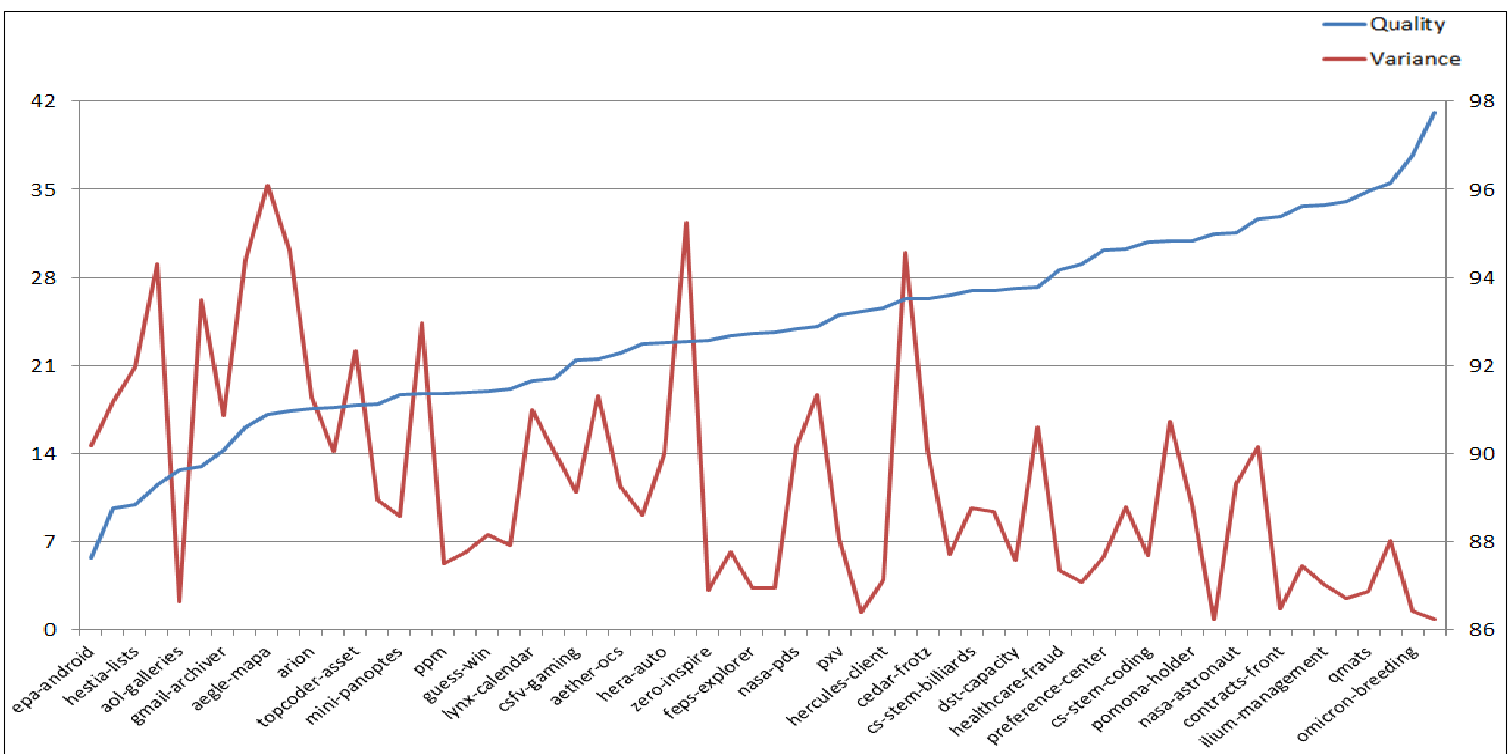
This implies that a "weak link" in any phase—be it a poorly defined specification or an unstable assembly—drags down the entire project's success.
Critical Analysis & Future Outlook
Takeaway: This work shifts the focus from "finding the best coder" to "managing the best process." For project managers, the message is clear: monitor the stability of deliverables across the lifecycle.
Limitations:
- The data is specific to TopCoder's competitive structure; applying this to collaborative platforms like GitHub might require different "effort" variables.
- The weighting based solely on payment assumes that price accurately reflects technical importance, which may not always be true in shifting markets.
Future Work: Integrating real-time quality monitoring into crowdsourcing platforms could allow managers to intervene mid-project when phase variance begins to spike, potentially saving failing projects before they reach the assembly stage.
Keywords: Software Quality, Crowdsourcing, Effort Level, TopCoder, Software Engineering.