
Event-Driven Data Mining: Bridging Financial News and Market Reality
Event-driven data mining methods for large-scale market prediction: a case study of an agricultural products company
The paper introduces an event-driven stock prediction framework that combines Latent Dirichlet Allocation (LDA) for news topic extraction with Support Vector Regression (SVR) for price forecasting. Implemented as a case study for a large Chinese agricultural firm (Mengniu), the model demonstrates that integrating daily financial news topics significantly outperforms benchmarks relying solely on historical price data.
TL;DR
Can we predict the stock market by "reading" the news? This paper argues yes, but with a twist: instead of just looking for keywords, we should look for Latent Topics. By combining LDA (Latent Dirichlet Allocation) with SVR (Support Vector Regression), the researchers built a system that analyzes news from portals like Sina Finance to forecast the stock prices of major agricultural players, achieving higher accuracy than models that only look at historical price trends.
Problem & Motivation: Beyond the Random Walk
The financial world is divided between two theories: the Efficient Market Hypothesis (EMH), which says prices reflect all available information, and the Random Walk Theory, which suggests price changes are essentially random.
The authors of this study lean towards EMH but identify a major gap: Information Overload. Traders have access to mountains of news, but not all news is equal. Previous methods often used "Bag of Words" approaches that missed the context. The motivation here was to create a "Decision Support System" that can digest complex news articles, extract the "essence" (topics), and use that to anticipate the next day's market move.
Methodology: The Logic of Topic Extraction
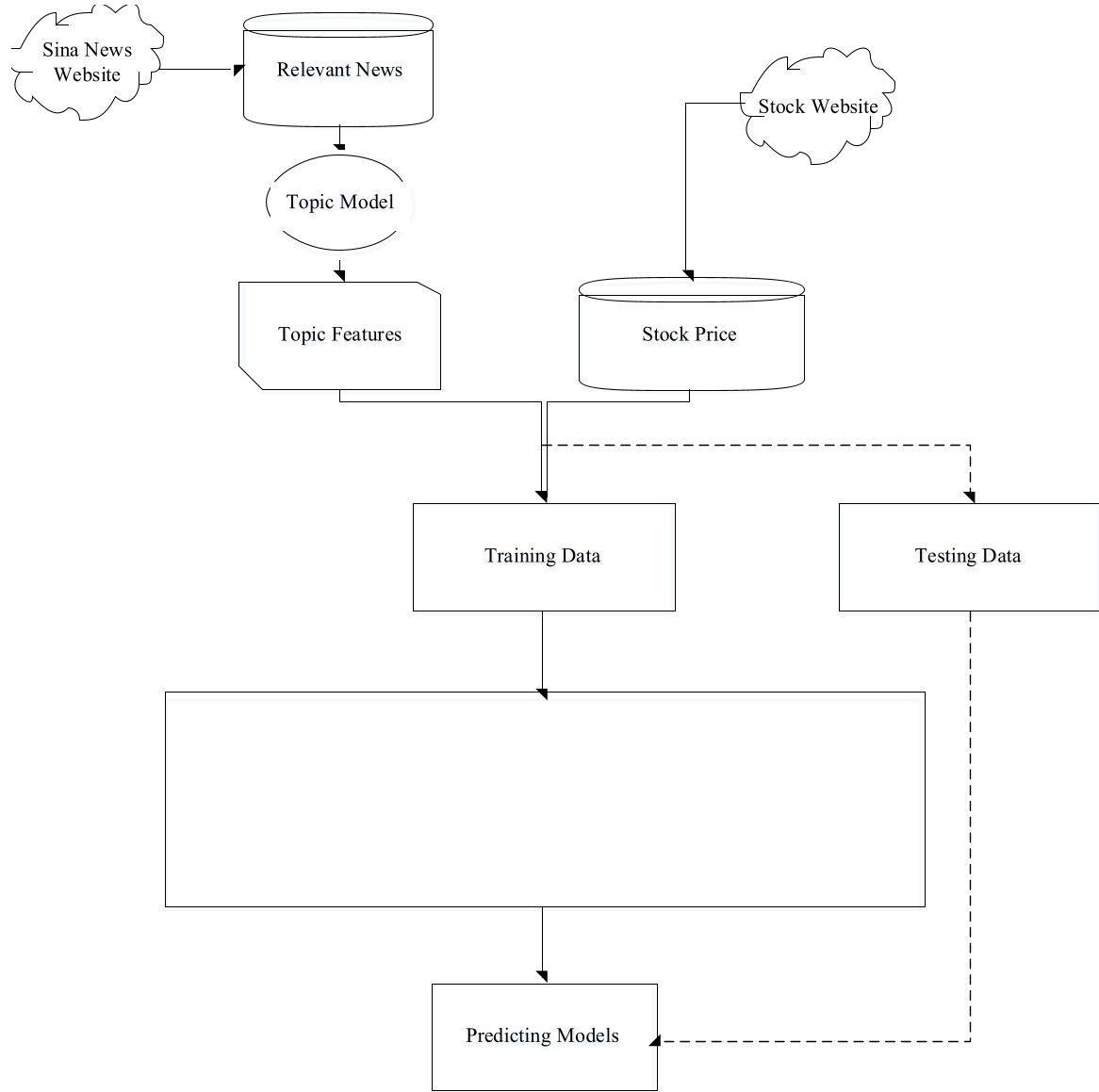
The proposed framework is a five-step pipeline designed to turn messy text into a predictive signal.
1. The Architecture
The core innovation lies in the feature engineering. Instead of using raw word counts, the authors use LDA to map documents into a "Topic Space." For example, a news article isn't just a list of words; it’s a distribution of topics like "Management," "Quality Control," or "Market Strategy."
2. SVR and Kernel Selection
Once the topics are extracted, they are joined with historical price data and fed into a Support Vector Regression (SVR) model. The authors experimented with four different mathematical "kernels" to find how to best map the relationship between news and price:
- Linear: Best performing in this study, suggesting a direct relationship.
- RBF/Polynomial/Sigmoid: Explored for non-linear complexities.

Experiments: Does News Actually Help?
The team conducted a case study on Mengniu, a giant in the Chinese dairy industry. They tracked news and stock prices through 2013 and 2014.
Key Findings:
- Topics Matter: Adding topic features (Experiment E2-E7) consistently lowered prediction errors (MAE, RMSE, MAPE) compared to the price-only baseline (E1).
- The "Sweet Spot" of Complexity: Interestingly, using 5 topics often performed better than using 30. This suggests that over-complicating the news analysis can introduce "noise" rather than "signal."
- Kernel Performance: The Linear Kernel was the SOTA for this dataset, providing the most stable predictions.
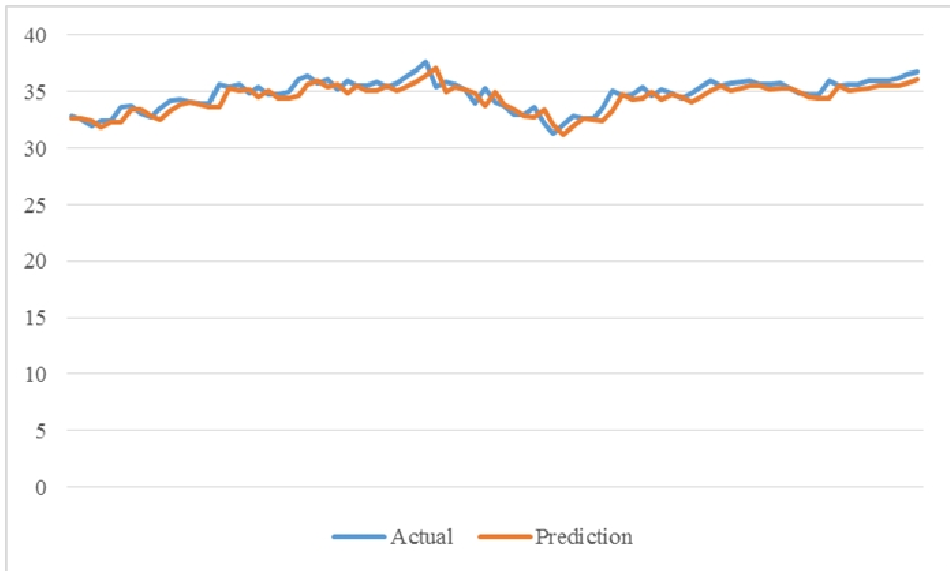 (Note: As shown in the figures, while the prediction follows the trend closely, there is a visible "delay" at major turning points).
Critical Analysis & Conclusion
The Takeaway
The paper proves that news is a significant "advanced signal." For companies in sensitive sectors like agriculture—where a single news report about food safety or a government subsidy can shift the market—topic modeling is a powerful tool for risk management and investment strategy.
Limitations & Future Work
Despite the success, the authors honestly note a persistent issue in financial AI: Lag. The model often reacts to a price shift slightly after the news breaks, rather than perfectly anticipating the peak of the inflexion.
For future research, the authors suggest:
- Sentiment Analysis: Not just what the topic is, but how people feel about it (Positive vs. Negative).
- High-Frequency Data: Reducing the time interval from "daily" to "intraday" or "hourly" to eliminate the delay and capture market reactions in real-time.
This work serves as a foundational bridge for academic topic modeling and practical financial decision-making, moving the industry closer to a truly "intelligent" market supervisor.