
Dynamic Preferences: Mastering User Recommendation for New Events in EBSNs
Event Participation Recommendation in Event-Based Social Networks
This paper introduces a sliding-window based machine learning model for event participation recommendation in Event-Based Social Networks (EBSN). By integrating multi-channel features—offline social ties, temporal preferences, spatial location, and activity levels—the model predicts which users are most likely to attend a new event, achieving a significant Recall@5 improvement of up to 51.43% over competitive baselines.
TL;DR
Recommending users for upcoming events in Event-Based Social Networks (EBSN) is notoriously difficult because every event is "cold-start" by definition. This paper presents a sliding-window machine learning approach that integrates social ties, activity levels, and spatial-temporal preferences to predict attendance. Tested on 12 years of Meetup data, it shatters traditional baseline performance, proving that short-term consistency is the secret sauce for real-time recommendations.
The "New Event" Dilemma
In platforms like Meetup, the recommendation task is inverted: instead of "which event should this user attend?", the host asks "which users should I invite to my new event?"
Standard Collaborative Filtering (CF) fails here for two reasons:
- Cold Start: Every target event is new with zero historical RSVPs.
- Sparse Commitment: Attending an offline event requires significantly more effort than "liking" a post, leading to extremely sparse interaction matrices.
The authors' insight was simple yet powerful: Human behavior is locally consistent. Your interest in "Tech Meetups" or "Sunday Yoga" fluctuates, but if you attended a session two weeks ago, your probability of attending the next one is exponentially higher than it was two years ago.
Methodology: Fusing Multi-Channel Signals
The researchers identified four critical "channels" that drive participation:
1. Offline Social Ties
Social links are defined by co-participation. Interestingly, the study found that links between Normal Members and Event Hosts are statistically stronger than peer-to-peer links. If you follow a specific host's events, you are far more likely to attend their next one.
2. Temporal & Spatial Preferences (via KDE)
Instead of simple histograms, the model uses Kernel Density Estimation (KDE) to create a continuous probability surface for each user.
- Time: Captures if a user is a "weekend warrior" or a "weekday lunchtime" attendee.
- Location: Reflects a user's geographical "comfort zone," often centered around home or favorite hubs (like Manhattan).
3. Activity Levels
A simple but effective predictor: a user's probability of attending a new event is almost directly proportional to their past participation ratio.
4. The Sliding Window Framework
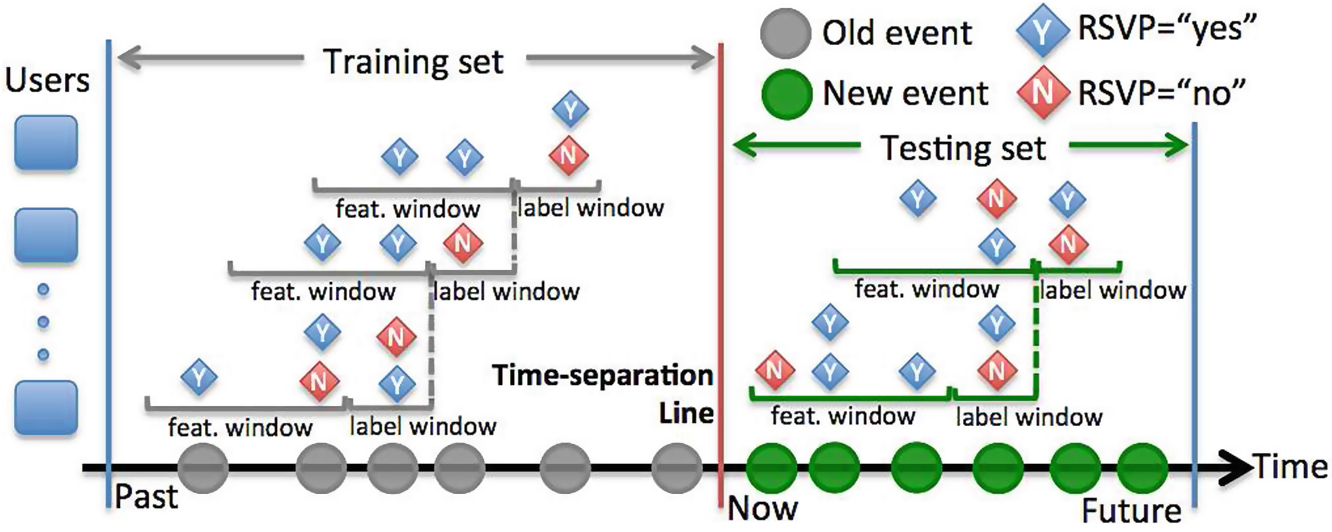
This is the model's engine. By using a "Feature Window" (historical look-back) and a "Label Window" (target prediction), the model treats the recommendation as a dynamic time-series problem rather than a static matrix factorization task.
Experimental Breakthroughs
The authors validated their approach using a massive dataset from New York City (17,234 groups, 1M+ users).
Key Findings:
- Window Size Matters: The best performance came from a feature window of 20 events. Looking further back actually added noise, as user interests had already shifted.
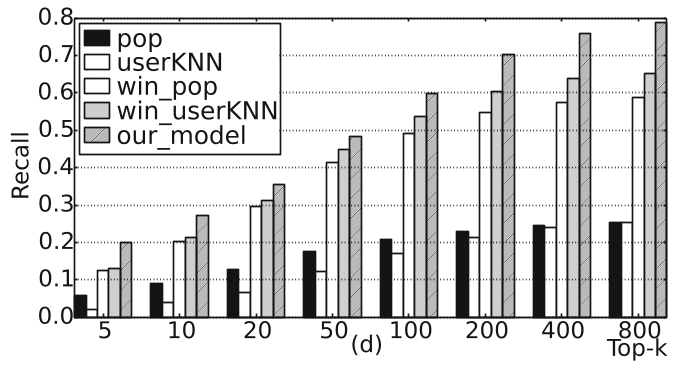
- Performance vs. Baselines: The proposed Linear Regression model crushed the competition. At
Recall@5, it improved upon the best windowed baseline by over 51%. - Feature Synergy: As shown in the ablation study, adding each feature (Location -> Time -> Social -> Activity) incrementally raised the Recall curve, proving that none of these signals are redundant.
Critical Insight & Future Outlook
The most impressive part of this work is the Missing Data Imputation. Most researchers treat unobserved data as "Negative" (0). Here, the authors used a probabilistic approach: if a user didn't RSVP, there’s a chance they just didn't see the invite. By imputing these values based on the user's general activity level, they prevented the model from overfitting to the sparse "No" RSVPs.
Limitations: The model is group-specific. While this ensures high accuracy within a community, it doesn't solve the "cold-start group" problem where no history exists for the group itself.
Takeaway: If you are building a recommendation engine for real-world events, stop obsessing over 10-year histories. Focus on the last 20 interactions and the spatial-temporal "pockets" your users inhabit.