
ER-ELM: Bridging the Online-Offline Gap in Event Recommendations
An event recommendation model using ELM in event-based social network
The paper introduces an event recommendation model tailored for Event-Based Social Networks (EBSN) using Extreme Learning Machines (ELM). By integrating five distinct feature categories, the model transforms recommendation into a binary classification task, achieving state-of-the-art performance on real-world datasets like Meetup.
TL;DR
Recommending a physical event (like a concert or a tech meetup) is significantly harder than recommending a movie or a book because it requires the user to be at a specific place at a specific time. This paper introduces ER-ELM, a recommendation model that treats localized event discovery as a binary classification problem. By leveraging the extreme speed of Extreme Learning Machines (ELM) and a rich set of spatiotemporal features, it achieves superior accuracy and massive speedups over traditional SVM-based methods.
Context: Why EBSNs are Different
Event-Based Social Networks (EBSNs) like Meetup or Plancust represent a hybrid world. Your interest in an event isn't just about what it is (Semantic), but also where it is (Spatial), when it happens (Temporal), and who you know going there (Social).
Previous works struggled because:
- They focused too much on online social graphs.
- They ignored the "travel cost" (spatial distance) and "availability" (temporal patterns).
- They relied on slow training algorithms like Back-Propagation (BP) or Support Vector Machines (SVM).
Methodology: The Five Core Pillars
The researchers identified that to capture the "human intent" of attending an event, one must analyze five distinct feature dimensions:
- Spatial: Not just how far the event is from you, but how close it is to the "clusters" of events you've attended before.
- Temporal: Dividing the week into 168 hours (24x7) plus holidays to match the user's routine.
- Semantic: Traditional keyword matching between user interests and event tags.
- Social: The weighted influence of your friends' likely participation.
- Historical: Measuring the similarity between a new event's nature and your past attendance history.
The Engine: Extreme Learning Machine (ELM)
Instead of using standard Deep Learning which requires iterative weight updates (Back-Propagation), the authors chose ELM.
- The Intuition: Hidden node parameters are randomly assigned and never tuned. Only the output weights are solved using a simple generalized inverse (Moore-Penrose).
- The Benefit: This leads to training speeds that are orders of magnitude faster than BP while maintaining high generalization capabilities.
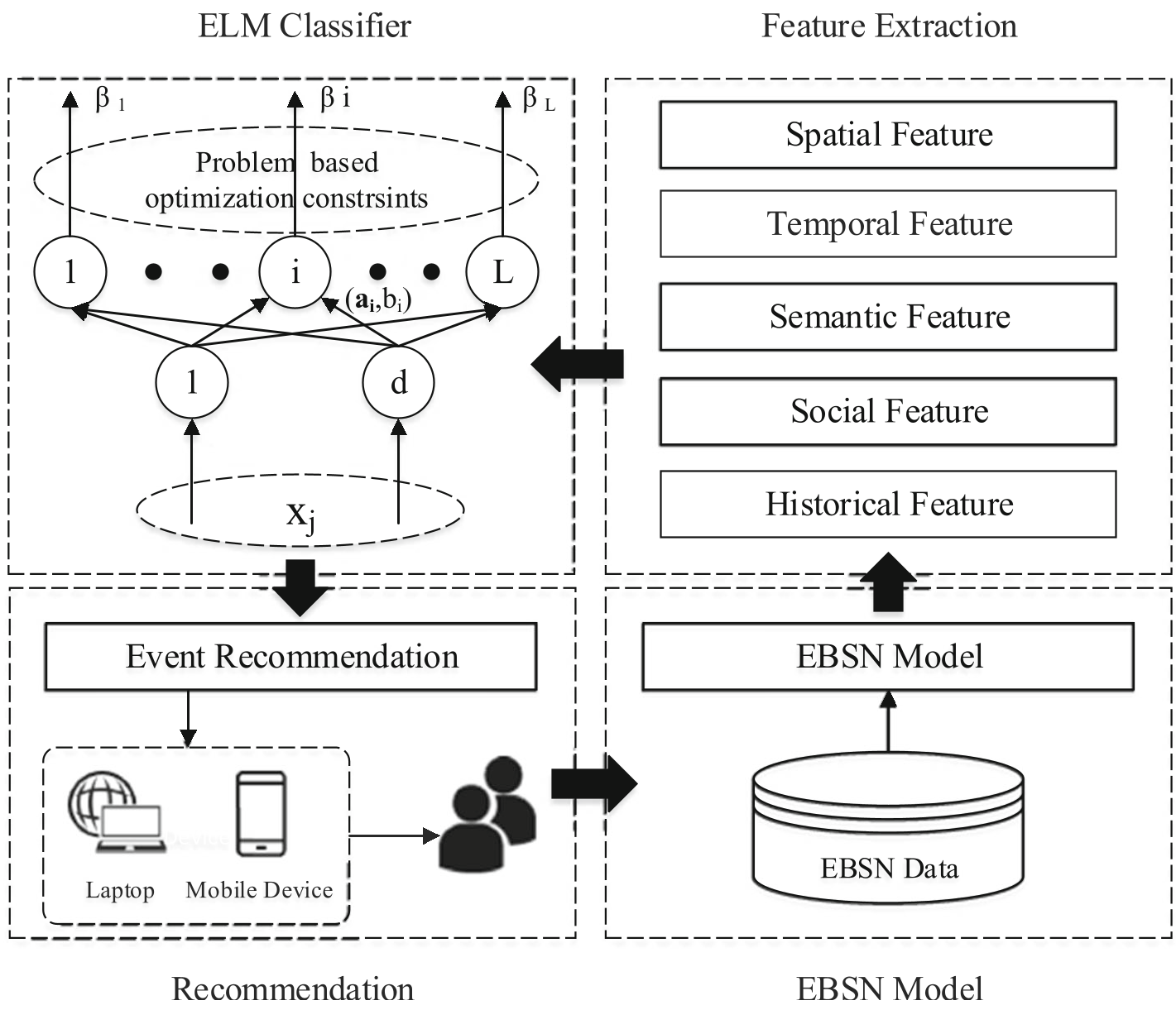 Figure: The overall architecture showing the flow from extraction to ELM classification.
Experimental Performance
The model was tested across five major cities (Beijing, Auckland, Hong Kong, Singapore, and Vancouver).
Efficiency Breakthrough
The most striking result is the training efficiency. While an SVM-based model took 179 seconds to train on the Vancouver dataset, the ER-ELM approach finished in just 4.3 seconds. This makes personalized, per-user model training feasible at scale.
Performance Gains
As shown in the table below, the ER-ELM model consistently outperformed SVM and BP in both Precision and Recall.
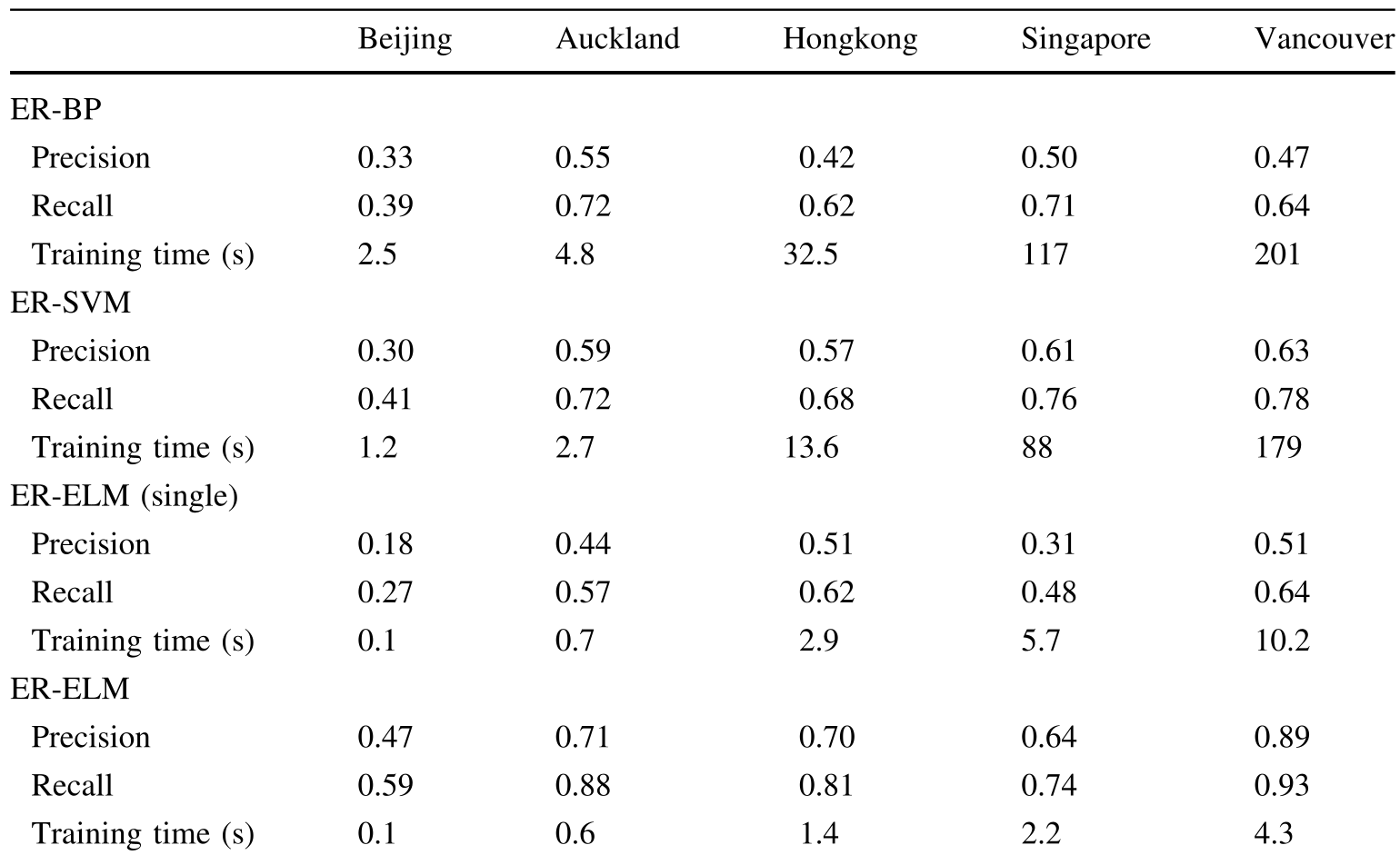 Table: Performance of ER-ELM vs other classifiers.
Critical Insight: The Value of "Per-User" Training
An interesting ablation study in the paper shows that training identically independent ELMs for each user performs significantly better than training one single "Global" ELM for all users. This suggests that in social recommending, "Local Inductive Bias"—the specific habits of an individual—is far more important than universal trends.
Conclusion & Future Outlook
The ER-ELM model proves that for specific domains like EBSNs, complex Deep Learning architectures might be overkill. A well-engineered feature set combined with a fast, "shallow" learner like ELM can provide better real-world utility.
Future Work: While ELM is fast, the current model still relies on manual feature engineering. Integrating representation learning (like Node2Vec or GNNs) while maintaining the ELM's speed could be the next frontier for event recommendation.