
Automated Event Curation: Turning Social Media Chaos into Vivid Stories
Event Representation and Visualization from Social Media
The paper introduces an automated framework for retrieving and visualizing social events based on arbitrary user queries. By integrating social news (Digg), microblogs (Twitter), and image search (Google), it constructs a multi-modal representation featuring textual descriptions, tag clouds, and photo collages.
TL;DR
This paper presents an end-to-end framework that automatically transforms a simple text query into a rich, multi-modal event summary. By leveraging social news platforms as a filter and combining Twitter's real-time buzz with Google’s visual data, the system generates "infographic-style" reports featuring tag clouds and photo collages without the heavy computational cost of traditional data mining.
Background: The Noise of the Social Stream
Extracting meaningful events from social media is often compared to finding a needle in a haystack. Most prior works attempt to detect events by processing millions of Tweets or Flickr uploads in real-time using wavelets or clustering. While scientifically interesting, these methods are resource-intensive and latency-prone. The authors of this paper ask: Why mine the raw data when "Collective Intelligence" has already done the filtering for us?
The Insight: Social News as a Shortcut
The core motivation is efficiency. Instead of scanning the entire Twitter firehose, the framework queries Digg.com (a popular social news aggregator at the time). Since users on Digg have already voted on and discussed the most "important" news, the system gains an immediate, ranked list of hot events. This allows for an online system that provides results instantly without requiring massive local storage.
Methodology: From Query to Collage
The framework follows a logical three-step pipeline to bridge the gap between a user's intent and a visual representation.
1. Semantic Query Parsing
The system doesn't just treat the query as a string. It uses NLTK to perform POS (Part-of-Speech) tagging and chunking.
- Location: Extracted via DBpedia lookup.
- Time: Parsed through custom scripts (e.g., "last 3 days" timestamp).
- Topic: Identified from the remaining noun phrases.
2. Event Extraction & Ranking
Using the parsed parameters, the system queries social news APIs. To ensure the most "informative" events are seen first, the authors implement an entropy-based ranking of the resulting tag clouds—identifying events with the richest variety of discussion.
3. Multi-modal Illustration
This is where the "vividness" comes in:
- Textual Content: Scraped from the original news source using character-density algorithms to strip out ads.
- Micro-opinions: Real-time Tweets are pulled and visualized as a Tag Cloud (a histogram of font sizes showing word frequency).
- Visuals: A Photo Collage is generated by querying Google Images, using a cosine distance filter on the metadata to ensure the images actually match the event.
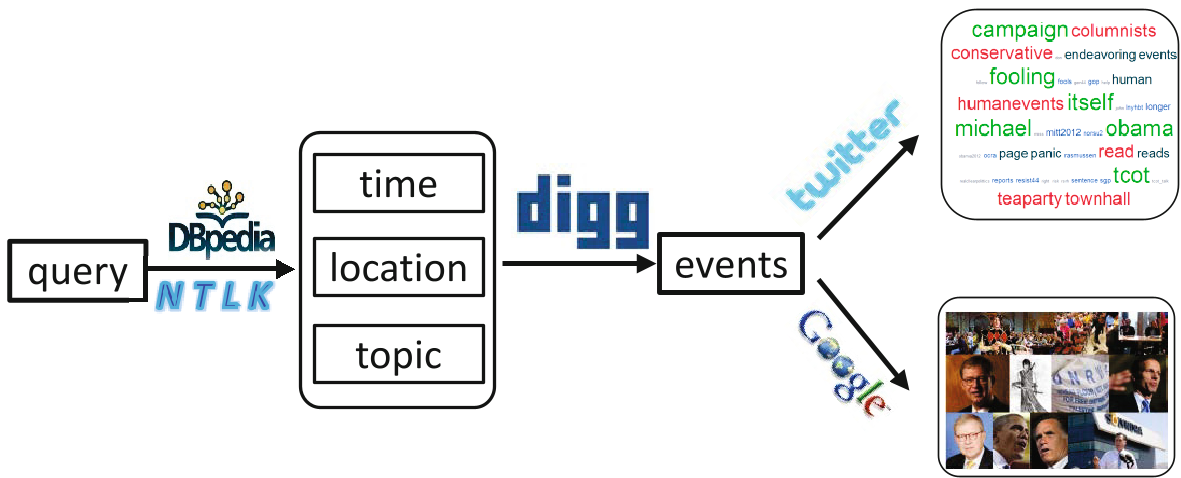 Fig 1: The proposed framework for event extraction and multi-modal illustration.
Experimental Results: Making Sense of "New York"
The researchers tested the system with the query "New York in the last 3 days." The system successfully generated a list of 20 candidate events, ranging from political news to local human-interest stories (e.g., "NYC big soda ban").
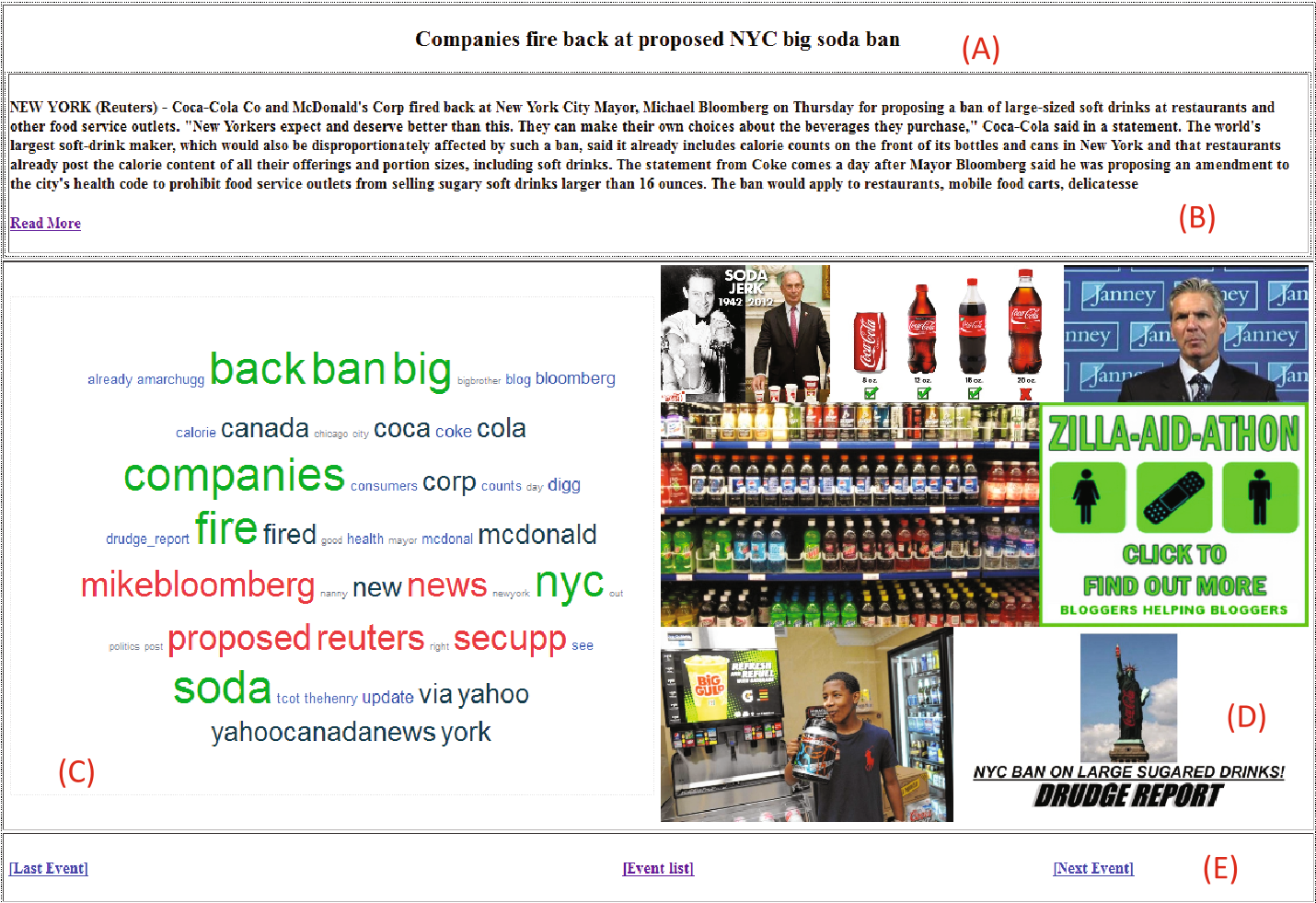 Fig 2: A visual summary of an event featuring (A) Title, (B) Text Body, (C) Tag Cloud from Twitter, and (D) Photo Collage.
The results demonstrated that:
- Tag Clouds effectively highlighted hot keywords like "ban," "fire," and "soda."
- Photo Collages provided an immediate visual context that raw text lacked.
- Efficiency was significantly higher than methods requiring direct Twitter stream processing.
Critical Analysis & Conclusion
The real value of this work lies in its pragmatic approach to data. By treating the internet as a structured database (via APIs) rather than a raw signal, the authors built a system that is lightweight enough for real-time use.
Limitations:
- The framework relies heavily on the availability of public APIs (like Digg), many of which have become more restrictive or defunct since publication.
- The visual collage, while "vivid," lacks a deeper semantic understanding of image content, relying purely on textual metadata for filtering.
Looking Ahead: In the age of LLMs and Generative AI, this framework's logic is more relevant than ever. Replacing the "Tag Cloud" with a GPT-generated summary and the "Photo Collage" with a Stable Diffusion-curated visual board would be the natural evolution of this pioneering "vivid interface" concept.