
EventGo: Decoding the Pulse of the City through Social Media Mining
EventGo! Exploring Event Dynamics from Social-Media Posts
This paper introduces EventGo, an event search engine and mining framework designed to extract local event information from social media posts (Facebook Fanpages and Events). It utilizes a specialized two-phase learning approach for Event Title Recognition (ETR) and Event Venue Recognition (EVR) to build a comprehensive database for urban dynamics analysis in Taiwan.
TL;DR
EventGo is a sophisticated event search and analysis engine that uncovers the "hidden" local happenings—high school concerts, craft sales, and local promotions—that often bypass formal ticketing platforms. By crawling over 230,000 Facebook Fanpages and employing a unique two-phase machine learning strategy, the system provides a real-time map of urban dynamics, achieving superior extraction accuracy compared to standard distant supervision methods.
The "Invisible" Event Market
Think about the last local festival or store promotion you attended. Was it on a major ticketing site like Eventbrite? Likely not. Most local organizers prefer the zero-friction environment of Facebook Fanpage posts. However, for a search engine, these posts are a nightmare: they are unstructured, ephemeral, and drowned in noise.
Prior works by Google researchers (Foley et al., Wang et al.) attempted to solve this by crawling the whole web, but this is computationally expensive and often results in low precision (around 0.36) for event title identification. The authors of EventGo realized that the key isn't more data, but better-targeted data and a smarter training pipeline.
Methodology: The Two-Phase Retraining Paradigm
The core innovation of EventGo lies in how it handles the "semantic gap" between formal event lists and informal social media chatter.
1. Model Architecture & Data Flow
The system uses a four-pronged crawler targeting ticketing seeds (CityTalk), Google Search snippets, Facebook Fanpages, and Facebook Event IDs.
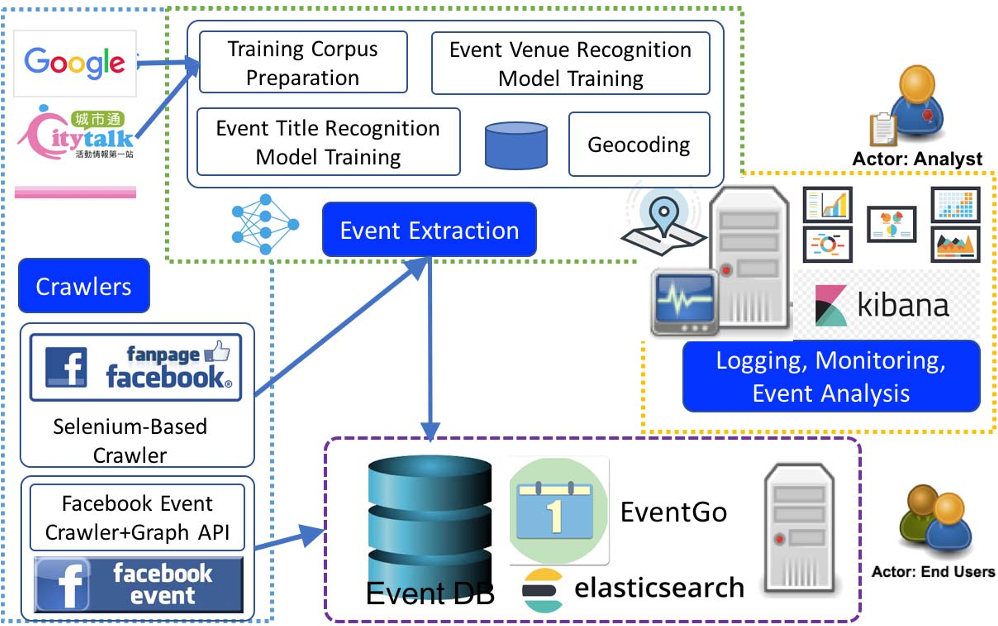 Fig 1. The EventGo architecture demonstrates a holistic pipeline from multi-source crawling to refined event search.
2. Solving Long Title Recognition
Standard Named Entity Recognition (NER) struggles with event titles because they are exceptionally long and contain nested entities (Dates, Venues, Orgs). The authors utilized:
- LCS (Longest Common Subsequence): To allow for "fuzzy" matching during training data preparation.
- Two-Phase Learning: They first trained a model on "clean" web snippets, used that model to label 13M "noisy" Facebook posts, and then retrained a Conditional Random Field (CRF) model on the highest-quality labeled posts. This "domain adaptation" is what pushed the F1-score to 0.565.
Insights: The Shift in Social Media Dynamics
By deploying EventGo, the researchers uncovered a major shift in how people consume event information in Taiwan.
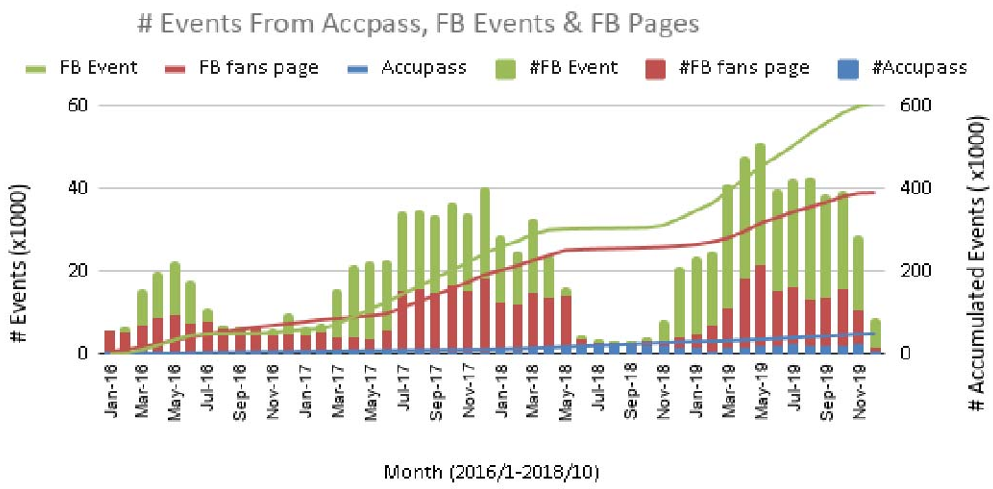 Fig 2. Trends showing the growth of Facebook Events vs. Fanpage posts from 2016 to 2019.
The data reveals a "cannibalization" effect: as Facebook’s News Feed algorithm changed, user engagement (Likes/Interests) shifted. Total Likes for Fanpage events plummeted from 8 million in 2017 to just 3 million in 2019. Meanwhile, dedicated "Facebook Events" saw a 14% increase in interests. This suggests that organizers are moving away from organic posts toward structured "Event" features to maintain visibility.
Geographic Diversity Analysis
EventGo doesn't just list events; it categorizes them to see what makes a neighborhood tick. For instance:
- Daan District: The most balanced event distribution (Art, Music, Exercise).
- Datong District: The cultural heart, boasting the highest percentage of artistic events.
- Beitou District: Dominated by food-related promotions, likely tied to its famous hot spring tourism.
Critical Analysis & Conclusion
While EventGo successfully bridges the gap between social media noise and structured event discovery, there are lingering challenges. The F1-scores (0.54-0.56) suggest that the diversity of human language in social posts still poses a significant hurdle for automated scrapers. Furthermore, the reliance on Facebook's structure makes the system vulnerable to API changes and privacy policy shifts, as evidenced by the "Cambridge Analytica" data gap mentioned in the paper.
The Takeaway: For developers and researchers, EventGo proves that retraining on auto-labeled domain-specific data is more effective than relying on generic distant supervision. It moves us closer to a future where "searching the city" is as easy as searching a library.