
[NeurIPS] Evidential Deep Learning: Empowering Neural Networks with the Courage to say "I Don't Know"
Evidential Deep Learning to Quantify Classification Uncertainty
This paper introduces Evidential Deep Learning (EDL), a novel framework for quantifying classification uncertainty by treating neural network outputs as parameters of a Dirichlet distribution. Unlike Bayesian Neural Networks that infer weight uncertainty, EDL directly models the "subjective opinion" of the network using Theory of Evidence, achieving SOTA performance in out-of-distribution (OOD) detection and adversarial robustness.
TL;DR
Standard neural networks are notorious for being "confident but wrong." Evidential Deep Learning (EDL) flips the script by replacing the standard Softmax output with a Dirichlet distribution. This allows a deterministic network to quantify its own ignorance, providing a high-fidelity uncertainty metric that excels at detecting Out-of-Distribution (OOD) data and resisting adversarial attacks—all without the high computational cost of Bayesian sampling.
Problem & Motivation: The Softmax Mirage
In traditional deep learning, the Softmax function squashes raw logits into a probability simplex. However, this is a point estimate. It tells you the "what" but completely ignores the "how sure."
The authors illustrate this with a simple experiment: rotating the digit '1' from the MNIST dataset. As the digit turns into a horizontal line, a standard LeNet model shifts its prediction to '2' or '5' with high confidence, simply because the ratios in the Softmax exponent remain biased. The model lacks the vocabulary to say, "I have never seen a horizontal '1' before; I am uncertain."
Existing solutions, primarily Bayesian Neural Networks (BNNs), attempt to solve this by placing distributions over network weights. While theoretically sound, BNNs are cumbersome, requiring multiple forward passes (Monte Carlo sampling) and often resulting in noisy uncertainty estimates.
Methodology: From Probabilities to Evidential Opinions
The core innovation of EDL is the integration of Subjective Logic (SL) into the deep learning pipeline.
1. The Dirichlet Shift
Instead of outputting a single probability vector , the network outputs an evidence vector . This evidence represents the support collected for class . These values parameterize a Dirichlet distribution: Where represents the parameters of the Dirichlet density. The total strength dictates the "certainty" of the model.
2. Decomposing Uncertainty
In this framework, the total belief is divided into:
- Belief mass (): The probability assigned to a specific class.
- Uncertainty mass (): The "void" or lack of evidence, calculated as . When the network sees a completely new pattern, , , and therefore (Total Uncertainty).
3. The Evidence Loss Function
The authors propose a specialized loss function (derived from the Bayes risk of the sum of squares loss) that forces the network to:
- Generate more evidence for the correct class labels.
- Minimize the variance of the Dirichlet distribution for known classes.
- Regularize via a KL-divergence term that penalizes evidence that doesn't contribute to data fit, effectively pushing the model toward the "I don't know" state for samples it cannot classify correctly.
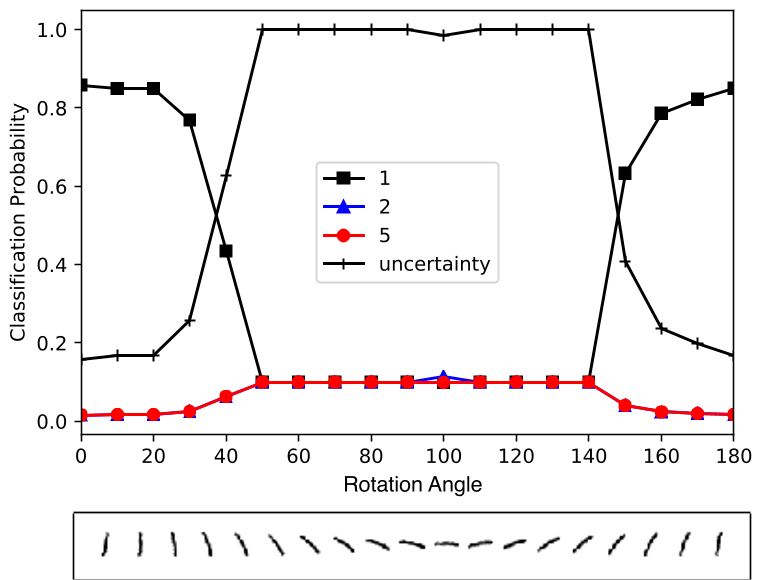 Figure 1: Comparison between Softmax (Left) and EDL (Right). Notice how EDL's uncertainty (red line) spikes as the rotation angle makes the digit unrecognizable.
Experiments & Results: Robustness in Action
Out-of-Distribution (OOD) Detection
The models were trained on MNIST (digits) and tested on notMNIST (letters). A perfect model should show maximum entropy for all letters.
- Result: EDL's Empirical CDF curves for entropy shifted significantly toward the bottom-right compared to Dropout and Deep Ensembles, indicating that it "knows it doesn't know" the letters much more effectively than competitors.
Adversarial Resilience
Against Fast Gradient Sign Method (FGSM) attacks, standard models (labeled L2 and Dropout) maintained high confidence in their wrong predictions as the perturbation increased.
- Result: EDL’s entropy increased linearly with the attack strength. While the accuracy dropped (as expected), the model's self-awareness of the error skyrocketed, making it far safer for deployment.
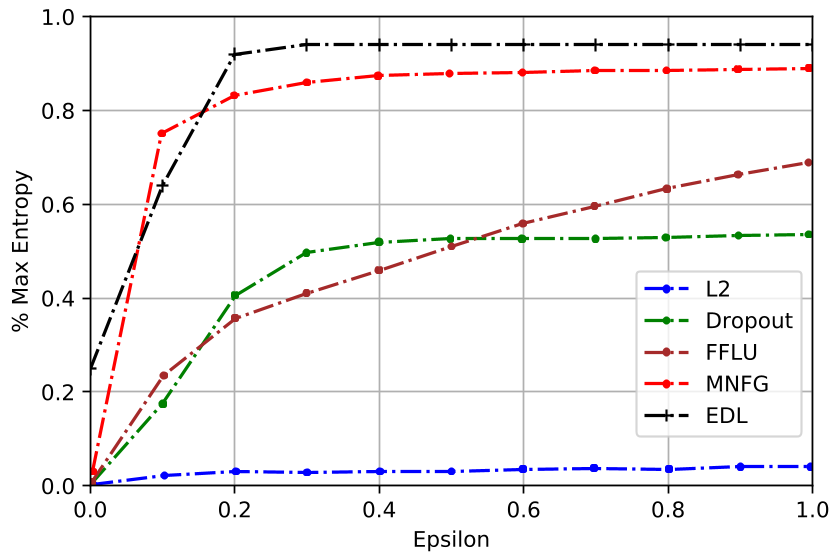 Figure 2: Accuracy vs. Entropy under adversarial attack. EDL (green) maintains a superior balance, reporting high entropy when accurate prediction is impossible.
Critical Analysis & Conclusion
The Takeaway
EDL provides a "Bayesian-lite" experience for the price of a deterministic network. By reframing classification as evidence collection, we gain a mathematically principled way to handle OOD data and adversarial noise.
Limitations
- Loss Sensitivity: The authors noted that the chosen L2-reg Bayes risk was more stable than Type II Likelihood or Cross-Entropy risks, suggesting the training stability of evidential models can be sensitive to hyperparameter tuning.
- Complex Evidence: For very complex datasets (e.g., ImageNet), the concept of "evidence" becomes harder to define than on MNIST/CIFAR, potentially requiring more sophisticated loss regularizers.
Future Outlook
EDL opens the door for Active Learning (where the model asks for labels on high-uncertainty samples) and Safe Reinforcement Learning, where agents can pause and seek human intervention when their "subjective uncertainty" exceeds a safety threshold.