
Evidential Link Prediction: Navigating Uncertainty in Social Graphs with Belief Functions
Evidential Missing Link Prediction in Uncertain Social Networks
This paper introduces an evidential approach for missing link prediction in uncertain social networks by integrating Belief Function Theory (BFT) with graph sampling. The core method, called Evidential Missing Link Prediction, utilizes structural local similarity measures and information fusion to quantify and resolve link existence uncertainty, achieving high precision in noisy real-world datasets.
TL;DR
Predicting missing links in social networks isn't just about finding common friends; it’s about managing "unknowns." This paper moves beyond binary 0/1 logic by using Belief Function Theory (BFT). By treating network samples as independent evidence sources and fusing them, the authors can predict hidden connections in noisy Facebook data with up to 71% precision.
Problem & Motivation: The "Certainty" Fallacy
Most link prediction algorithms (like Jaccard or Adamic-Adar) operate under the assumption that we have a clear, albeit incomplete, view of the network. But real social data is messy:
- Hidden Data: Users change privacy settings.
- Noisy Data: Observation errors lead to false positives.
- Partial Observation: We rarely see the full graph at once.
While probabilistic models exist, they often struggle to distinguish between "not existing" and "total ignorance." The authors argue that a belief-based framework, which explicitly models uncertainty between existence and non-existence, provides a more realistic representation of human social ties.
Methodology: The Evidential Framework
The core innovation lies in how the authors adapt traditional local similarity measures into an evidential reasoning pipeline.
1. The Evidential Social Network
Instead of a simple weight, every edge is assigned a Basic Belief Assignment (BBA) . This mass distribution resides in a frame of discernment , where represents the link exists and represents it doesn't.
2. Architecture: Similarity to Fusion
The process follows five rigorous stages:
- Sampling: Create multiple versions of the network to mimic partial observations.
- Distance Calculation: Use local metrics (Common Neighbors, Jaccard, Adamic-Adar) to find the "most similar" existing links to a candidate missing link.
- Discounting: Treat the similarity score as a measure of "reliability." If a similar link is far away, its evidence is "discounted."
- Global Fusion: Combine evidence from all graph samples using the Conjunctive Rule of Combination.
- Pignistic Decision: Convert the final mass back into a probability (BetP) to make a hard decision on whether the link exists.
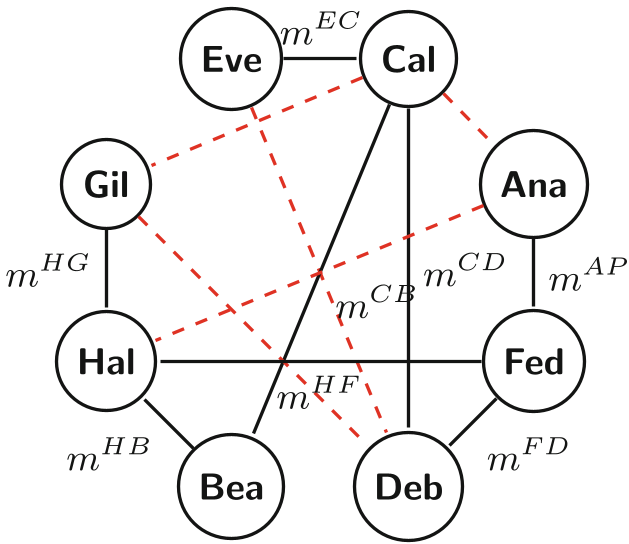 Figure 1: Illustration of an evidential social network where dashed lines represent missing links to be inferred via fusion.
Experiments & Results: Robustness under Noise
The authors tested their approach on a real-world Facebook dataset. To simulate real-world conditions, they added "false links" (noise) ranging from 10% to 25%.
Key Findings:
- Precision vs. Recall: The method maintains high precision (above 60%) even as noise increases. However, the recall drops slightly in noisier environments because the local neighborhood becomes cluttered.
- Sample Volume Matters: Increasing the number of graph samples (from 2 to 4) significantly boosted precision from 64% to 71%. This confirms that the fusion of multiple independent evidence sources successfully "filters out" the noise.
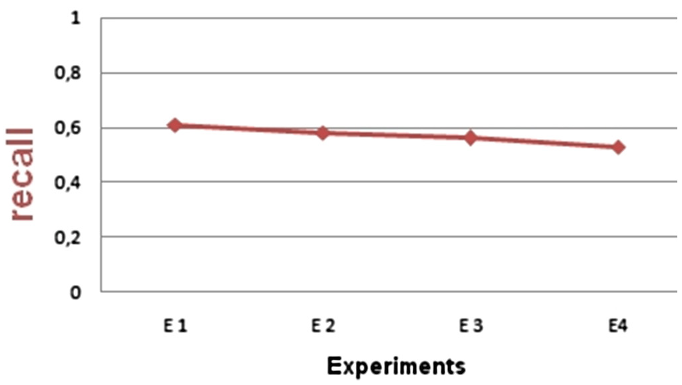 Figure 2: Performance metrics across different experimental settings. The stability of precision indicates the robustness of the evidential fusion.
Critical Analysis & Conclusion
Takeaway
This work demonstrates that link prediction is not just a topological problem but an information fusion problem. By combining graph sampling with Belief Function Theory, the authors provide a principled way to reason about missing data without over-committing to false positives.
Limitations
The primary bottleneck is the reliance on Local Information Measures. While computationally efficient, these measures are sensitive to node degree. High-degree hubs can skew the similarity distances. Furthermore, the approach was tested on 1,500 nodes; the quadratic complexity of distance calculations between multiple graph samples might face scalability challenges on "billion-scale" social networks without optimization.
Future Outlook
The authors hint at a fascinating next step: Jointly missing attributes. In the future, we might not just predict who you are friends with, but also what your hidden profile attributes are, using the same evidential framework to solve for both simultaneously.