
Evidential Influence Maximization: Precision Viral Marketing Through Opinion-Aware Belief Functions
Evidential positive opinion influence measures for viral marketing
This paper introduces an evidential opinion-based Influence Maximization (IM) framework for viral marketing. By utilizing the Theory of Belief Functions (Dempster-Shafer theory), the authors propose six influence measures across three real-world scenarios designed to target positive influencers and specific neighbor opinion polarities, achieving superior seed quality on Twitter datasets compared to the Opinion-based Cascading (OC) and Credit Distribution (CD) models.
TL;DR
Marketing campaigns often fail when "influencers" turn out to have negative views of the product they are supposed to promote. This paper proposes a mathematical framework using Theory of Belief Functions to navigate the uncertainty of social media metadata. By categorizing influencers into three distinct "opinion scenarios," the researchers demonstrate a way to pick seeds that are not only central to the network but also authentically positive, leading to vastly higher engagement (Mentions and Retweets) than traditional structural models.
The Problem: The High Cost of "Blind" Influence
Most Influence Maximization (IM) algorithms treat influence like a virus: it doesn't matter if the "patient zero" likes the virus; they just need to spread it. In Viral Marketing, this is a dangerous assumption.
- Data Imprecision: Social media APIs provide noisy, incomplete data.
- Opinion Negativity: Social psychology shows that negative news spreads faster and stays longer than positive news.
- Missing Context: A user might have many followers but a toxic relationship with the brand, making them a "negative influencer."
Methodology: The Evidential Framework
The researchers move beyond simple probabilities by employing Dempster-Shafer Theory. This allows them to model not just the probability of influence, but the certainty of that influence.
1. Estimating Opinion Polarity
The authors use a pipeline involving Part-of-Speech (POS) tagging and SentiWordNet to assign positive, negative, and neutral scores to tweets. Instead of a single score, they generate a Basic Belief Assignment (BBA), which explicitly accounts for neutral or "uncertain" sentiments.
2. Three Strategic Scenarios
The heart of the paper lies in its three targeted scenarios:
- Scenario 1 (Positive Influencers): Filters for seeds who explicitly love the product ().
- Scenario 2 (The Echo Chamber): Targets positive influencers who influence already positive users (), maximizing the chance of a "safe" success.
- Scenario 3 (The Conversion): Targets positive influencers who influence negative users (), ideal for "flipping" public perception.
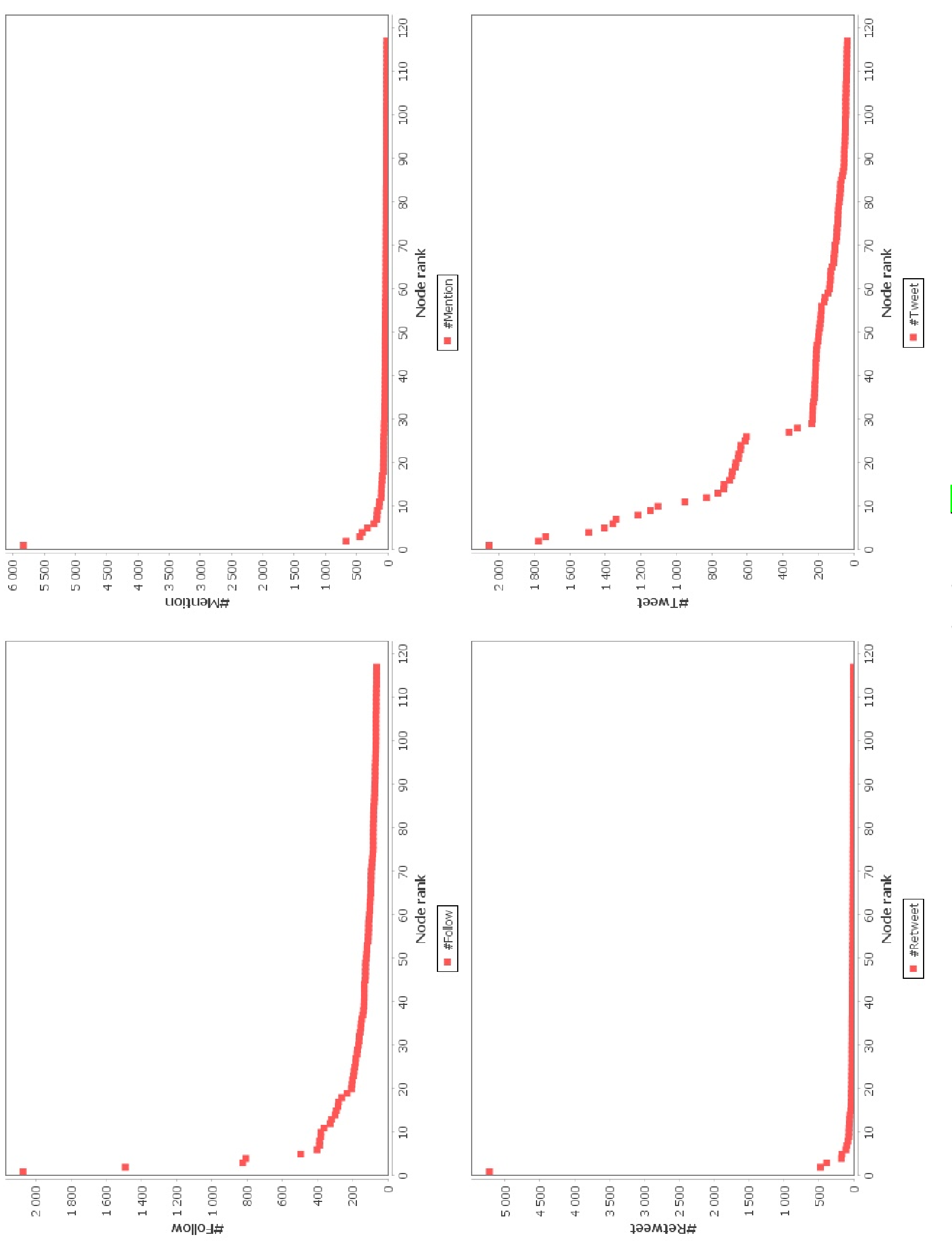 Note: The system integrates network structure (mentions/retweets) with sentiment belief functions.
Experiments and Results
The authors tested their framework against two heavyweights: Credit Distribution (CD) and Opinion-based Cascading (OC) on a dataset of 251k tweets regarding smartphones.
Performance Metrics
The evidential models crushed the baselines in terms of "Active Engagement":
- Seed Quality: While the OC model picked seeds with only 41% positive sentiment, the proposed evidential models reached 85% positive sentiment.
- Engagement Volume: In the "Second Scenario" (Belief Opinion), the accumulated retweets from selected seeds were orders of magnitude higher than the CD or OC models.
(The charts clearly show the "Second Scenario" (green/red lines) achieving much higher engagement than the flat lines of CD and OC).
Quantitative Accuracy
On a controlled, generated dataset, the "Evidential Model" maintained an accuracy of over 80% in identifying true influencers, even when the simulated influence was extremely weak (low signal-to-noise ratio).
Critical Insight: Why Evidence Theory?
Traditional probability () cannot distinguish between "I am 50% sure he is an influencer" and "I have no idea at all." Evidence theory uses mass functions that allow the model to say "I don't know" (allocating mass to the whole frame ). This prevents the algorithm from making reckless decisions based on insufficient data, a common pitfall in Twitter-based marketing.
Conclusion and Future Work
This work signals a shift from "Volume-based" marketing to "Sentiment-first" marketing. By mathematically representing the "Scenario" a recruiter wants to achieve—be it preaching to the choir or converting the heathens—the authors provide a toolkit for surgical viral marketing.
Future Outlook: The authors suggest applying this to Community Detection. Instead of maximizing influence across the entire global Twitter graph (which is computationally expensive), future models might focus on dominating specific "Evidence-based Communities" where trust and sentiment are already dense.