
MAKER: Bridging the "Trust Gap" in AI Preprocessing for Healthcare and Finance
Evidential reasoning for preprocessing uncertain categorical data for trustworthy decisions: An application on healthcare and finance
The paper introduces MAKER (Maximum Likelihood Evidential Reasoning), a novel preprocessing framework for transforming and imputing uncertain categorical data in highly regulated domains like healthcare and finance. It achieves SOTA-level performance compared to missForest and MICE, particularly in high-missingness scenarios, while providing a mathematically rigorous foundation for data-driven decisions.
TL;DR
Current AI models often fail in high-stakes environments because they treat missing categorical data as a nuisance to be "filled in" rather than a source of uncertainty to be managed. This paper proposes MAKER (Maximum Likelihood Evidential Reasoning), a framework that transforms messy, incomplete categorical data into a "Belief Distribution." By doing so, it provides a mathematically sound way to maintain Pre-modelling Explainability, ensuring that if a model is "unsure," we know exactly why.
The Blind Spot of Modern Imputation
In highly regulated sectors like healthcare or finance, data is rarely perfect. We face three distinct types of uncertainty:
- Informational: Missing values in symptoms or credit histories.
- Unforeseeable: New categories appearing after a model is deployed.
- Inexplicability: Standard tools like missForest might fill a missing "Peak Expiratory Rate" with a value of 2.4, but what does 2.4 mean in a categorical sense? Is it a "Low" or a "Medium"?
Prior works often ignore the Ignorance factor—the possibility that the evidence doesn't point to any specific outcome at all.
Methodology: Data as Evidence
The core insight of MAKER is to move away from "Label Encoding" or "One-Hot Encoding" toward Belief Distributions based on Dempster-Shafer theory.
I-MAKER vs. C-MAKER
- I-MAKER (Individual): Processes each attribute by mapping its categories to a probability mass representing its support for different outcomes.
- C-MAKER (Conjunctive): Fuses interrelated attributes. For example, "Physical Exercise" and "Peak Expiratory Rate" are often correlated in asthma; C-MAKER combines them into a joint evidence space to reduce dimensionality and preserve the joint signal.
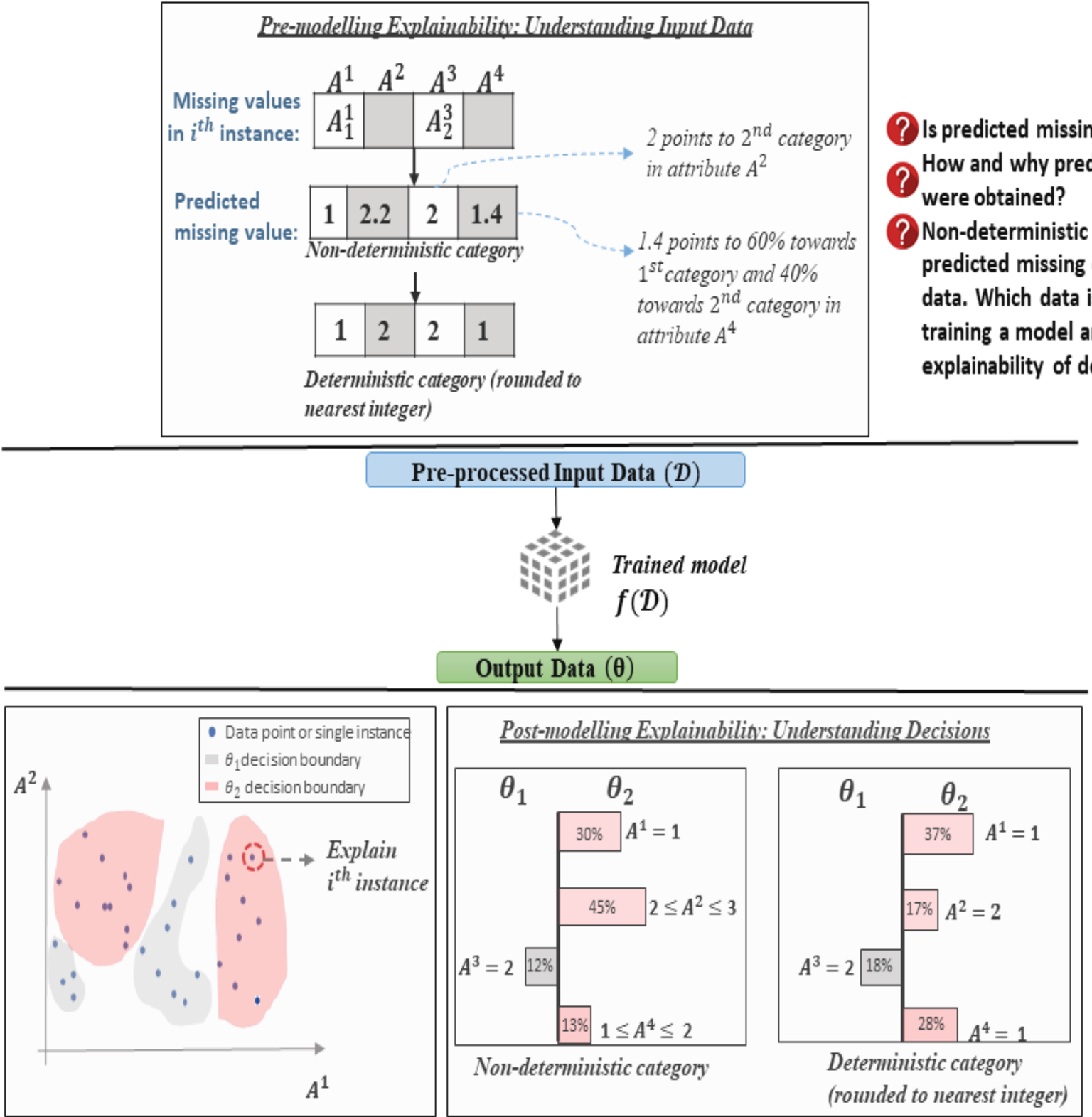 Figure 1: Comparison of how missing data flows through a standard pipeline vs. the MAKER framework.
The Calculus of Reliability
Unlike standard imputers, MAKER calculates the Reliability () and Weight () of each piece of evidence. If a certain symptoms only appears in 5 cases out of 5,000, its reliability is low. MAKER ensures this lack of statistical "sufficiency" is reflected in the final feature vector.
Experimental Evidence
The authors tested MAKER against industry standards (MICE, KNN, missForest) across three model architectures: ANN (Deep Learning), Decision Trees (Tree-based), and BRB (Rule-based).
Key Result: Robustness under Stress
As the percentage of missing data increased from ~10% to ~45%, the performance of standard methods like MICE and KNN plummeted. MAKER (specifically I-MAKER in the asthma study) maintained a much higher AUC.
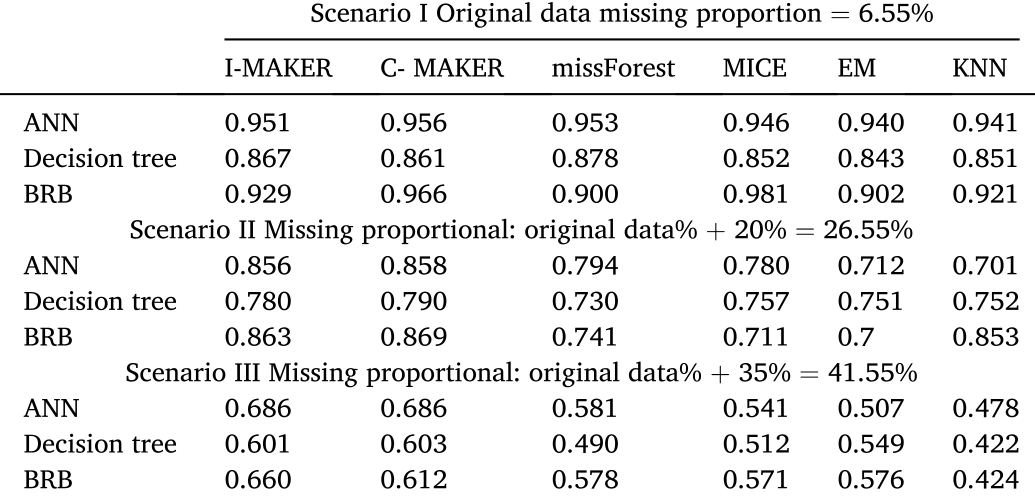 Table 1: Performance metrics showing MAKER's superiority in high-missingness scenarios (Scenario III).
Deep Insight: Why This Matters for XAI
Explainable AI (XAI) usually focuses on the "Post-modelling" stage—using tools like LIME or SHAP to explain what a black box did. However, if the input data was transformed via an uninterpretable imputer, the post-modelling explanation is built on a foundation of sand.
MAKER enables Pre-modelling Explainability. Because each feature corresponds to a belief in an actual outcome, we can trace a prediction back to the physical reality of the symptoms, even if those symptoms were originally missing.
Conclusion and Future Outlook
MAKER transforms preprocessing from a "cleaning" step into a "reasoning" step.
- Takeaway: The "Belief Distribution" format is arguably a much better inductive bias for categorical data than One-Hot vectors.
- Limitations: Training the reliability ratios and weights can be computationally expensive (though parallelizable).
- Future: The next frontier involves extending this to continuous data and handling conflicting judgments from multiple human experts.
By treating data limitations as a first-class citizen, MAKER paves the way for AI systems that are not just accurate, but fundamentally trustworthy.