
Beyond the Popularity Contest: How Mobile Social Networks Truly Evolve
Evolution Analysis of a Mobile Social Network
This paper presents a comprehensive evolution analysis of "Friend View," a Nokia-developed mobile social network, using its entire 11-month lifetime dataset. The study utilizes social network analysis (SNA) to examine user activity patterns and the structural development of friend and comment networks, identifying small-world and scale-free properties.
TL;DR
In a rare "autopsy" of a mobile social network, researchers analyzed the entire 11-month lifecycle of Nokia's Friend View. Unlike traditional Online Social Networks (OSNs) like Facebook or Twitter, where the "rich get richer," mobile social networks evolve through tight-knit, reciprocal clusters. The study reveals that mobile users prioritize deep, strong-tied subgroups, maintaining a "small-world" structure while defying standard preferential attachment models.
The "Snapshot" Bias in Social Science
For years, our understanding of social networks has been built on "crawling"—taking a quick picture of a network at a single point in time. This creates a bias. We see the giants (nodes with thousands of links) but miss how the network actually grew or why new users chose their friends. Furthermore, most data comes from desktop-centric platforms. This paper shifts the lens to Mobile Social Networks (MSNs), where the ubiquity of GPS and the constraints of mobile interaction change the rules of engagement.
The Discovery: Why "Rich get Richer" Fails on Mobile
One of the most striking findings is the evolution of the power-law exponent. In classic models of Preferential Attachment, new users flock to the most popular individuals. However, in Friend View, the power-law fitted exponents became larger over time.
The Insight: New users weren't hunting for "celebrities." Instead, they were looking for Reciprocity. Because mobile interaction (typing on a small keypad, sharing location) is high-effort, users prefer back-and-forth engagement with known associates over passive following.
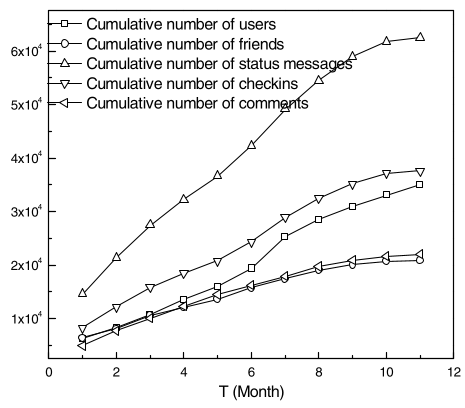 Figure 1: Comparison of Cumulative Users, Friends, and Activities showing the "S-curve" growth and eventual saturation.
Methodology: Friends vs. Commenters
The authors split the network into two distinct graphs:
- Friend Network (Undirected): Formal "friendship" links.
- Comment Network (Directed): Actual interaction through status comments.
By analyzing Assortativity (the tendency of similar nodes to connect), they found that the comment network was significantly more cohesive. Users who comment frequently tend to interact with others who also comment frequently.
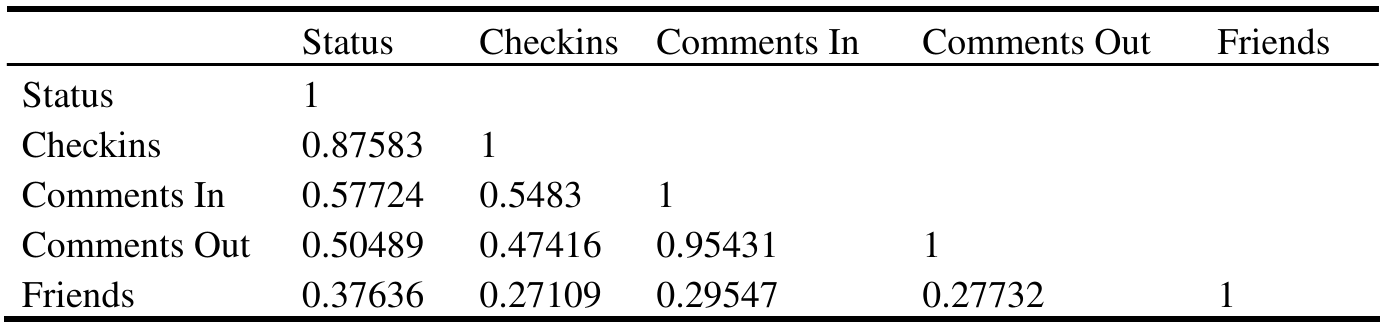 Table 1: Strong correlation (0.87) between posting status and sharing GPS location (Checkins).
Structural Integrity: Small-Worlds and Scale-Free
Despite its mobile nature, Friend View confirmed the Six Degrees of Separation. The average shortest path length stayed around 6 hops. However, while the clustering coefficient decreased over time (as the network grew and subgroups expanded), it remained much higher than that of desktop OSNs.
- Mobile Intuition: MSNs are composed of "cohesive subgroups." You aren't just a node in a massive web; you are part of a tight, strongly-tied circle.
- Assortative Mixing: The network is consistently positive in assortativity, meaning high-degree nodes connect to high-degree nodes, and low to low—a defining characteristic of "true" social networks versus technological or biological ones.
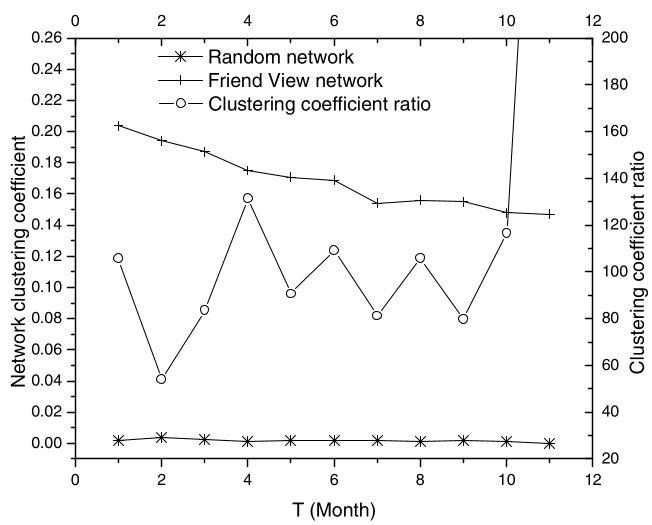 Figure 4: The declining clustering coefficient and density as the network matures.
Critical Insight & Future Outlook
The study concludes that mobile social platforms are not just "smaller versions" of the web; they are fundamentally more intimate. The high correlation between status updates and GPS check-ins (0.87) suggests that location is the primary "glue" for mobile interaction.
Limitations: Since Friend View was an experimental Nokia project that was eventually discontinued, the "saturation" observed in the 10th month might be influenced by the impending shutdown rather than natural social exhaustion.
Takeaway for Developers: If you are building a mobile social app, stop trying to create the next "Global Feed." The data suggests that success lies in facilitating the growth of small, high-density, reciprocal clusters. Focus on the tools that help users maintain "strong ties" in physical proximity.
Conclusion
This research provides a rare, un-crawled look at the birth, life, and death of a mobile social ecosystem. It proves that while the "Small-World" theory holds true, the way we occupy those worlds on our phones is driven by mutual interaction, not just following the crowd.