
Mapping the AI Revolution in Medicine: A 19-Year Bibliometric Evolution
Evolution of the Data Mining and Machine Learning Techniques Used in Health Care: A Scoping Review
This scoping review tracks the evolution of Data Mining (DM) and Machine Learning (ML) in healthcare using the MEDLINE database from 2000 to 2018. Following PRISMA-ScR protocols, it identifies "Cluster," "Support Vector Machine (SVM)," and "Neural Networks" as the dominant techniques driving medical research.
TL;DR
This study provides a roadmap of how computer science transitioned from the fringes of healthcare into its core analytical engine. By analyzing 18 years of MEDLINE data, researchers uncovered that while classic statistics still dominate volume, the "triad of power"—Cluster, SVM, and Neural Networks—defines the modern frontier of medical decision support.
The "Linguistic Noise" Problem in Medical AI
The bridge between clinicians and data scientists is often hindered by shared vocabulary with different meanings. For instance, a search for "Neural Networks" in a medical database might return papers on biological brain structures rather than Artificial Neural Networks (ANN).
Furthermore, the authors highlight a "Temporal Indexing Bias":
- Data Mining was only officially recognized as a MeSH term in 2010.
- Machine Learning didn't receive its own MeSH tag until 2016.
This means that any researcher using only current keywords to find "Machine Learning" papers would effectively ignore the foundational work of the early 2000s, which was indexed under different, often broader, categories.
Methodology: The Dual-Strategy Approach
To solve the search ambiguity, the authors compared two distinct strategies:
- Direct Terminology: Searching for the specific technique names (e.g., "K-means," "SVM").
- Hierarchical MeSH Terms: Filtering techniques through the "Data Mining" or "Machine Learning" branch of the official medical hierarchy.
 Figure 1: The dual-front search algorithm used to filter results from the PubMed/MEDLINE database.
The Changing Guard: From Regression to SVM
The data reveals a fascinating "changing of the guard." In the early 2000s, Neural Networks and Decision Trees held equal weight. However, around 2010, Support Vector Machines (SVM) experienced an exponential spike, surpassing Decision Trees by 2012 and Neural Networks by 2014 as the top choice for high-dimensional medical data classification.
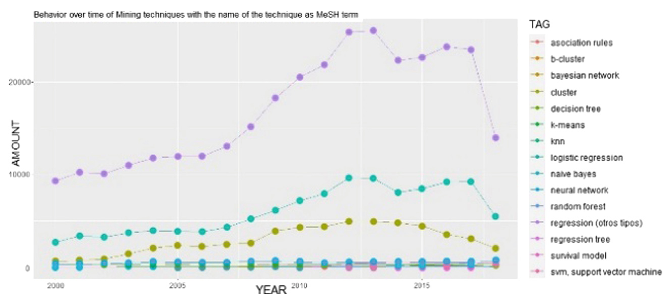 Figure 2: The rise of modern ML. Note the aggressive growth of SVM (Support Vector Machine) and the steady climb of Neural Networks compared to the stagnation of basic Decision Trees.
Key Statistical Insights:
- The Big Three: Cluster analysis, SVM, and Neural Networks are the most influential techniques in recent healthcare literature.
- The Random Forest Surge: By 2017, Random Forest surpassed Decision Trees, reflecting a move toward ensemble methods for better accuracy and reduced over-fitting in clinical settings.
- Statistical Persistence: Despite the hype of AI, classical "Regression" and "Logistic Regression" still represent the highest absolute volume of publications, showing that the medical community still relies heavily on easily interpretable statistical models.
Critical Analysis & Conclusion
The study concludes that the evolution of AI in healthcare is not just a technological shift but an indexing shift.
Takeaway for Researchers: When performing a literature review on medical AI, you cannot rely on modern tags. Your strategy must be "backwards compatible," combining both informatics keywords and clinical descriptors to capture the full trajectory of the field.
Limitations: The study ends in 2018. It misses the subsequent explosion of Transformers (BERT, GPT), which have since redefined natural language processing in healthcare, and the transition from "Machine Learning" to "Foundation Models."
Ultimately, this paper serves as a vital reminder: in the world of Big Data, how we classify the knowledge is just as important as the knowledge itself.