
Augmented Intelligence: Turning Educators into Co-Architects of Machine Learning
Evolution of Decision Tree Classifiers in Open Ended Educational Data Mining
This paper introduces the Augmented Intelligence (AUI) method for Educational Data Mining (EDM), employing an iterative human-in-the-loop approach with ID3 Decision Trees. The study demonstrates how educators can collaborate with white-box algorithms to transform overfitted, complex models into meaningful, generalizing classifiers.
TL;DR
Educational Data Mining (EDM) is shifting from "Black Box" predictions to "White Box" collaborations. This paper proposes the Augmented Intelligence (AUI) method, an iterative process where teachers and ID3 algorithms co-evolve decision tree classifiers. By allowing teachers to adjust model parameters based on their classroom experience, the approach avoids the common pitfall of overfitting while deepening the educator's understanding of student behavior.
Background: Beyond the Black Box
In many data science applications, "accuracy" is the only metric that matters. However, in education, a model that predicts a student will fail is useless if the teacher doesn't understand why. Prior works in EDM have utilized tools like Weka or RapidMiner, but these still often keep the user at arm's length from the model's inner logic.
The authors argue that for EDM to be truly transformative, it must embrace Augmented Intelligence. Unlike standard AI, which seeks to replace human decision-making, AUI seeks to support it. It draws from Empirical Modelling, where the goal is to capture the "state-as-experienced" by the teacher, turning the algorithm into a partner rather than a replacement.
Methodology: The AUI Iterative Cycle
The AUI framework functions through a continuous feedback loop:
- Data Labeling: The teacher labels a training set based on their perception of student performance.
- Machine Generation: An ID3 algorithm generates a visualized Decision Tree.
- Human Adjustment: The teacher reviews the tree. If a branch doesn't make sense (e.g., "Why is '3D Design' usage the only factor for success?"), they manually adjust pivot values, swap attributes, or change class labels.
- Refinement: This process repeats until the teacher is satisfied that the model reflects the classroom reality.
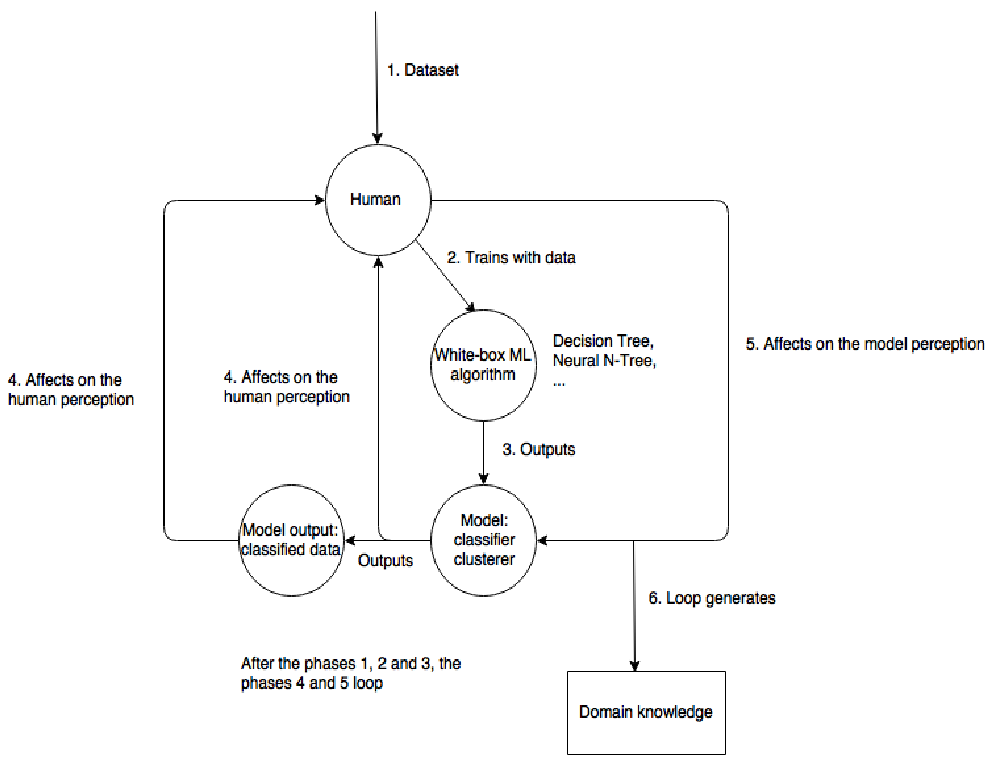
Case Study: Evolution of a Teacher’s Model
The study followed a secondary school teacher (a data science novice) analyzing data from an Arduino maker workshop. The dataset included 12 features, such as "idle time," "search usage," and "use of specific tools like Tinkercad."
The "Overfitting" Phase
Initially, the system-generated models were complex and messy. As shown in the early iterations, the ID3 algorithm focused on minute statistical differences that led to "overfitting"—the model worked for that specific data but didn't make logical sense to the teacher.
The "Meaningful" Phase
By the fourth iteration, the model had "evolved." The teacher simplified the tree, focusing on attributes that his experience suggested were the true indicators of "Good Performance."
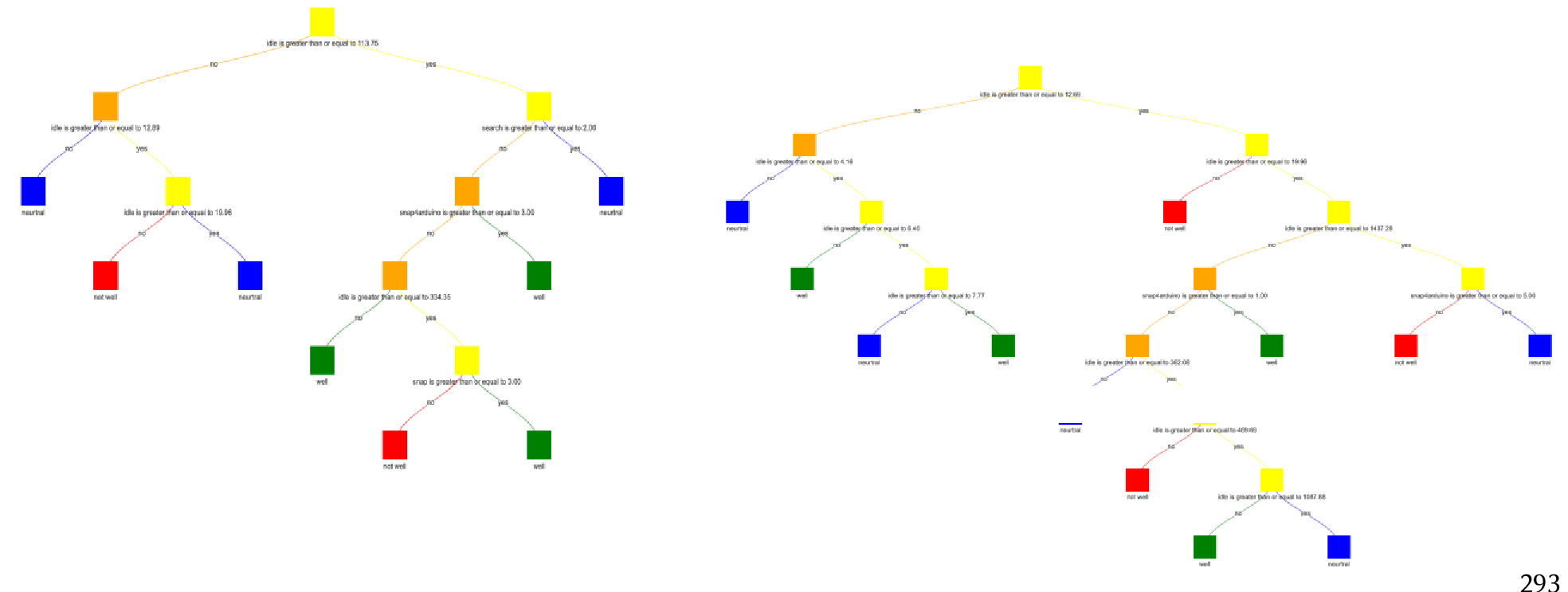 Note: The progression from complex, overfitted trees to streamlined, instructor-validated models is a hallmark of the AUI process.
Key Results & Critical Insights
The research yielded two powerful conclusions:
- Novice Capability: Despite having no background in data science, the teacher created a meaningful, generalizing model in just 45 minutes.
- Process Over Product: The teacher noted that the act of adjusting the model was more valuable than the final model itself. It forced him to reconcile his classroom observations with the digital traces left by students, leading to "New Knowledge" discovery.
| Evolution Metric | Initial Model | Final Model |
|---|---|---|
| Complexity | High (Deep branches) | Lower (Broad but shallow) |
| Generalization | Poor (Overfitted) | High (Teacher-validated) |
| Insight | Low (Statistical noise) | High (Meaningful attributes) |
Critical Analysis & Conclusion
Takeaway
The AUI method proves that "White Box" algorithms like Decision Trees are uniquely suited for education because they allow for human intervention. The study highlights that in niche domains with small datasets (like a 30-person workshop), human intuition is the best defense against the "noise" of machine learning.
Limitations & Future Work
The authors acknowledge a significant caveat: the teacher must know the context. If an outsider tries to use AUI on a dataset they didn't personally witness, the "adjustments" might lead to bias rather than insight. Future research aims to scale this to other algorithms like Random Forests and K-Nearest Neighbor to see if higher-dimensional models can remain equally interpretable.
Ultimately, this work serves as a reminder that the goal of AI in the classroom shouldn't be to find the "perfect" algorithm, but to build a better bridge between data and the teacher's intuition.