
Evolution: Bridging the Logic Gap with Game-Based Computational Thinking
10990_Evolution Design and Implementation of Digital Educational Material to Strengthen Computational Thinking Skills.
The paper introduces "Evolution," a Digital Educational Material (DEM) designed as an educational game to enhance Computational Thinking (CT) skills. Targeted at Logical Programming students, the method integrates mathematical, algorithmic, and critical thinking challenges to bridge the gap in foundational skills required for computer science.
TL;DR
"Evolution" is a specialized Digital Educational Material (DEM) designed to combat the high failure rates in logic programming. By gamifying the development of Computational Thinking (CT), it forces students to move beyond passive learning and actively engage with mathematical and algorithmic patterns through seven evolutionary-themed levels.
Academic Positioning: This work is an applied pedagogical study that bridges Constructionism (Papert) with modern ICT integration, focusing on the "pre-computing" skills necessary for vocational students in high-failure environments.
Problem & Motivation: The 70% Failure Reality
In Colombian vocational institutes like INCAP, the subject of Logic Programming stands as a daunting gatekeeper. The authors identify a sobering statistic: nearly 70% of students fail state tests due to poor reading comprehension and basic math skills.
The core insight of the researchers is that Computational Thinking is not just about coding. It is a composite of:
- Algorithmic Thinking: Finding patterns and steps.
- Mathematical Thinking: Data interpretation and number sense.
- Critical Thinking: Analyzing and evaluating solutions.
Existing methods fail because they assume these foundations are already present. "Evolution" assumes they are not, and seeks to rebuild them.
Methodology: The Architecture of "Evolution"
The DEM "Evolution" is built on the philosophy that knowledge is constructed through experimentation. The authors structured the material into a hierarchical progression of logic:
- Level Cell/Multicellular: Focuses on memory, concentration, and basic arithmetic.
- Level Amphibious/Marsupial: Introduces data control and simple pattern recognition.
- Level Orangutan/Caveman: High-level abstraction and complex algorithmic sequence solving.
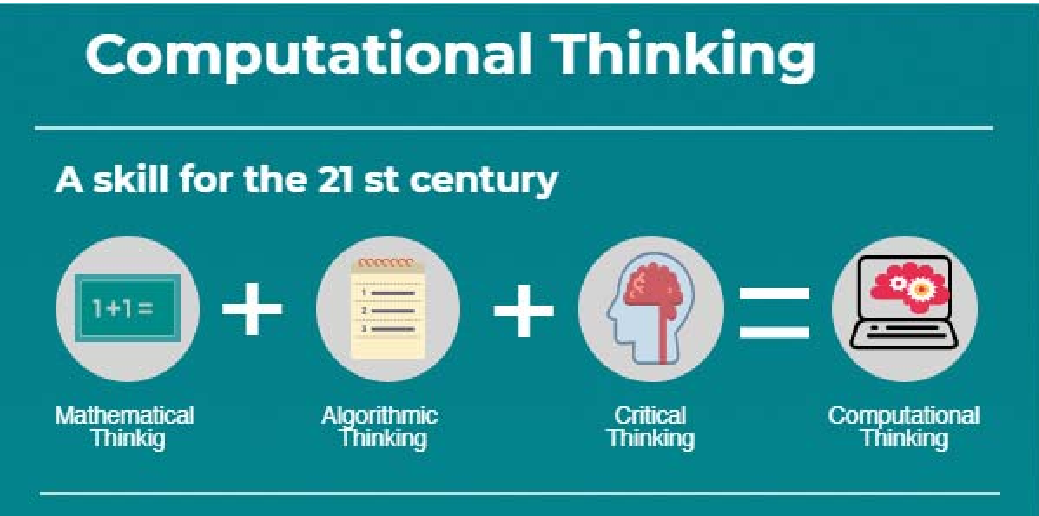 The conceptual framework showing how Algorithmic, Critical, and Mathematical thinking converge into CT.
The technical implementation used HTML5 to ensure cross-platform accessibility, allowing students to engage in a controlled environment where "making mistakes" was a recognized part of the learning loop.
Experiments & Results: Evidence of Progress
While the study was qualitative (using field diaries, screen captures, and focus groups), the data points to clear shifts in student capability:
- Iterative Success: As shown in the rubric analysis, students initially struggled with "Caveman" and "Amphibious" levels (algorithmic patterns), with some requiring up to 17 attempts.
- Before vs. After: Post-test results (the "Exit Test") showed that even low-performing students began to explain how they reached solutions, a hallmark of critical thinking.
- Student Perception: Participants noted that the "pressure of time" and "logic exploration" helped them regain skills they had forgotten since secondary school.
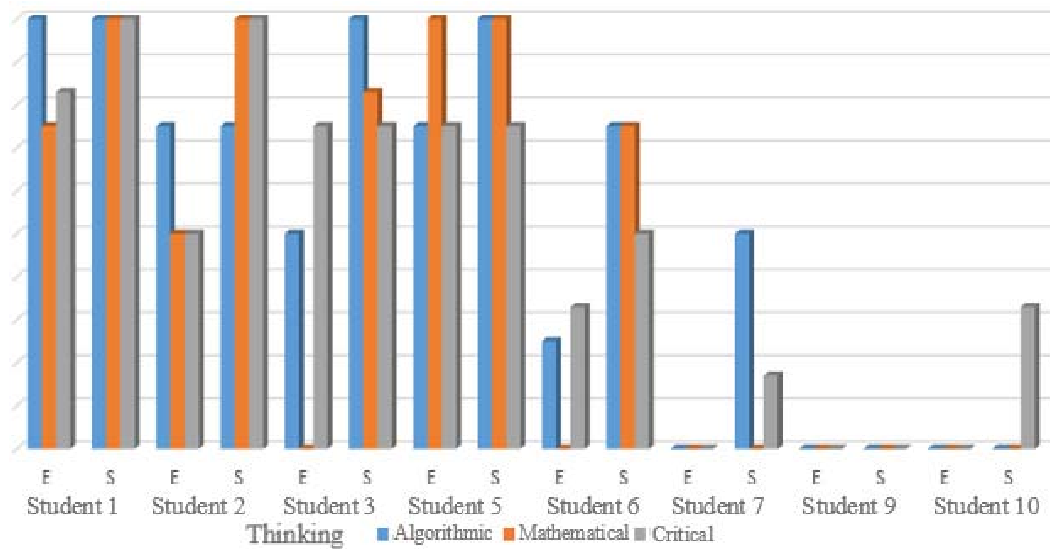 Comparison of performance in the Entrance (E) vs. Exit (S) tests across different modes of thought.
Critical Analysis & Conclusion
The strength of "Evolution" lies in its holistic definition of CT. It doesn't distract the student with syntax (like Java or Python) but isolates the logic required to eventually write that syntax.
Limitations:
- Sample Size: The pilot only involved 8 students. While qualitative depth was high, statistical significance remains to be proven in broader populations.
- Time Constraints: The 3-hour session was exhausting for students, potentially skewing performance in later, more difficult levels.
Future Outlook: The authors plan to deploy "Evolution" across all INCAP headquarters. This study serves as a blueprint for other technical institutes: stop teaching code to students who haven't mastered logic; teach the logic through play first.
Takeaway: Digital materials are not just "tools" for the classroom; when designed correctly, they are active pedagogical agents that can rehabilitate foundational cognitive deficits.