
Beyond the Giant: Decoding the Life and Death of Disconnected Components in Social Networks
Evolution of disconnected components in social networks: Patterns and a generative model
This paper investigates the temporal evolution of disconnected components (non-giant components) in social networks across six diverse datasets. It introduces the "Surfer Model," a generative mechanism that successfully replicates observed patterns of component longevity and merging.
TL;DR
In the study of social networks, the "Giant Connected Component" (GCC) usually steals the spotlight. However, this paper shifts the lens toward the "Islands"—the Disconnected Components (DCs). By analyzing six massive datasets (including Renren and arXiv), the authors uncover universal laws governing how these islands form, grow, and eventually vanish, providing a new generative framework called the Surfer Model.
Problem & Motivation: Why Look at the Small Fish?
In graph theory, we often assume that once a network is large enough, the "small stuff" doesn't matter. But these disconnected components are the "pre-life" of the GCC. Understanding them is critical for:
- Anomaly Detection: If a component grows too fast or lives too long without merging, it might be a botnet or a sybil attack.
- Community Growth: Predicting when localized groups will finally integrate into the mainstream.
The researchers identified a gap: we knew components existed, but we didn't know their Longevity (lifespan) or Final Size (size at the moment of death/merging).
Methodology: The Surfer Model
The core contribution is the Surfer Model, based on the physical intuition of a new user joining a social network.
How it Works:
- Host Selection: A new node picks a random host in the network.
- Recursive Exploration: Like a user clicking through "friend-of-friend" links, the new node explores neighbors of with a probability .
- The Bridging Effect: Through a parameter , the node can start multiple "rounds" of visits. If these rounds pick hosts in different components, the new node acts as a bridge, merging them.
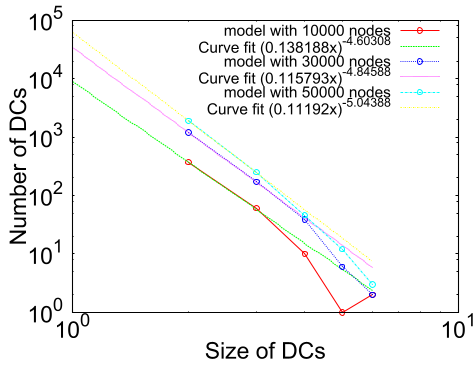 Figure 1: The random surfing process showing how a new comer bridges different parts of the network.
Key Empirical Observations
The authors identified three fundamental patterns across all datasets:
- Longevity Decay: Most DCs are short-lived. They either merge into the GCC or other DCs almost immediately. Long-lived DCs are rare "isolationists."
- Final Size Power Law (FSPL): The distribution of how large a component gets before it "dies" follows . Essentially, it is exponentially harder for a component to stay disconnected as it gets larger.
- Small-Scale Merging: Merging events are rarely "mass collisions." Usually, only 2 DCs merge at a time (as seen in Table II).
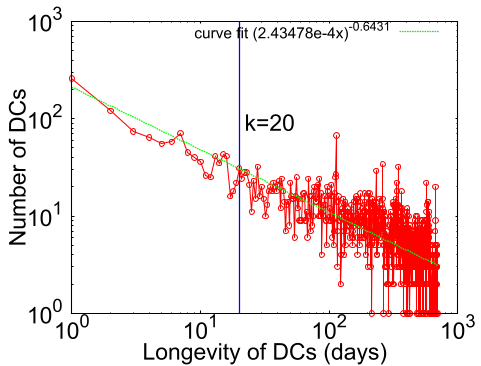 Figure 2: Distribution of DC longevity across different datasets showing the decaying trend.
Experiments & Results
The researchers validated the Surfer Model by generating networks of up to 50,000 nodes.
- Matching Real Data: The model successfully reproduced the FSPL and the longevity decay observed in real social networks.
- Network Densitization: Beyond just components, the model naturally obeyed the Densification Power Law, meaning the generated networks become denser over time, just like real-world graphs.
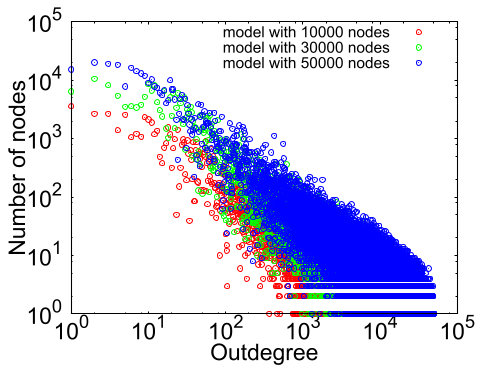 Figure 3: Comparison of the Surfer Model's generated distributions vs. theoretical power laws.
Critical Analysis & Conclusion
This work completes our understanding of network macroscopic evolution. By defining the life cycle of disconnected components, the authors provide a "baseline" for normal network growth.
Limitations: The model assumes node addition only (no node deletion), which may not apply to platforms with high churn rates. Future Outlook: Integrating these DC patterns into real-time monitoring systems could revolutionize how we detect "digital cults" or hidden malicious clusters in online ecosystems before they merge with the general population.