
The Gravity of Social Ties: How Geography Shapes Network Evolution
Evolution of a Location-based Online Social Network: Analysis and Models
The paper presents a longitudinal study on the evolution of Gowalla, a location-based online social network (LBSN). It introduces a gravitational attachment model that combines node degree and spatial distance to explain social link creation, alongside social and mobility-driven closure mechanisms.
TL;DR
This study dissects the growth of the Gowalla social network, revealing that "popularity" (preferential attachment) is not enough to explain how we make friends online. By analyzing 400,000 users and millions of check-ins, the authors demonstrate that Gravitational Attachment—a blend of social status and physical proximity—is the true engine of network evolution.
Context: Why Space Still Matters in a Digital World
In the early days of social network theory, "death of distance" was a common trope. However, the rise of Location-Based Social Networks (LBSNs) like Gowalla and Foursquare proved otherwise. Prior research focused on static snapshots, but this paper asks the "How" and "Why" of the process: How do geographic constraints influence the temporal birth of a link?
The authors argue that existing models like triadic closure (making friends with friends-of-friends) are only half the story. The missing piece is how physical mobility (check-ins) provides a "common focus" that facilitates new connections between strangers.
Methodology: Testing the "Physics" of Friendship
The researchers used a Maximum Likelihood Estimation approach to put different growth "theories" to the test. They compared four primary models of edge attachment:
- Preferential Attachment (): You connect to the most popular person.
- Age-based (): You connect to the oldest/most established accounts.
- Spatial (): You connect to the closest person.
- Gravitational (): A combination of popularity and proximity.
The Growth Architecture

The evidence was clear: Gravity won. As a user's degree increases, they are willing to bridge longer geographic distances, but for the average user, the "cost" of distance acts as a major deterrent.
Key Insights: Social vs. Spatial Closure
The paper makes a fascinating distinction between Global Attachment and Local Closure:
- Global scale: Degree and distance together drive the creation of new links.
- Local scale: When closing a "social triangle," geography disappears. If we share a mutual friend, the distance between us doesn't matter much—the social bond overrides the spatial barrier.
- Mobility as a Catalyst: 10% of links are formed between users who share no friends but visit the same venues. This "Mobility-driven closure" relies on the popularity of the venue (check-in frequency) rather than the physical distance between the users' homes.
Performance Evidence
The following table highlights how different "closure" strategies performed compared to a random baseline. Notably, models incorporating node degree and shared check-ins achieved the highest likelihood of matching real-world events.

Simulation & Validation
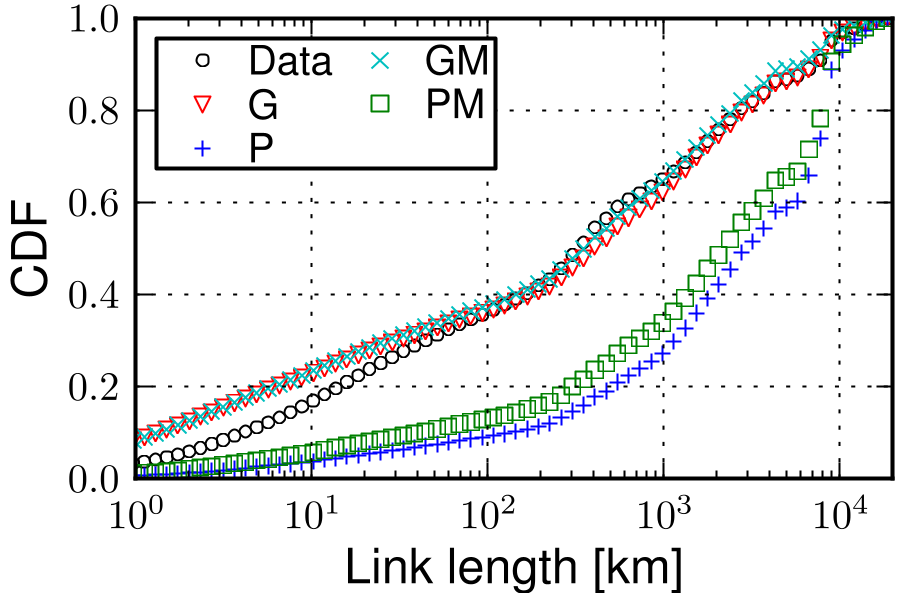
To "put it all together," the authors built a generative model that births nodes and edges according to these gravitational and closure rules.
The results (as seen in the graphs below) show that the Gravity (G/GM) models perfectly align with real-world Gowalla data (solid line), whereas the pure Preferential (P/PM) models drastically overestimate the length of social links.
Critical Perspective: Beyond the Paper
Takeaway: This work proves that spatial information is not just secondary metadata—it is a fundamental "Inductive Bias" that constrains human behavior.
Limitations:
- Demographic Bias: The data comes from 2010; modern social habits (like remote work/globalized digital communities) might have changed the exponent of distance decay.
- Discontinued Service: Gowalla was acquired and shut down; whether these rules hold for "ephemeral" location services (like Snapchat's Snap Map) remains an open question.
Future Outlook: For engineers building recommendation systems, the "Gravity" mechanism offers an elegant way to balance "Exploration" (global degree-based links) with "Exploitation" (local spatial/social closure).