
Beyond Popularity: How Social Aggregators Really Evolve
Evolution of an online social aggregation network: an empirical study
This paper presents a longitudinal empirical study of FriendFeed, a pioneer social aggregation service, analyzing its network evolution from September 2008 to May 2009. The authors evaluate the applicability of preferential attachment, proximity bias, and group affiliation in driving link formation across different user demographics.
TL;DR
While "the rich get richer" (Preferential Attachment) is the gold standard for explaining how social networks grow, it doesn't tell the whole story. By analyzing the now-legacy service FriendFeed, this study demonstrates that network evolution is a multi-stage process: new users rely on common interests and shared services to find friends, while "veterans" follow the gravitational pull of high-degree nodes and triadic closure.
The "Popularity" Fallacy
In network science, Preferential Attachment (PA) suggests that a node’s probability of gaining new links is proportional to its existing degree. If you have many followers, you get more. However, this paper argues that PA is an "old man's game." For a user who just joined FriendFeed, the massive degree of a celebrity account is often less relevant than a shared interest or a mutual "friend of a friend."
Methodology: The Anatomy of a Link
The researchers crawled FriendFeed over several months, capturing snapshots of ~218,000 users and 4 million edges. They segmented users by "Age" (time since joining) and tested three primary drivers:
- Preferential Attachment: Do users follow the most popular accounts?
- Proximity Bias: Do users follow people "close" to them in the graph (e.g., friends of friends)?
- Group Affiliation: Do shared tools (Twitter, Flickr, Reddit) act as catalysts for friendship?
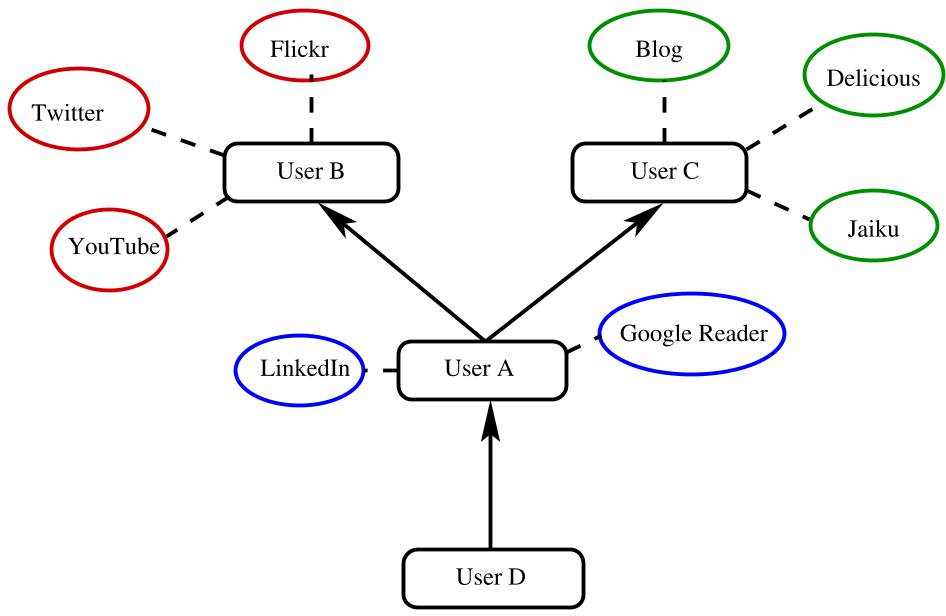 The aggregate nature of FriendFeed: Users pull data from multiple silos into a unified social graph.
Key Insights: Age Changes Everything
The study’s most striking finding is the variance in the α (alpha) exponent—the measure of preferential attachment strength.
- For Veterans (>50 days): α ≈ 1.0. These users behave exactly as the Barabási-Albert model predicts; they are entrenched in the network and follow established social hierarchies.
- For Newcomers: α is significantly lower (as low as 0.1). New users aren't looking for the "most followed" accounts; they are exploring the network through external context.
Proximity as a Tie-Breaker
The authors found that linear PA alone cannot explain the short path lengths in the graph. Instead, they propose that Proximity Bias acts as a tie-breaker. When a user decides to follow someone with a high degree, they are statistically much more likely to pick the high-degree person who is only 2 hops away rather than someone 5 hops away.
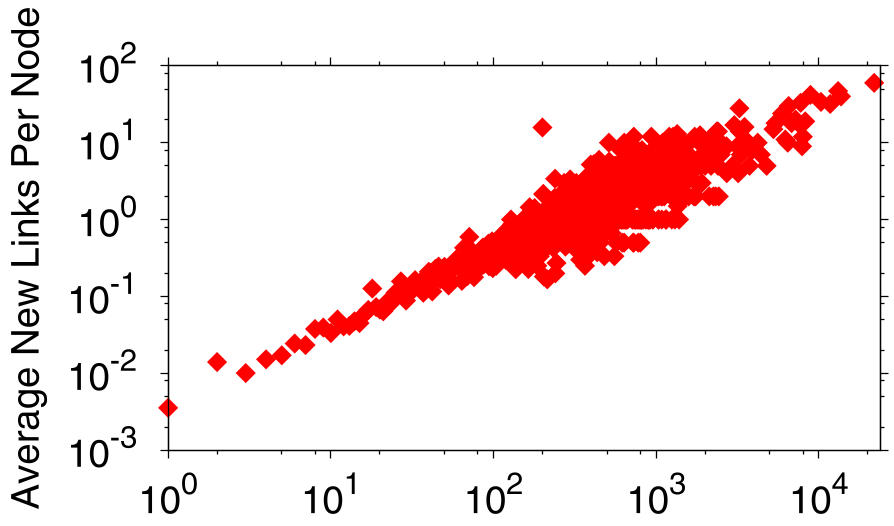 Experimental results showing that while Indegree (popularity) matters, the correlation is much cleaner for 'old' destination nodes than for 'young' ones.
The Power of "Shared Foci"
FriendFeed was unique because it aggregated 57 different services. The researchers used "shared service subscriptions" as a proxy for Group Affiliation.
- New users who share a common service (like Flickr) are orders of magnitude more likely to follow each other than those who don't.
- As users age, this "service bias" fades, suggesting that once you are "in" the network, internal social dynamics take over.
Critical Analysis & Future Outlook
This paper provides a necessary nuance to Scale-Free network theory. It suggests that Homophily (liking people like ourselves) and Group Affiliation are the "on-ramps" of the social highway, while Preferential Attachment is the "steady-state" cruise control.
Limitations: The dataset is from 2009. In the modern era of algorithmic feeds (TikTok/Threads), "Proximity Bias" might be artificially enforced by recommendation engines rather than organic user discovery. However, the core insight—that node age dictates behavior—remains a fundamental principle for anyone building or studying social platforms today.
Takeaway for Developers: If you are launching a new social platform, don't just show users the "most popular" accounts. For new users, shared context (Common Foci) is the only metric that effectively drives the first crucial links.