
Evolution of Social Networks: The Power of Clique-Superposition
Evolution of Social Networks: New Patterns and a New Generator
This paper introduces the Clique-superposition model, an event-driven undirected weighted graph generator for social networks. Based on Scott Feld's sociological theory and validated on large-scale datasets (CiteULike, Delicious, DBLP), the model reproduces both classical power-law distributions and newly discovered patterns in weighted network evolution.
TL;DR
How do millions of local interactions form the global structure of a social network? This paper moves beyond simple node-to-node link models by proposing the Clique-superposition model. By viewing network evolution as a series of social events (cliques), the authors successfully replicate new weighted patterns observed in DBLP and social bookmarking data that previous SOTA generators missed.
Background: Beyond Preferential Attachment
While the classic Barabási-Albert (BA) model explained the "rich-get-richer" phenomenon through degree-based preferential attachment, it lacked a sociological basis. In reality, we don't just "match" with a stranger; we meet groups of people through shared events—a meeting, a research paper, or a tag on a resource.
The authors pivot to Scott Feld's theory: a social network is the result of superposed cliques of different sizes. This "event-driven" intuition suggests that the fundamental unit of growth isn't an edge, but a subgraph.
New Patterns in Weighted Networks
Before building their generator, the authors identified three new "signatures" of real-world networks using datasets from CiteULike, Delicious, and DBLP:
- Weight Distribution Power Law (WDPL): The frequency of edge weights (how many times two people interact) follows a power law.
- Strength Distribution Power Law (SDPL): Node strength (sum of weights of adjacent edges) acts as a microscopic indicator of importance, also following a power law.
- Edge Weight Addition: The probability of an interaction frequency increasing decreases as the current frequency or the addition value increases.
Methodology: The Clique-Superposition Model
The core mechanism is elegant: in each evolution step, the model either adds a new node or selects an existing node (a "newcomer") and connects it to a size- clique.
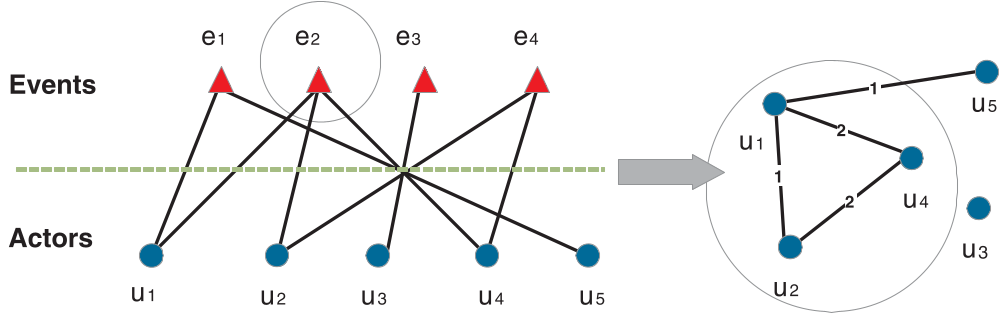 Figure 1: The model treats social networks as projections of hidden actor-event affiliation networks.
The Engine: KEWLS Algorithm
To find these cliques efficiently in a growing graph, the authors use the KEWLS (k-Edge weighting Local Search) algorithm. This allows the generator to find complete subgraphs of size (sampled from a persistent power law) and link them to the newcomer. This naturally creates a "rich-get-richer" effect because nodes in larger cliques are mathematically more likely to be part of the sub-cliques chosen for new connections.
Experimental Validation
The model was tested against varying parameters ( for growth pace and for clique size distribution).
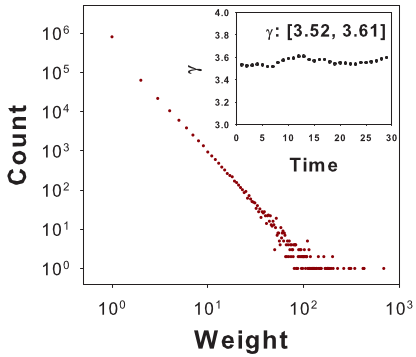 Figure 2: The synthetic networks successfully replicate the Power Law distributions (WDPL/SDPL) found in real-world data.
Key Findings:
- Densification: The generated graphs satisfy the Densification Power Law (), meaning the network gets denser over time.
- Clustering: Unlike random graphs, the Clique-superposition model maintains a high clustering coefficient, a hallmark of "Small World" social structures.
- Robustness: The parameter (clique size distribution) had a stable effect, showing the model is robust to different types of event distributions.
Conclusion and Future Outlook
The Clique-superposition model serves as a bridge between sociology and graph mining. By focusing on the event as the catalyst for the link, it provides a more authentic blueprint for generating synthetic social data.
Limitations: The model currently focuses on undirected networks. The next frontier involves extending this to directed graphs (e.g., following/follower relationships) and exploring how these clique structures influence information diffusion or community detection.
Ref: Yan, F., et al. "Evolution of Social Networks – New patterns and a new generator." Peking University.