
Evolution of Social Power: Why Distrust and Antagonism Reshape Collective Influence
Evolution of social power over influence networks containing antagonistic interactions
The paper proposes a discrete-time dynamic model to study the co-evolution of opinion dynamics and social power over influence networks featuring both cooperative and antagonistic (negative) interactions. By integrating the Reflected Appraisal Mechanism into signed graphs, the authors demonstrate that individual self-confidence and social influence eventually converge exponentially to a steady state determined solely by the interpersonal appraisal structure.
TL;DR
How much "say" you have in a group doesn't just depend on how confident you are, but on how everyone else perceives you—especially your enemies. This paper extends the famous DeGroot-Friedkin (DF) model to signed networks (coopetitive environments), proving that individual social power exponentially converges to a state dictated by the network topology, even when "hate" is part of the equation.
Context: Beyond "Everyone is a Friend"
In classical socio-cybernetics, models like the French-DeGroot framework assume social influence is like a convex combination: you take a weighted average of your friends' opinions. But what if you have enemies? What if your neighbor's suggestion makes you want to move in the opposite direction?
Existing research often ignores these antagonistic interactions. This paper fills that gap by looking at how social power—the ability to shift the collective needle—evolves over a sequence of discussions in a world where "my enemy’s enemy is my friend."
The Core Insight: The Reflected Appraisal Mechanism
The authors argue that social power is not static. It evolves through a feedback loop:
- Discussion: A group debates an issue.
- Outcome: A collective decision is reached.
- Reflection: Individuals realize how much influence they actually had on that outcome.
- Adjustment: Individuals update their self-confidence and interpersonal trust for the next issue.
In a signed graph, this means your social power can have orientation—meaning some people exert "negative influence" that drives others away.
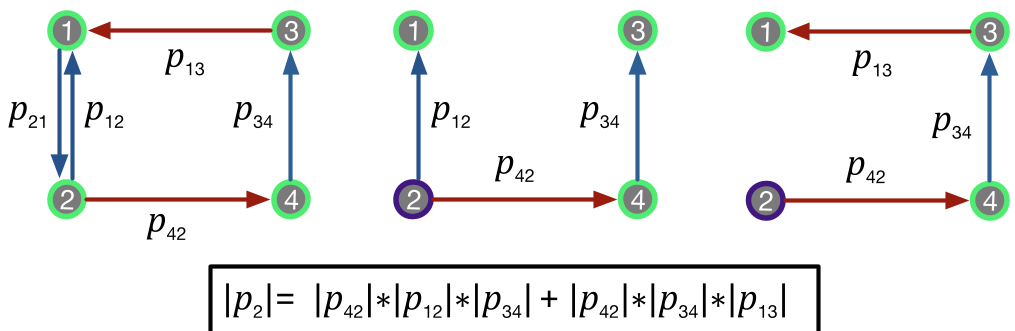 The design philosophy: Interpersonal appraisals drive the co-evolution of influence and opinion.
Methodology: The Math of "Forgetfulness"
The paper’s technical heavy lifting comes from Differential Lyapunov Theory. Instead of checking if a system moves toward a single point, the authors check if different trajectories "contract" toward each other.
They prove that for almost any network structure (SC and SB - Strongly Connected and Structurally Balanced), the group will exponentially forget their initial power perceptions. Whether you start as an arrogant dictator or a humble observer, the network's inherent structure will eventually force your social power to a specific "equilibrium."
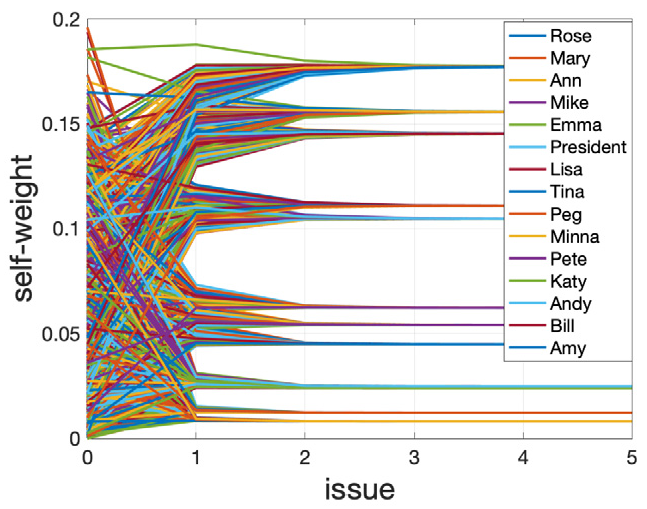 Simulation results showing the exponential convergence of self-appraisals regardless of initial states.
Key Results & Real-World Evidence
The authors tested their model on Thurman’s informal network (a real-world study of office politics) and Sampson’s monastery network.
- The "Iron Law of Oligarchy": Even in democratic settings, power tends to accumulate. In Thurman’s network, certain individuals (like "Emma") naturally became the "power hubs" because of their central position in the appraisal graph.
- Autocracy vs. Democracy: If the network is a "Star Topology" (everyone looks to one person), that person becomes an absolute dictator. In a "Balanced Graph," power is distributed more democratically.
- Social Power Bound: An individual's absolute social power is strictly capped by their "eigenvector centrality." You cannot be more powerful than your position allows.
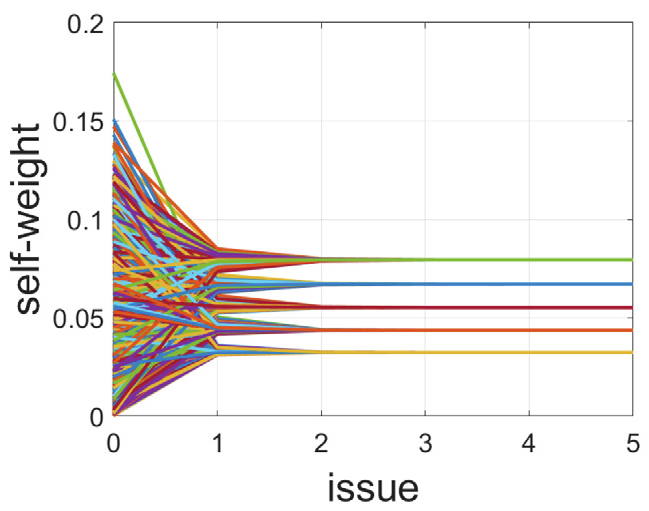 Comparison of different social power metrics on the Sampson’s monastery network.
Critical Analysis: A Double-Edged Sword
While the model is mathematically rigorous, it assumes that opinion formation and power reflection happen on different timescales—i.e., you finish the debate before you think about your "influence." In the real world (especially on social media), these happen simultaneously.
Furthermore, the paper notes that if a network is structurally unbalanced (too much chaos/distrust), the system tends toward "neutrality"—where NO ONE has power. This is a fascinating mathematical explanation for why highly polarized, chaotic groups often fail to accomplish anything.
Conclusion
This paper is a significant leap forward in understanding Coopetitive Social Networks. By moving away from non-negative weights, it provides a much more realistic mirror of human society. It reminds us that in the long run, your power is not a reflection of your ego, but a reflection of the network you inhabit.