
Facebook's Interaction Paradox: Why Your 500 Friends Mean Less Than You Think
On the evolution of user interaction in Facebook
This paper presents a longitudinal study on user interaction dynamics within Facebook by analyzing "activity networks" derived from wall posts. Using data from 60,000 users over two years, it reveals that while social links are persistent, actual interaction is highly volatile and characterized by a rapid "churn" of active ties.
TL;DR
Is a "friend" really a friend if you haven't spoken in years? This seminal paper investigates the Activity Network—the subset of your Facebook friends you actually talk to. The researchers discovered a striking paradox: while the people we interact with change constantly (70% churn rate), the overall structure of the social network remains eerily stable.
The Problem: The Illusion of Connectivity
In the mid-2000s, social networks exploded, with users amassing hundreds of "friends." However, researchers realized that a binary "friend" link is a poor metric for trust or influence. Existing studies focused on the Social Network (static links), but this paper argues we should focus on the Activity Network (active interactions). The core challenge was understanding how these interactions evolve: do they grow stronger over time, or do they inevitably fade away?
Methodology: Mapping the Ebb and Flow
The researchers crawled the Facebook New Orleans network, capturing two years of data (2006-2009) encompassing 60,000 users and over 800,000 wall posts.
They defined the Activity Network by creating snapshots of users who exchanged at least one wall post within a specific window. To measure how the network changed, they used a "Resemblance" formula:
This allows them to pinpoint exactly how many links survive from one period to the next.

Key Insights: The Mechanics of Interaction
1. The "Icebreaker" Effect
For infrequent interactors (the majority), the first interaction often doesn't happen when the friend request is accepted. Instead, it's delayed by months. The primary catalyst? Platform nudges. Over 54% of low-frequency interactions were triggered by Facebook's birthday reminders.
2. The Decay of Tie Strength
For those who do interact frequently, the intensity is highest immediately after the link is formed and decays sharply thereafter.
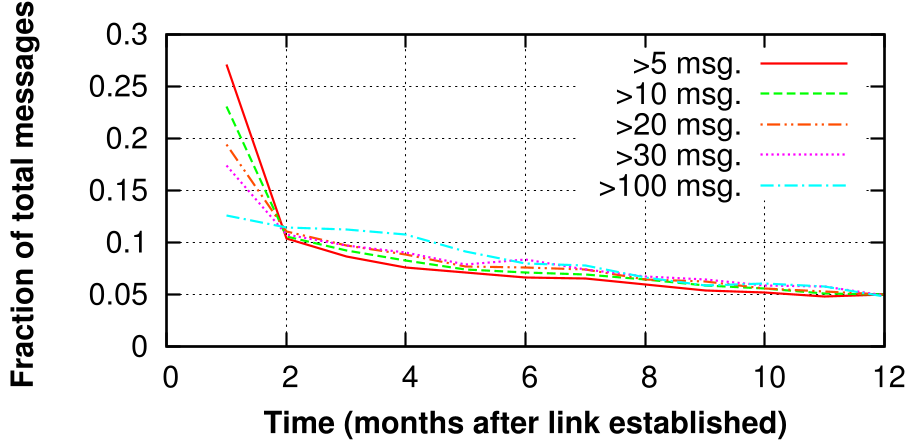
3. Macroscopic Stability vs. Microscopic Churn
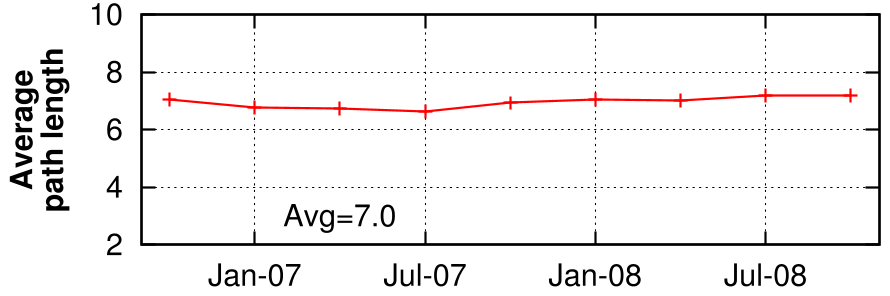
The most surprising finding is captured in the graph below. While 70% of the active links "died" within a month (high churn), the global properties like Clustering Coefficient and Path Length remained nearly horizontal lines. The system replaces old interactions with new ones in a way that preserves the network's "Small World" geometry.
Critical Analysis & Conclusion
Takeaway
Strength of ties in digital spaces is ephemeral. If you are building a system that relies on social trust (like Sybil defense or recommendation algorithms), using the raw social graph is misleading. You must use a decay-weighted activity graph.
Limitations
The study focuses exclusively on "Wall Posts," which are public, broadcast-style interactions. It does not account for private messaging or the "passive consumption" of news feeds, which have become the dominant modes of interaction in the modern era.
Future Outlook
As AI and algorithmic feeds (like TikTok’s "For You") take over, the "Icebreaker" effect is no longer just birthdays but algorithmic serendipity. The evolution from a "Social Graph" to an "Interest Graph" makes the findings of this paper—that links are transient but structures are stable—more relevant than ever.