
Beyond the "Rich Get Richer": Deconstructing the Evolution of Social Aggregators
Evolution of an online social aggregation network: an empirical study
This paper presents an empirical study of FriendFeed, a social aggregation network, to analyze how social ties evolve over time. Utilizing longitudinal data from 2008 to 2009, the authors demonstrate that network growth is driven by a combination of preferential attachment, proximity bias, and group affiliation.
TL;DR
While the Barabási-Albert model suggests that popular nodes inevitably attract more links, this study of the FriendFeed network reveals a more nuanced reality. By analyzing nearly 4 million edges, the researchers found that "age" is a critical gatekeeper: established users follow a power law, but newcomers are driven by proximity bias (friends of friends) and group affiliation (shared interests).
The Social Physics of Aggregation
In the late 2000s, FriendFeed emerged as a "network of networks," aggregating data from Twitter, Flickr, and YouTube. Unlike static social graphs, FriendFeed's evolution provided a laboratory to test a fundamental question: Why do we follow who we follow?
The authors argue that existing models are too simplistic. If network growth were purely mathematical, we would only ever follow the most famous accounts. In reality, our social "pull" is influenced by how long we've been in the system and who we share "foci" with.
Methodology: The MLE Approach to Social Ties
The researchers used Maximum Likelihood Estimation (MLE) to fit the parameter in the probability function .
- When , we see linear preferential attachment.
- When , the "rich-get-richer" effect is dampened.
1. The Age Gap
The most striking finding is the disparity between "Young" and "Old" nodes. As shown in the study's data, for nodes older than 50 days, the attachment is almost perfectly linear. However, for new entrants, the attachment logic is far more distributed.
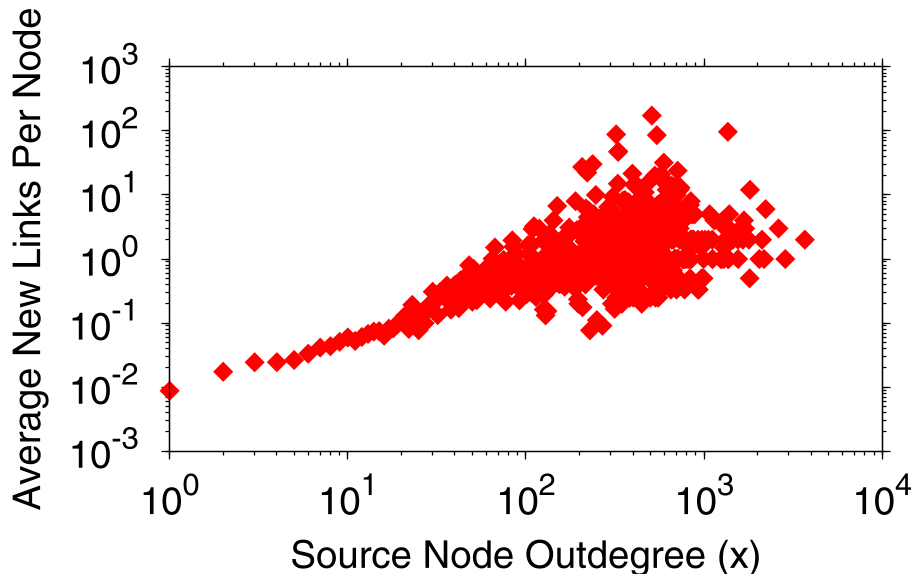 Figure: (a) Older nodes show linear growth; (b) Younger nodes show a much weaker correlation with degree.
Proximity as a Tie-Breaker
Does having a high degree make a node attractive, or is it just that high-degree nodes are "closer" to everyone in a small-world network?
The study simulated a network using pure preferential attachment and compared it to the real FriendFeed graph. The real graph showed a massive spike in Triadic Closure (the 2-hop distance). To explain this, the authors proposed a hybrid model:
- Step 1: The user picks a general "tier" of popularity (In-degree) they want to follow.
- Step 2: Among nodes in that tier, the user picks the one closest to them in the network.
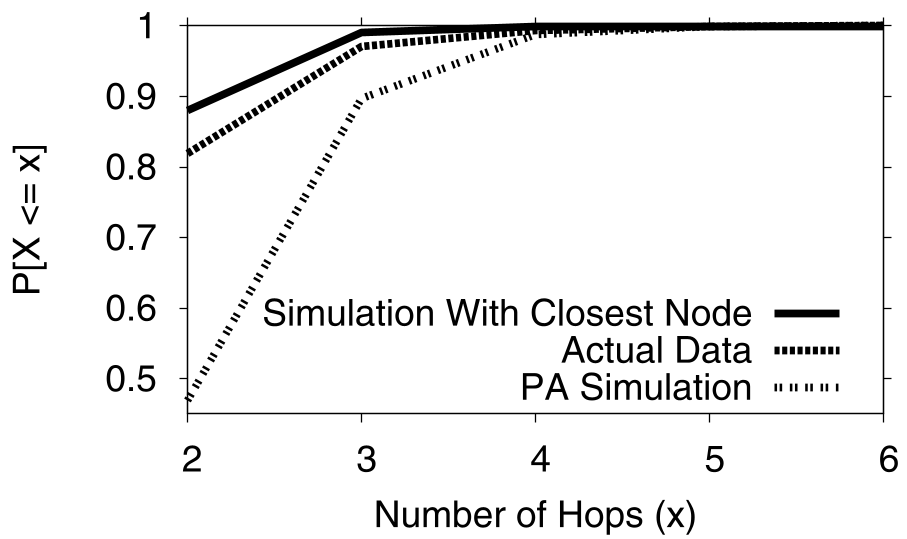 Figure: The "Distance 2" (Triadic Closure) effect is significantly higher in empirical data than in pure degree-based models.
Group Affiliation: The New Entrant's Strategy
If you just joined a network, you have no "friends of friends" to follow. So, what do you do? You follow people who use the same tools as you.
- New Users (<10 days): For 84% of links, a common service (like Flickr or Twitter) existed between the source and destination.
- Established Users: As users age, the "shared service" factor becomes less relevant, superseded by the network's internal popularity.
Critical Insight & Conclusion
This paper fundamentally challenges the universality of scale-free growth models. It suggests that network maturity changes the rules of engagement.
Takeaway for Today's Developers: When building recommendation engines for new platforms, optimizing for "Popularity" (Global SOTA) will fail your new users. Instead, look for Group Affiliation (Common interests/external services) to seed the initial graph, then transition to Proximity (Triadic Closure) as the user's local network matures.
Limitations
The study is limited by the lack of exact timestamps for link formation (relying on 5-day crawl snapshots) and the presence of private profiles (12%) which may hide internal clusters. Furthermore, as a "social aggregator," FriendFeed's users were likely more "information-hungry" than the average social media user, potentially biasing the results toward high-activity behaviors.