
EPMiner: Unveiling the Temporal Logic of Dynamic Social Networks
Evolution pattern mining on dynamic social network
The paper introduces EPMiner, a novel algorithm designed to discover Evolution Patterns in dynamic social networks. By transforming graph sequences into an interaction-interval database, it efficiently captures temporal relationship changes using a unique endpoint-based representation.
TL;DR
Social networks are not static; they breathe, expand, and wither. EPMiner is a high-performance framework that moves away from computationally heavy graph-matching. Instead, it transforms dynamic networks into a sequence of "interactions," treating relationship changes as temporal intervals. With a suite of three specialized pruning strategies, it discovers complex evolution patterns with remarkable efficiency.
Problem & Motivation: The Static Trap
Most social network analysis treats data as a single snapshot. Even dynamic approaches often simply "chain" static results together, leading to two major bottlenecks:
- Computational Cost: Comparing subgraphs (Isomorphism checking) across thousands of time steps is an NP-hard nightmare.
- Loss of Logic: Chaining snapshots often fails to capture the "duration" and "overlap" of interactions effectively.
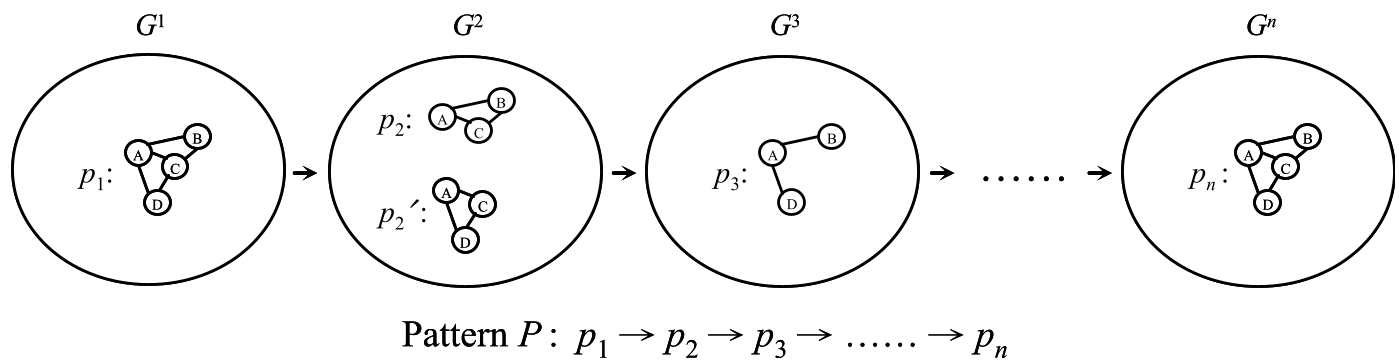
The authors argue that we should view social evolution not as a series of graphs, but as a continuous sequence of intervals where relationships start and end.
Methodology: From Graphs to Endpoint Sequences
EPMiner’s secret sauce is its Interaction Representation. Instead of storing edges, it converts every node’s history into an endpoint sequence.
- For example, if user A interacts with B from time 1 to 2, it’s recorded as .
- If multiple interactions overlap, they are grouped into point sets, e.g., .
The Growth Engine
EPMiner uses a projection-based mining strategy (inspired by PrefixSpan) but optimizes it for the unique "paired" nature of evolution patterns.
The Three Pruning Musketeers
To survive the exponential search space, EPMiner introduces:
- Scan-pruning: Stops scanning a sequence early if it's clear no more pairs can be formed.
- Point-pruning: Eliminates "orphan" endpoints (e.g., a finish point without a preceding start point ) before building projected databases.
- Postfix-pruning: Cleans up the projected database by removing insignificant items that won't lead to a complete pattern.
Experiments & Results: Real-World Performance
The authors tested EPMiner on a decade of data from the Mobile01 forum, specifically focusing on car brand discussions (FORD, HONDA, TOYOTA, MAZDA).
Efficiency and Scalability
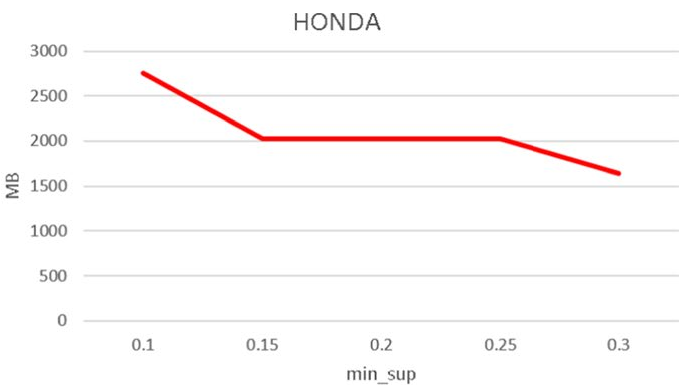
As the minimum support threshold () drops, the number of patterns explodes. EPMiner handles this gracefully, maintaining stable memory usage and execution time.
Pruning Impact
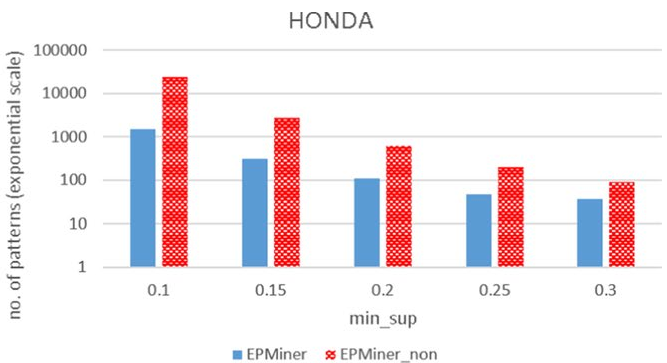
The comparison between EPMiner and EPMiner_non (the version without pruning) is stark. The pruning strategies aren't just minor tweaks; they are the reason the algorithm can process large datasets in reasonable time frames.
Critical Analysis & Conclusion
Takeaway
EPMiner succeeds because it redefines the problem. By treating dynamic networks as interval databases, it leverages mature sequential pattern mining techniques while adding domain-specific temporal logic.
Limitations & Future Work
While EPMiner is excellent for frequent interaction patterns, it might struggle with weighted interactions (e.g., the intensity of a conversation). Future research could integrate edge weights or semantic analysis of the interactions (e.g., sentiment evolution) to provide a richer picture of social dynamics.
In conclusion, EPMiner provides a robust, scalable foundation for anyone looking to go beyond "what" a network looks like, and instead understand "how" it evolves.