
Beyond Binary Cooperation: The Evolution of Threshold-Based Resource Sharing in Social Networks
Evolution of Resource Sharing Cooperation Based on Reciprocity in Social Networks
This paper introduces a Multi-player Donor-Recipient Game with multiple Strategies (MDRGS) to model resource sharing in P2P social networks. It evaluates the evolution of peer contribution using spatial evolutionary game theory, demonstrating that direct and total reciprocity mechanisms can effectively maintain SOTA cooperation levels.
TL;DR
This research moves past the simplistic "share or don't share" model of P2P networks. By introducing a multi-strategy game where peers choose how much to contribute, and applying reciprocity-based rewards, the authors demonstrate how networks can reach a stable state of high cooperation even when faced with "free-riders," slanders, and irrational actors.
Background: The Tragedy of the P2P Commons
In Peer-to-Peer (P2P) social networks, the collective value depends on voluntary contributions—specifically, upload bandwidth. However, for a rational agent, the cost of uploading is real, while the benefits of downloading are often decoupled from their own contribution. This creates a classic social dilemma. Previous research heavily relied on the Prisoner's Dilemma, which limits peers to binary choices. This paper argues that real-world behavior is a spectrum of contribution willingness.
Methodology: MDRGS and Reciprocity Mechanisms
The authors propose the Multi-player Donor-Recipient Game with multiple Strategies (MDRGS).
- Strategy Space: Instead of {0, 1}, peers choose from a set such as {0, 0.2, 0.4, 0.6, 0.8, 1}, representing the percentage of bandwidth they are willing to share.
- Evolutionary Logic: Using the Fermi Rule, peers observe their neighbors' payoffs. If a neighbor is more successful, the peer is likely to imitate that neighbor’s contribution strategy.
The core of the solution lies in two allocation mechanisms:
- Direct Contribution Based Allocation Mechanism (DCAM): You get resources from me based solely on how much you gave to me in the past.
- Total Contribution Based Allocation Mechanism (TCAM): You get resources based on your global reputation (how much you gave to everyone).
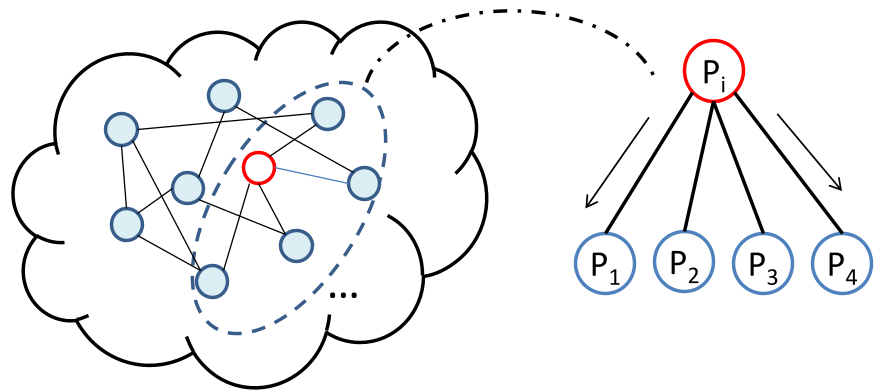 Figure 1: Illustration of a resource transaction where a single donor serves multiple recipients based on their contribution history.
Experiments and Evolutionary Stability
The researchers tested these mechanisms against the Cost-to-Benefit Ratio (R).
- Superiority over Default: Without these mechanisms, cooperation fails if the cost is even 5% of the benefit. With DCAM/TCAM, cooperation persists until the cost reaches nearly 76% of the benefit.
- The "High-Degree" Phenomenon: In TCAM, the study found that peers with many connections (high degree) could survive with slightly lower contribution levels (S0.8) because their sheer volume of transactions kept their reputation and payoff high.
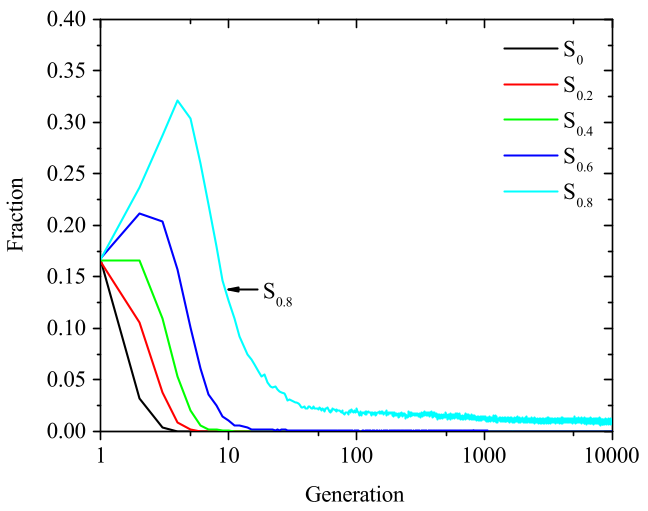 Figure 2: Evolutionary process showing how the 100% contribution strategy (S1) dominates the network over time when the benefit is high (R=0.2).
Resilience Against Attacks
The paper doesn't assume a "clean" environment. It tests:
- Leave-Rejoin Behaviors: Peers trying to "whitewash" their bad reputation by rejoining as new users.
- Slandering: Malicious actors providing false negative feedback about others to hoard bandwidth.
The findings suggest that as long as the inherent benefit of the resource remains high, these reciprocity mechanisms create an "evolutionary pressure" that favors altruism, making it extremely difficult for selfish or malicious strategies to take over the population.
Critical Insight & Conclusion
This work demonstrates that service differentiation is not just a feature—it is a requirement for the survival of decentralized systems. By rewarding contribution levels proportionally, we turn a "social dilemma" into a "coordinated equilibrium."
Future Outlook: While the model is robust, the current study assumes a homogeneous distribution of total bandwidth. Future iterations should explore how "bandwidth-rich" versus "bandwidth-poor" nodes affect evolutionary stability, particularly in mobile-edge computing (MEC) environments where resources are naturally lopsided.