
The Hidden Pulse of Peer Groups: How Depression and Gender Shape Adolescent Friendships
Evolution of Social Networks and Depression for Adolescence
This study investigates the co-evolution of social networks and mental health among 175 high school students using Stochastic Actor-Oriented Models (SIENA). It tracks how friendship ties form and dissolve over three semesters in relation to gender and depressive symptoms measured by the MC-CES-D scale.
TL;DR
Do we choose friends because they look like us, or because they feel like us? This longitudinal study of 175 adolescents reveals a fascinating temporal shift: while gender (a visible trait) dictates who we hang out with from day one, depression (an invisible trait) takes months to surface as a factor for social bonding. Using the SIENA framework, researchers found that "depression homophily"—the tendency to befriend others with similar mental health states—only kicks in during the second semester of high school.
Problem & Motivation: The Transition from Strangers to Friends
Adolescence is a critical window for the onset of depressive disorders. While we know that social support protects mental health, the "chicken and egg" problem remains: does social isolation cause depression, or do depressed individuals struggle to integrate?
The authors argue that friendship formation is an evolutionary process. Strangers first rely on proximity and visible similarities (gender, age) to initiate contact. Only after meaningful interaction do invisible similarities (values, mental health) begin to influence whether a relationship is maintained or dissolved. Previous studies often missed this nuance by looking at snapshots rather than a continuous evolution.
Methodology: Mapping the Social Web
The researchers tracked 93 boys and 82 girls in Taiwan over 10 waves of data collection across three semesters.
- Measurement: They used the Mandarin Chinese version of the Center for Epidemiological Studies-Depression scale (MC-CES-D) to categorize students' mental health.
- Modeling: They employed SIENA (Simulation Investigation for Empirical Network Analysis), a stochastic actor-oriented model. This allows researchers to simulate network changes as a series of individual "micro-steps" where students choose to create, maintain, or drop ties based on:
- Network Structure: Reciprocity (you like me, I like you) and Transitivity (friend of a friend).
- Covariates: Gender (visible) and Depression (invisible).
Note: The model accounts for both "Ego" effects (the actor's tendency to send ties) and "Alter" effects (the actor's popularity).
Results: The Time-Lag of Emotional Similarity
The study's findings provide a clear timeline for social evolution:
- The Gender Dominance: Gender similarity was significant throughout all three semesters. Girls tended to be more active in making friends (higher ego effect), and students overwhelmingly preferred same-sex peers.
- The Delayed Depression Effect: In the first semester, depression had zero impact on who befriended whom. However, by the second semester (Wave 4-5), a significant "depression similarity" effect emerged.
- Network Stabilization: The "Rate Parameter" (the speed of network change) was highest at the start (6.965) and dropped over time, indicating that the social structure was settling.
Key Data Comparison:
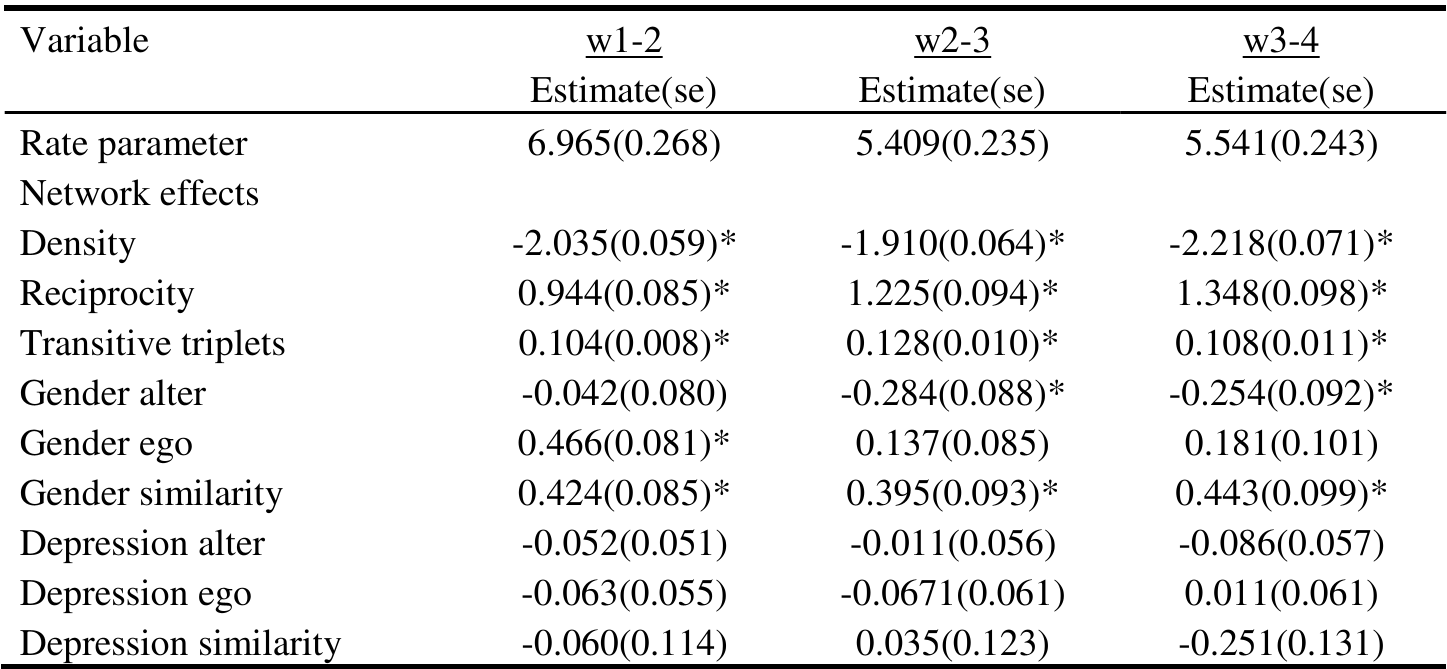 Table: In the first waves (w1-2, w2-3), Depression Similarity estimates are non-significant (p > .05), while Gender Similarity is strongly positive.
Critical Analysis & Deep Insight
Why does Depression take time to matter?
The authors suggest that depressive symptoms are "invisible" during the initial "honeymoon" phase of a new social environment. It is only after the initial barriers of proximity and demographic similarity are crossed that deep-seated psychological states begin to drive social clusters. This supports the Homophily Principle—we are attracted to those similar to us—but adds a temporal constraint: the similarity must be detectable to be actionable.
Limitations
- Sample Specificity: The study was conducted within a specific cultural context (Taiwan) and a relatively small sample (175 students).
- Gender Balance: The class had more boys than girls, which may have influenced the gender-based results.
- The Rejection Hypothesis: The paper touches on the idea that depressed students might eventually face "rejection" from non-depressed peers, leading to a decrease in their social "out-degree," a phenomenon that requires more qualitative investigation.
Conclusion
This research highlights that adolescent social networks are not static entities but evolving organisms. For educators and mental health professionals, the takeaway is vital: social "cliques" based on mental health status do not form overnight. There is a window of a few months where social intervention might prevent the formation of "depressive clusters" before invisible similarities start cementing the network's structure.