
Deciphering the Digital Tribe: How Tagging Practices Shape Social Evolution
Evolution of Social Networks Based on Tagging Practices
This paper explores the evolution of object-centered social networks derived from tagging practices within the PlanetRDF community. It utilizes social network analysis (SNA) to demonstrate how shared interests—mediated through tags—form implicit social structures that emerge and shift over time.
TL;DR
Social networks are not just about who you know, but what you share. This paper investigates the "PlanetRDF" community to show how tagging activities create a hidden, dynamic social structure. By analyzing three years of data, the researchers prove that tags serve as "social objects" that bridge disparate groups, turning a collection of individual bloggers into a tightly-knit, "small-world" network.
Beyond the Friend Request: Object-Centered Sociality
In the early days of Web 2.0, social networks were often defined by explicit links: "User A is friends with User B." However, the authors argue that this ego-centered view misses the point of most online interactions. Real sociality often happens around objects—a photo on Flickr, a video on YouTube, or a tag on a blog post.
This is called Object-Centered Sociality. The challenge lies in the heterogeneity of these objects. How do you find common ground across different sites? The answer lies in Tags. Tags are low-cost, free-text keywords that represent a user's interest. The paper's core hypothesis is that we can map the "hidden structure" of a community simply by looking at how users share these tags.
Methodology: Mapping the Folksonomy
The researchers collected RSS feed data from PlanetRDF (a hub for Semantic Web enthusiasts) from 2004 to 2008. To understand the evolution, they transformed the data into two types of networks:
- Two-Mode Networks: Connections between two different entities (Users and Tags).
- One-Mode Networks: Connections between users who share the same tags.
They focused on two critical metrics:
- Degree Centrality: Identifying the "power players" or the most popular tags.
- Betweenness Centrality: Identifying the "brokers"—the users or tags that act as bridges between different sub-communities.
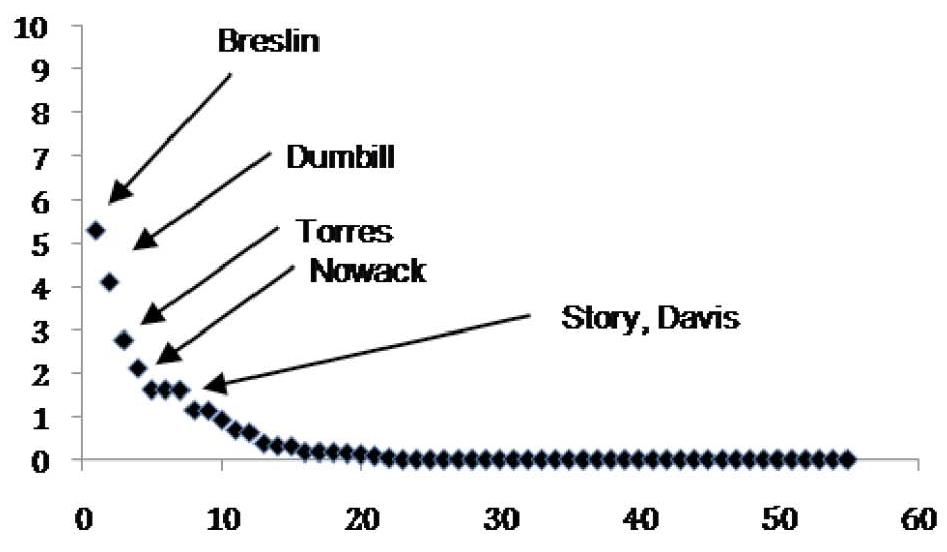 Fig 1: Principal component layout showing how users cluster based on tagging practices in different periods.
The Evolution: From Chaos to Community
The findings suggest a clear maturation of the digital community:
- 2006 (The Early Phase): Tagging was sparse and inconsistent. The network was fragmented, and tags were often "general" or unrelated to the core mission (e.g., "bicycle", "work").
- 2007 (The Surge): As social software like Twitter gained traction, the community began using more specialized, domain-specific tags like "Web 2.0" and "Social Software."
- 2008 (The Maturation): The network reached a "Small-World" state. The Clustering Coefficient (CG) shot up from 11.51 to 58.31, meaning users were much more interconnected than before.
 Table 1: The quantitative evidence of network densification—notice the dramatic rise in CG and Density ().
The "Broker" Effect: Bridging Tags
One of the most profound insights is the role of Bridging Tags. While defining tags (like "Semantic Web") stay within a cluster, bridging tags (like "RDF" or "FOAF") connect different clusters together.
The authors observed that certain users, such as John Breslin or Dan Brickley, consistently held high betweenness centrality. These individuals weren't just active; they were the "connective tissue" of the community, using tags that appealed to multiple sub-interest groups simultaneously.
Critical Insight & Future Outlook
This paper proves that tagging is not just an organizational tool; it is a social one. It creates a dynamic record of a community's "collective intelligence" and changing interests.
Limitations: The study is limited to a small, highly technical community (PlanetRDF). How these dynamics play out in massive, diverse platforms like X (formerly Twitter) or Reddit—where "tagging" is less formal and more ephemeral—remains a frontier for further research.
Future Work: The authors suggest using Semantic Web ontologies to make these implicit relationships explicit. By standardizing how tags are represented, machines can automatically discover "hidden friends" based on shared tagging behaviors, potentially revolutionizing how recommendation engines work.
Key Takeaway: If you want to understand a community, don't just look at who they talk to—look at the keywords they use to describe their world.