
The Evolution of Social Power: Why Your Influence Depends on Others, Not Your Ego
6898_Evolution of Social Power in Social Networks With Dynamic Topology.
This paper provides a rigorous mathematical analysis of the DeGroot–Friedkin model, extending it to social networks with dynamic topologies. Using nonlinear contraction analysis, the authors prove that individual social power exponentially converges to a unique trajectory, significantly advancing previous asymptotic convergence results.
TL;DR
In a world of constant discussion, how much power do you actually hold? This paper explores the DeGroot–Friedkin model, proving that in any social network—even those where relationships change over time—your "perceived" social power is eventually forgotten at an exponential rate. Your long-term influence is not determined by how much you believe in yourself (initial self-weight), but strictly by the topology of the network (how much others trust you).
The "Looking Glass Self": Problem & Motivation
The paper builds on the sociological concept of the "looking glass self"—the idea that our self-image and self-confidence are reflections of how much influence we observe ourselves having on others.
The DeGroot–Friedkin model formalizes this:
- Opinion Discussion: A group discusses an issue until they reach a consensus.
- Self-Appraisal: Individuals look at the final consensus and see how much they contributed to it.
- Power Update: For the next issue, individuals update their self-confidence based on that previous contribution.
The Gap: Previous studies assumed social ties were static. But in reality, trust fluctuates. If I'm an expert on defense but a novice on social security, my influence should shift depending on the topic. The authors sought to prove that even with these shifts, the system remains stable and predictable.
Methodology: The Geometry of Influence
To tackle dynamic topologies, the authors moved beyond standard stability proofs to Nonlinear Contraction Analysis.
1. The Interaction Matrix
The core of the model is the influence matrix : Where is the self-weight (social power) and is the relative interaction matrix (trust).
2. Nonlinear Contraction
The brilliant insight here is the use of a transformed Jacobian. By defining a virtual displacement through a transformation matrix , the authors linearized the complex, issue-varying dynamics. They proved that the system "contracts" towards a unique trajectory.
 Figure 1: The mathematical framework for social power evolution (Conceptual).
Key Results: Forgetting Your Ego
The most striking finding is the Exponential Forgetting Property.
- Independence of Initial Conditions: Whether you start with 99% self-confidence or 1%, if the network doesn't trust you, you will lose power at an exponential rate.
- The Bound of Power: For any individual , their equilibrium social power is strictly bounded by the network's structure: , where is their centrality in the trust graph.
- Dynamic Stability: In a switching network, social power doesn't settle at a point but follows a unique "limiting trajectory."
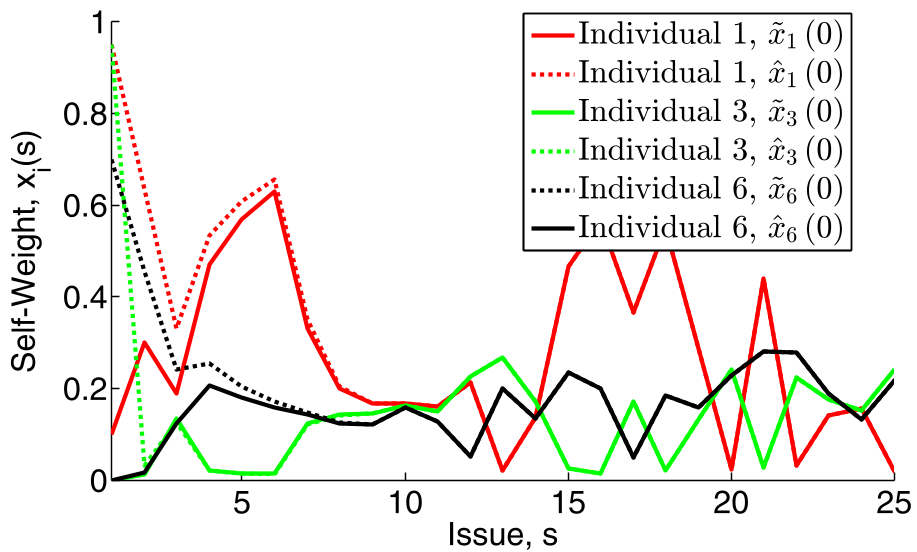 Figure 2: This simulation shows how different initial self-estimates (solid vs. dotted lines) converge to exactly the same power trajectory after just 10 issues.
Critical Insight: The Network is Self-Regulating
This research highlights a "self-regulating" mechanism in human groups. If we iterate through enough topics, the "arrogant" (those with high initial ) and the "humble" (those with low initial ) are leveled by the reality of their interpersonal influence.
Limitations & Future Work
While the math is robust, the model assumes strongly connected graphs—meaning everyone can eventually influence everyone else. Future research needs to address:
- Stubborn Individuals: What happens if some people never change their opinions?
- Antagonism: How do negative relationships (distrust) affect social power?
- Reducible Topologies: What happens in "echo chambers" where influence doesn't flow through the whole group?
Conclusion
Social power isn't something you have; it's something the network gives you. By proving that internal self-appraisal combined with sequential discussion leads to an exponential alignment with external reality, this paper provides a powerful control-theoretic foundation for sociological phenomena.