
The Physics of Influence: How Social Networks Systematically "Reset" Your Power
16673_Evolution of Social Power in Social Networks With Dynamic Topology.
This paper investigates the DeGroot–Friedkin model for the evolution of social power across sequential issues in a social network. Using nonlinear contraction analysis, the authors prove exponential convergence of social power and extend the model from constant to dynamic network topologies.
TL;DR
In any group discussion—from corporate boards to government cabinets—how much influence you have changes over time. This paper rigorously proves that your long-term social power is purely a function of your network position, not your initial confidence. By applying nonlinear contraction analysis, the authors show that social networks exponentially "forget" an individual's initial perceived power, self-regulating toward a state defined strictly by interpersonal trust.
The "Looking Glass Self" in Mathematics
The DeGroot–Friedkin model is built on a fascinating sociological premise: the reflected appraisal. After a group reaches a consensus on an issue, you look back and realize how much you actually influenced that outcome. If you were the primary driver, your self-confidence (social power) for the next issue increases.
However, previous studies couldn't quite prove how fast this reached a steady state, nor could they handle "dynamic topologies"—real-world scenarios where trust between members changes depending on the topic (e.g., trusting a general on defense, but not on economics).
The Breakthrough: Why Non-Autocracy is Built-In
The authors leverage Nonlinear Contraction Analysis to solve a long-standing conjecture. By transforming the virtual dynamics of the system, they prove that the social power vector is pulled toward a unique equilibrium at an exponential rate.
One of the most profound insights is the instability of autocracy. Unless a network is a perfect "Star Topology" (where one person is the sole hub for all communication), a single person holding 100% of the power is a mathematically unstable state. In a strongly connected network, power naturally redistributes.
 The DeGroot-Friedkin model loop: Opinion Discussion (Issue s) -> Reflected Appraisal -> Updated Social Power -> Next Discussion (Issue s+1).
Methodology: The Math of Forgetting
The core innovation lies in the Jacobian of the self-appraisal map. The authors show that the transformation ( \delta z_s = ext{diag}(\frac{1}{1-x_i(s)}) \delta x_s ) turns the complex social power update into a weighted Laplacian system.
Key findings include:
- Self-Regulation: Even if an arrogant individual starts with 99% perceived power, if the network topology doesn't support that influence, their power will decay exponentially.
- Dynamic Environments: In networks where relationships switch between issues, social power doesn't settle at a point but follows a unique limiting trajectory.
Experimental Evidence: The Convergence
The simulations validate that regardless of where you start (high perceived power or low), the network topology eventually forces you into a specific role.
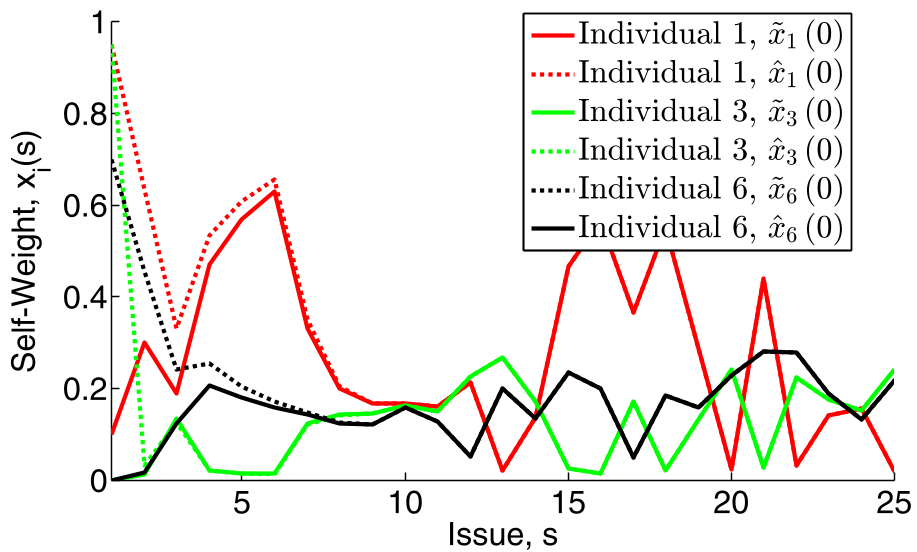 Comparison of social power evolution for individuals with different starting perceived powers (( \hat{x} ) vs ( ilde{x} )). Both sets converge to the same trajectory rapidly.
Critical Insight & Future Outlook
While this paper is a tour de force in systems theory, it operates under the "Strongly Connected" assumption. In the real world, social networks can be fractured or contain "stubborn" individuals who never change their minds.
The takeaway for engineers and sociologists alike is clear: Network structure is destiny. If you want to increase your long-term influence, don't just "act" confident; move into a network position where more people rely on your input to reach their own conclusions.
Conclusion
This work elevates the DeGroot-Friedkin model from a theoretical curiosity to a robust tool for predicting influence. By proving exponential convergence, the authors provide the mathematical guarantee that social systems are inherently designed to wash away initial biases and settle on the "truth" of the underlying relationship graph.