
From Handcrafted Audio to Self-Supervised Latents: The Evolution of Speech Emotion Recognition
17850_On the Evolution of Speech Representations for Affective Computing A brief history and critical overview.
This paper provides a critical evolution of speech representations for Affective Computing, tracing the journey from handcrafted acoustic features (GeMAPS, MFCCs) to modern Deep Representation Learning. It highlights the paradigm shift toward Self-Supervised Learning (SSL) and multimodal fusion as the primary means to overcome data scarcity and poor generalization in automatic emotion recognition.
TL;DR
The field of Affective Computing is moving away from human-engineered features like MFCCs and toward Deep Representation Learning. By leveraging vast amounts of unlabeled data through Self-Supervised Learning (SSL), researchers are finally overcoming the chronic shortage of labeled emotional datasets, creating models that generalize better across different languages, ages, and speakers.
The "Subjectivity Trap" in Affective Computing
For decades, researchers relied on "usual suspects" like pitch, energy, and Mel-frequency cepstral coefficients (MFCCs). However, these handcrafted features are limited by our narrow understanding of how humans actually perceive emotion.
The rise of Deep Learning introduced End-to-End (E2E) systems, but they hit a wall: Emotion labeling is expensive and subjective. Unlike Transcribing text (where "apple" is objectively "apple"), two annotators might hear the same voice and disagree on whether it sounds "frustrated" or just "tired." E2E models trained on small, noisy datasets struggle to generalize to the "real world."
Methodology: The Shift to Unsupervised Learning
To solve the data scarcity problem, the industry is pivoting toward Unsupervised and Self-Supervised Learning. The core idea is to let the model learn the "grammar" of speech from thousands of hours of unlabeled audio before ever showing it an emotion label.
1. Autoencoders and VAEs
These models learn to compress speech into a "Latent Space" and then reconstruct it. By doing so, they capture the most essential patterns of the signal.
- VAEs (Variational Autoencoders): Enforce a probabilistic structure on the latent space, making it more robust.
- AAEs (Adversarial Autoencoders): Use a GAN-style discriminator to ensure the latent representation follows a specific distribution.
2. Self-Supervised Learning (SSL) - The Current Frontier
SSL models like wav2vec or Autoregressive Predictive Coding (APC) use auxiliary tasks, such as predicting the next audio frame or masking parts of the signal. This forces the model to understand long-term context and high-level acoustic structures.
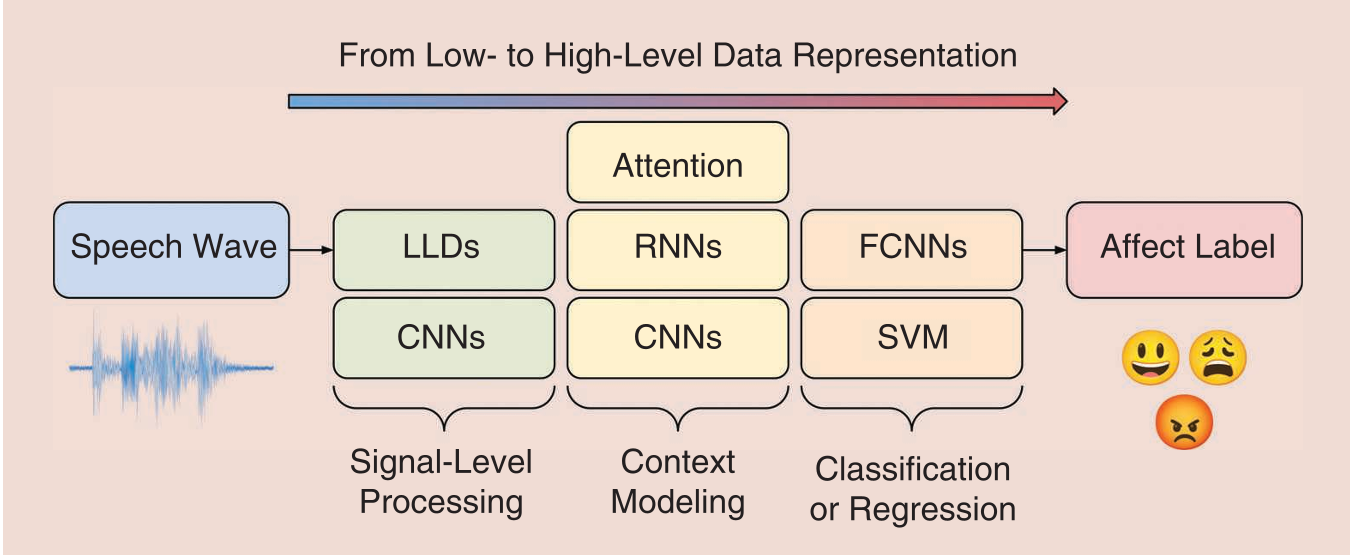 Figure 1: The pipeline from raw waveform to emotion labels across different architectures.
Experiments: Breaking the SOTA
The paper analyzes years of data from the RECOLA dataset and the ComParE/AVEC challenges. Two major trends emerge:
- Transfer Learning Works: Using "Deep Spectrum" features—treating audio spectrograms like images and processing them with pre-trained Computer Vision models (like ResNet)—often beats specialized acoustic sets.
- Multimodal Fusion is Mandatory: Emotion isn't just how you say it (Acoustics), but what you say (Linguistics). Fusing SSL speech embeddings with text embeddings (like BERT) leads to massive gains, particularly in the Valence (positive vs. negative) dimension.
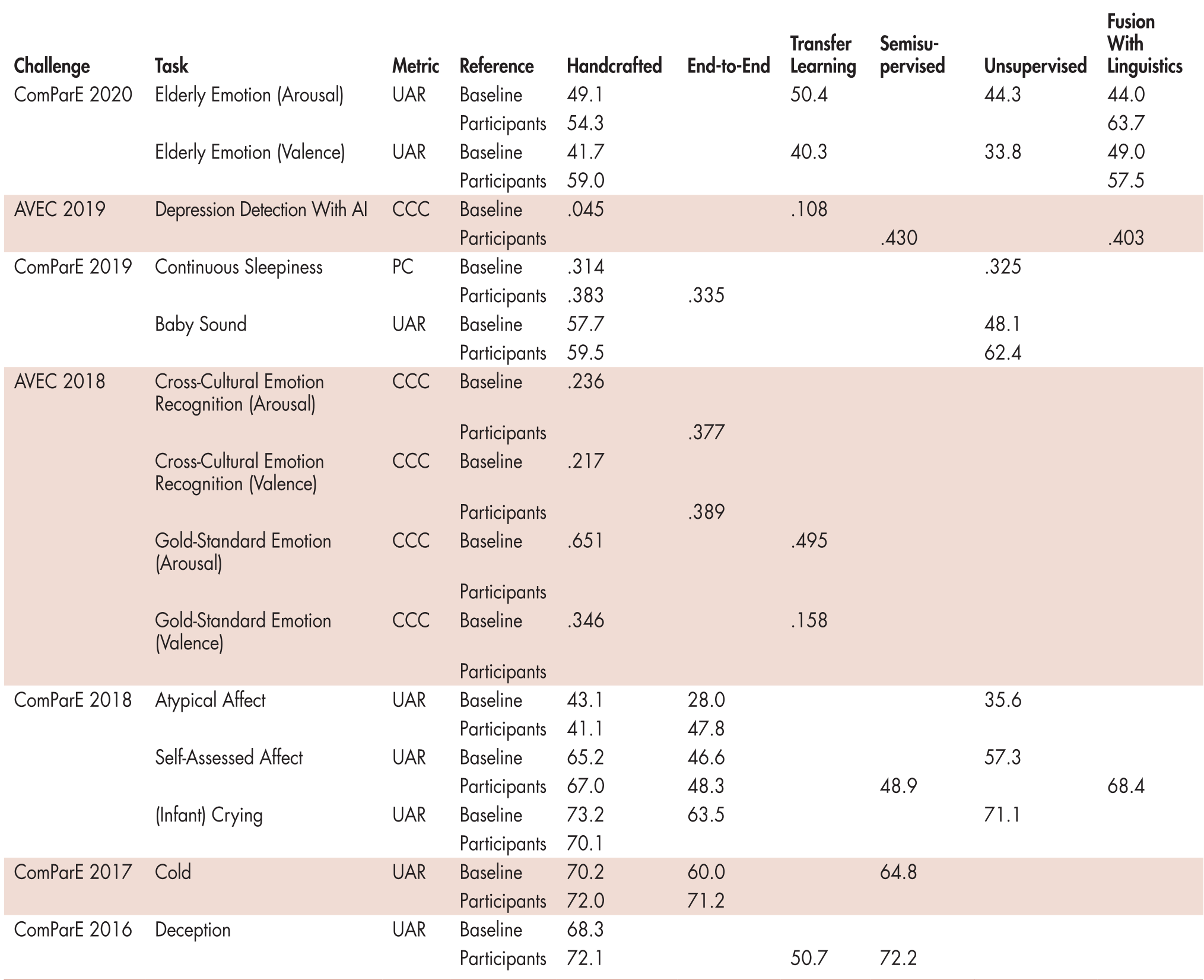 Table 1: Performance of various representations across major Affective Computing challenges (2016-2020).
Conclusion & Future Outlook
The gap between human and machine perception of emotion is narrowing. The author concludes that while handcrafted features are still useful for explainability (we know what "pitch" means, but we don't always know what a "latent vector" means), the raw power of Self-Supervised Learning is undeniable.
The Takeaway: Future Affective systems won't be built on bigger labeled datasets, but on smarter unsupervised pre-training that captures the universal "physics" of human speech.
Critical Reflection
While SSL represents a breakthrough, the paper rightly points out a lingering issue: Explainability. As we move toward black-box deep representations, we lose the ability to tell a user why a system thinks they sound depressed. Future research must bridge the gap between high-performance SSL latents and interpretable acoustic parameters.