
[arXiv 2025] EGGROLL: Scaling Evolution Strategies to the Billion-Parameter Frontier
Evolution Strategies at the Hyperscale
The paper introduces EGGROLL (Evolution Guided GeneRal Optimisation via Low-rank Learning), a novel Evolution Strategies (ES) framework that utilizes rank-r matrix perturbations to solve scalability bottlenecks on GPUs. It enables efficient training of billion-parameter models, achieving up to 91% of pure batch inference throughput.
TL;DR
Evolution Strategies (ES) have long been the "black sheep" of deep learning—theoretically elegant for non-differentiable objectives but practically too slow for modern GPUs. EGGROLL changes this by refactorizing perturbations into low-rank matrices. By increasing arithmetic intensity, EGGROLL allows ES to train billion-parameter models at speeds nearly equal to pure inference, even enabling the pretraining of pure integer-only (int8) neural networks.
The Bottleneck: Why ES Failed to Scale
The central challenge of Evolution Strategies on GPUs isn't just the memory footprint of the population; it's arithmetic intensity. In standard backpropagation, we benefit from highly optimized GEMM (General Matrix Multiply) operations. In naïve ES, adding unstructured noise to a weight matrix for population members creates different matrices. Calculating for a batch of inputs results in a series of matrix-vector products that are memory-bound, not compute-bound.
As models hit the billion-parameter mark, the ratio of operations to memory traffic (arithmetic intensity) drops so low that the GPU spends all its time moving data rather than calculating gradients.
Methodology: The Low-Rank Insight
The authors introduce EGGROLL (Evolution Guided GeneRal Optimisation via Low-rank Learning). Instead of sampling a full-rank noise matrix , they sample two low-rank matrices and and define the perturbation as:
1. Hardware-Efficient Forward Pass
This decomposition allows the forward pass for a layer to be rewritten: The term is a standard, efficient matrix multiply shared across the whole population. The second term is a cheap, low-rank update. This allows EGGROLL to saturate GPU compute even with millions of unique perturbations.
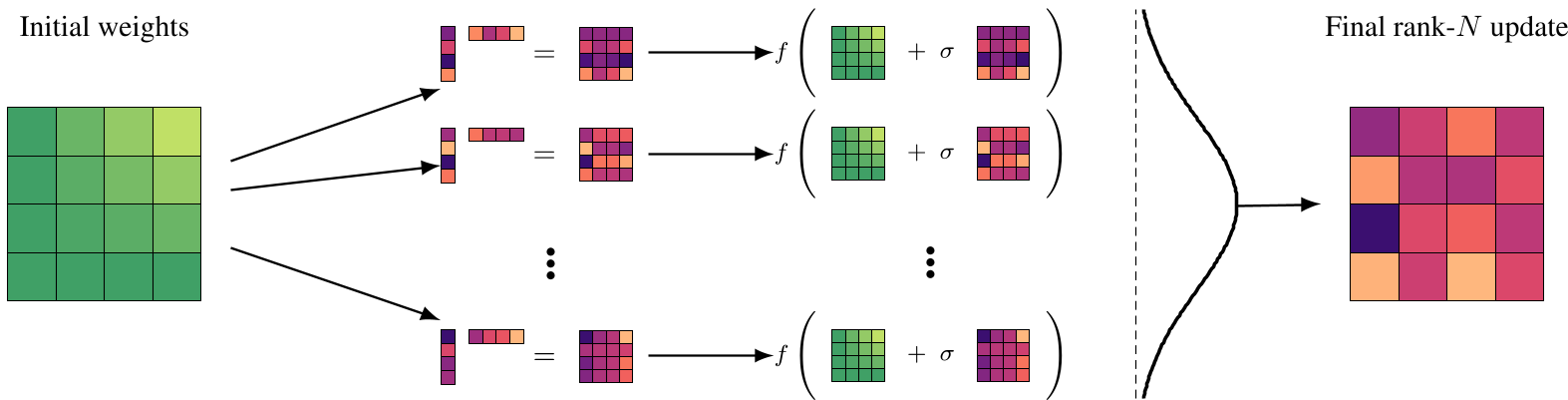 Figure 1: Comparison of hardware-efficient low-rank perturbations vs. naïve full-rank ES.
2. Full-Rank Updates from Low-Rank Noise
A common misconception might be that EGGROLL restricts the model's learning to a low-rank subspace (like LoRA). However, because the final parameter update is a weighted sum of different low-rank matrices, the resulting update is rank . With large population sizes (), the updates remain effectively full-rank.
Theoretical Rigor: Linearization in High Dimensions
The paper provides a profound theoretical analysis of why ES works in high-dimensional spaces. They prove a "Linearization Theorem": as the parameter dimension , the Gaussian ES update converges to the first-order derivative , provided the noise scales at a critical rate of .
This bridges the gap between zeroth-order "black-box" optimization and the Neural Tangent Kernel (NTK) regime of standard deep learning, explaining why EGGROLL can pretrain models despite only seeing scalar rewards.
Experimental Breakthroughs
1. The Integer-Only Language Model (EGG)
Perhaps the most radical result is the EGG architecture. Since ES doesn't require backpropagation, we don't need differentiable activation functions or high-precision floats. The authors trained a nonlinear RNN using pure int8 datatypes (no explicit activations, relying on integer clipping).
- Result: The EGG model pretrained with EGGROLL achieved 3.40 bits/byte, actually outperforming a float32 Transformer trained with SGD on the same data.
2. LLM Reasoning & Fine-tuning
EGGROLL was tested on fine-tuning RWKV-7 and Qwen models for reasoning (GSM8K, AIME).
- Performance: In the "Countdown" task, EGGROLL reached 35% accuracy compared to 23% for GRPO (a popular RL alignment method) given the same wall-clock time.
- Pass@K Optimization: Because EGGROLL is a black-box optimizer, it can directly maximize pass@k—a non-differentiable metric that standard RL often struggles to optimize directly.
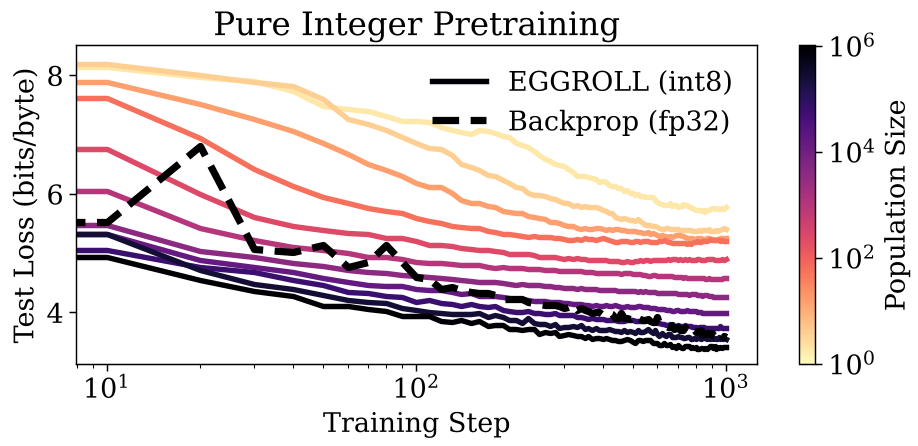 Figure 2: Throughput and test loss for the EGG integer-only model across population sizes.
Critical Analysis & Outlook
Strengths:
- Hardware Alignment: It turns a memory-bound problem into a compute-bound one.
- Flexibility: Opens the door for non-differentiable neurosymbolic systems and hardware-native (bit-level) training.
Limitations:
- Compute Cost: While throughput is high, ES typically requires significantly more total FLOPS/samples than backprop to reach the same loss in standard supervised settings (though it excels where gradients are noisy or unavailable).
- Hyperparameter Sensitivity: The noise scale remains a critical hyperparameter that requires careful tuning as the model scales.
Takeaway
EGGROLL is a "hyperscale" reset for Evolution Strategies. By making ES as fast as inference, the authors have provided a viable pathway to train the next generation of non-differentiable and low-precision AI models.