
Deciphering the Hidden Patterns of Mobile Social Networks: A Topological Evolution Study
Analysis on Evolution and Topological Features of a Real Mobile Social Network
This paper presents a comprehensive analysis of the evolution and topological features of a real-world Mobile Social Network (MSN) using a dataset from a university’s XMPP-based chatting software. The study identifies that MSNs are typical scale-free, small-world networks that evolve toward structural stability and full connectivity over time.
TL;DR
By analyzing real-world chatting data from a university environment, researchers have mapped how Mobile Social Networks (MSNs) grow and organize. The study reveals that MSNs are not just random connections but highly structured "Small-World" and "Scale-Free" systems where most users are connected by fewer than three hops, and a small elite of "hubs" facilitates most of the communication.
Context: Why Static Analysis Isn't Enough
As mobile devices become our primary interfaces for social interaction, the resulting networks have moved into the realm of "Big Data." Traditional social network analysis (SNA) often treats these networks as static snapshots. However, MSNs are living entities—they grow, prune, and reorganize daily. Understanding this evolution is crucial for network operators who need to optimize traffic, allocate bandwidth, and design more efficient communication protocols.
Evolution: From Chaos to Connectivity
The researchers analyzed the network over a four-week span. Their findings suggest a fascinating lifecycle:
- Rapid Expansion: In the early stages, the network grows exponentially as new users join and form connections at an accelerated rate.
- Convergence: Over time, the rate of new user entry slows, and the network structure stabilizes.
- Global Connectivity: As the network matures, it shifts from isolated clusters to a single "Largest Connected Sub-graph," eventually tending toward a state where every node can reach any other node.
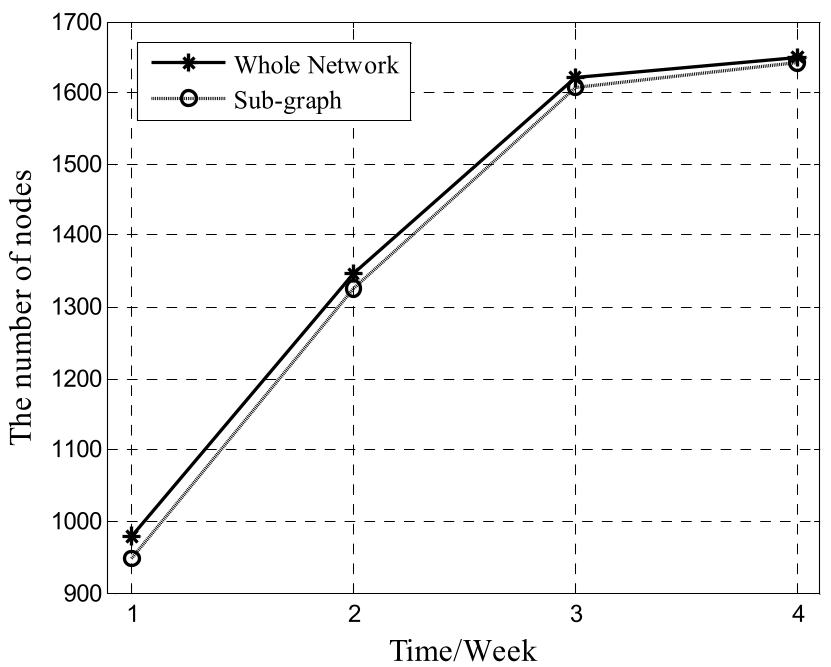 Fig 1: The growth of the network shows that the largest connected component (sub-graph) quickly evolves to encompass nearly the entire user base.
Methodology: The Architecture of Human Interaction
The paper employs four heavy-hitting metrics to define the "shape" of the MSN:
1. The Scale-Free Phenomenon (Degree Distribution)
Does everyone have the same number of friends? Decidedly no. The study confirms that MSNs follow a Power-Law Distribution. Most users have very few connections, while a small percentage of "hubs" have hundreds. This makes the network robust against random failures but vulnerable to targeted disruptions of these hubs.
2. The Small-World Effect (Distance)
With an average path length of just 2.99 and a diameter of 8, the network is incredibly "tight." This is significantly more compact than the classic "six degrees" theory suggests for global populations.
3. Importance Metrics (Closeness & Betweenness)
- Closeness Centrality: Measures how "near" a node is to all other nodes. High closeness usually means faster information reception.
- Betweenness: Measures a node's role as a "bridge." Interestingly, the study found that even some nodes with low degrees (few friends) have high betweenness—these are the vital connectors linking different social communities.
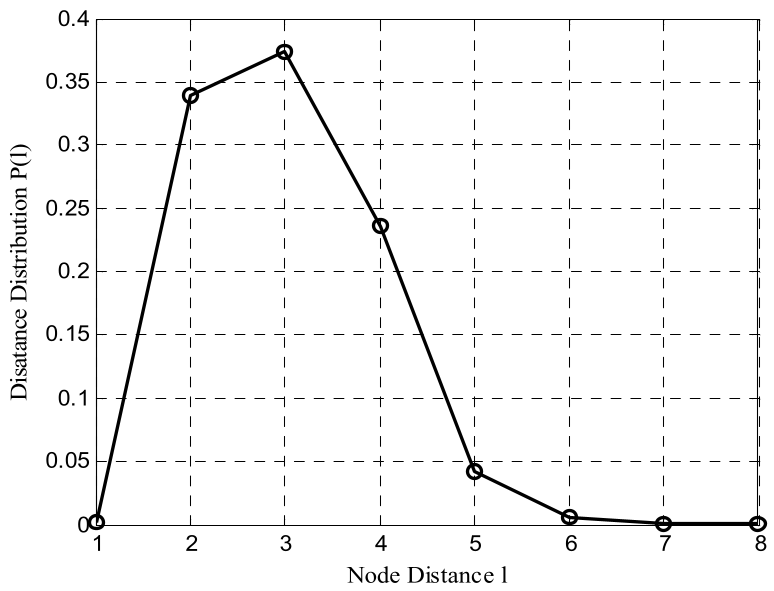 Fig 2: The straight line on the log-log scale confirms that the degree distribution follows a power law.
Deep Insights: Hubs and Bridges
One of the most valuable findings from this study is the relationship between node degree and betweenness. While they are generally positively correlated, the "bridge" nodes—influential users who connect disparate groups—are the secret sauce of the network's efficiency.
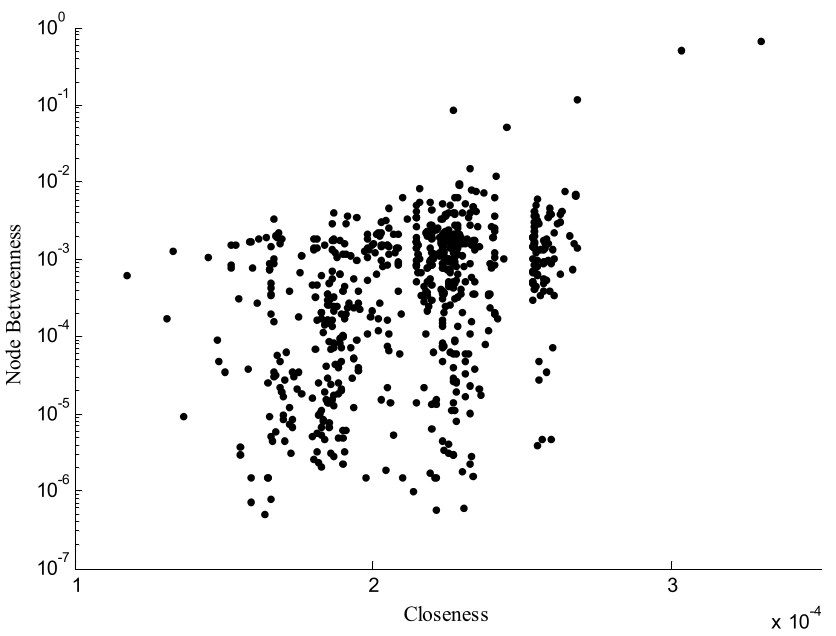 Fig 3: The correlation between betweenness and closeness reveals that the central core of the network is extremely tightly knit.
Conclusion & Future Impact
This research provides a mathematical foundation for understanding how mobile communication software shapes human interaction. By identifying that these networks are Scale-Free and Small-World, the authors pave the way for:
- Optimized Routing: Prioritizing "hub" nodes for message relay.
- Infection Control: Using topogical insights to stop the spread of mobile malware.
- Resource Allocation: Dynamically shifting bandwidth to highly central nodes during peak hours.
While the current study focuses on a university setting, its methodology is highly scalable to larger, more diverse mobile datasets.