
The Social Glue: How Community Density Prevented the MySpace Exodus
Evolution of User Activity and Community Formation in an Online Social Network
This paper presents an empirical longitudinal study of MySpace, analyzing user population evolution and activity levels using 1 million randomly sampled profiles. It utilizes local community detection algorithms—specifically Fortunato et al. and Clique Percolation—to reveal that social community membership is a primary factor in preventing user churn.
TL;DR
MySpace served as a massive laboratory for the first era of social media. This study analyzes 1 million profiles using local community detection (Fortunato and Clique Percolation) to prove a critical sociological point: user activity is contagious. While "Tourists" abandon platforms quickly, users embedded in dense cliques stay active together, creating a synchronized "social heartbeat" that resists network decay.
Background: The Hidden Decline of Social Giants
When an Online Social Network (OSN) begins to fail, the signals are often obscured by the noise of new sign-ups. In 2011, MySpace was facing a decline, yet was still gaining ~348,000 new accounts daily. The authors of this paper argue that to understand the true "health" of a network, you must look past population counts and into the local community structure.
Problem & Motivation: Why Do People Leave?
Traditional research often views social networks as static monoliths. However, users don't perceive the "whole" network; they perceive their immediate circle. The researchers identified a major pain point: existing global clustering methods were too computationally heavy for real-world OSNs and failed to capture the local dynamics that drive user retention. They hypothesized that activity synchronization within a community is the primary indicator of whether a user will stay or migrate to a competitor.
Methodology: Hunting for Clusters
The researchers used two distinct "local" algorithms to find communities without needing the full system graph—a necessity in the age of private APIs.
- Fortunato et al. Algorithm: Grows a community from a "seed" node by maximizing a fitness function based on the ratio of internal to external links.
- Clique Percolation: Defines a community as a series of overlapping -cliques (fully connected subgraphs).
Architecture of Discovery
These methods are "local" because they expand outward from a single node, making them resilient to the massive, dynamic scale of MySpace.
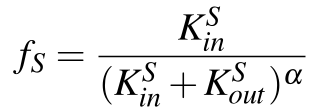 The fitness function used in the Fortunato algorithm to determine community boundaries.
Experiments & Results: The Synchronized Heartbeat
The study successfully identified hundreds of communities and uncovered three striking patterns:
- The Invalid Overhaul: As user IDs increased (representing newer accounts), the proportion of "Invalid" (deleted/banned) profiles actually surpassed "Private" and "Public" profiles. MySpace was becoming a "Ghost Town" of abandoned accounts.
- Activity Correlation: In over 97% of detected communities, the "Last Login" dates of members were remarkably close (standard deviation < 10 days). If your friends log in, you log in.
- The Tourist Exclusion: Users known as "Tourists" (active for <10 days) were almost never found in communities. Without community "glue," there was nothing to prevent them from bouncing off the platform.
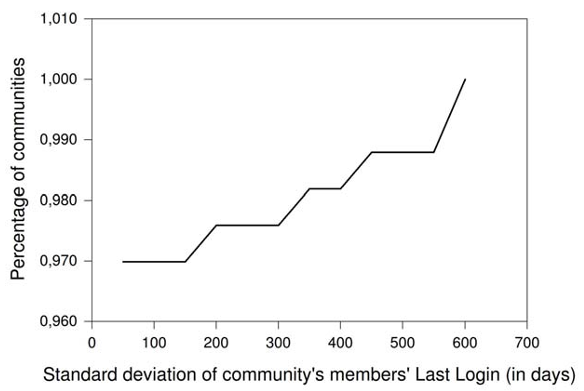 Experimental Results: Comparing Fortunato vs. Clique Percolation in terms of community size and density.
Deep Insight: Is Community Membership a Shield?
The most profound takeaway is that local density inhibits abandonment. Even as MySpace lost its crown to Facebook, users within high-density communities (especially those found via the Fortunato method with a density of 0.80) remained active.
Limitations & Future Outlook
While the study confirms the power of communities, it relies on HTTP scraping which is now largely blocked by modern OSNs (like Instagram or X). The next frontier for this research is applying these local detection insights to "decentralized" social networks where community formation is the only structure that exists.
Conclusion
Don't look at the total user count; look at the cliques. This paper teaches us that the survival of a digital space depends on the strength of its smallest, densest circles. If you want to keep users, you shouldn't just help them make friends—you must help them form communities.