
Beyond Greedy: Turbocharging Influence Maximization with Evolutionary GPGPU
6131_Evolutionary algorithm for seed selection in social influence process.
This paper introduces a GPGPU-accelerated Evolutionary Algorithm (EA) for the Influence Maximization (IM) problem under the Linear Threshold model. By framing seed selection as a genetic optimization task, the method consistently outperforms the traditional Greedy algorithm in both finding larger influence spreads (up to 16% improvement) and achieving significantly higher computational efficiency (up to 35x faster).
TL;DR
Influence Maximization (IM)—the art of picking the most influential "seeds" in a social network—has long been dominated by the Greedy algorithm. However, this paper demonstrates that a Genetic Algorithm (GA) accelerated by GPGPU can shatter the performance of Greedy heuristics. It achieves up to 16% higher influence quality and runs up to 35 times faster, proving that considering the "joint influence" of node sets is far superior to picking nodes one by one.
The "Greedy" Trap: Why Sequential Selection Fails
Most practitioners rely on the Greedy algorithm because it offers a proven theoretical floor. But Greedy has a fundamental flaw: it is short-sighted. It picks the single best node at each step, ignoring potential "synergistic pairs"—nodes that might be weak individually but trigger massive cascades when combined.
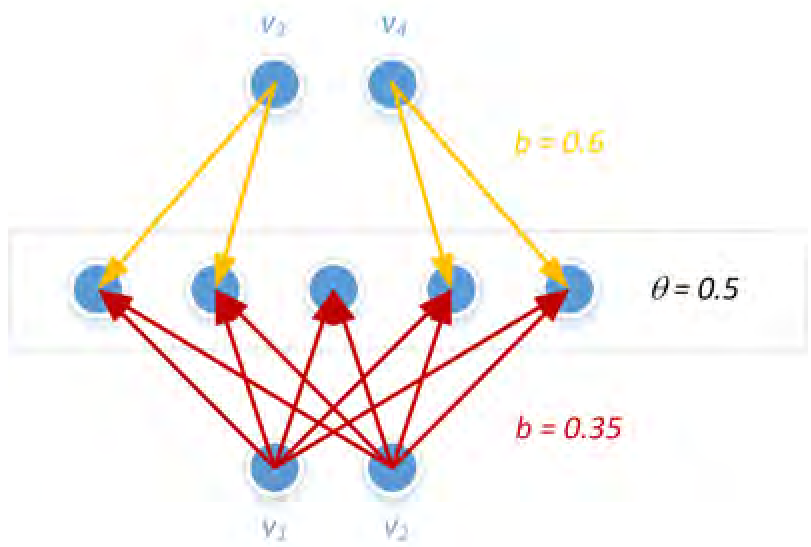 In the figure above, Greedy picks v3 and v4 for a local win, missing the global optimum of v1 and v2 which, combined, activate a larger portion of the network.
Methodology: The Genetic Approach
The authors reframe IM as a survival-of-the-fittest challenge. Instead of adding nodes sequentially, they maintain a population of potential seed sets.
1. The Evolutionary Loop
- Population Initialization: Sets of random seed nodes are generated.
- Fitness Function: Measured as the number of nodes activated under the Linear Threshold (LT) model.
- Crossover & Mutation: The "genetic material" (seed nodes) is swapped and mutated. Crucially, the authors found that high-frequency, low-potency mutation (Mutation Factor 0.9, Potency 0.01) prevents the algorithm from getting stuck in local optima.
2. GPGPU Acceleration
The Linear Threshold model is computationally heavy due to its iterative nature. By using CUDA, the authors treated the network as an adjacency matrix, allowing the GPU to evaluate the influence spread of an entire population of candidates in parallel.
Evidence of Superiority
The researchers tested their approach on three real-world datasets: UC Irvine messages, Digg, and Facebook wall posts.
Performance Gain (Quality)
When given the same budget of time, the Evolutionary Algorithm (EA) consistently matched or exceeded Greedy's spread.
- Result: In the Digg dataset, EA outperformed Greedy by 16%.
- Insight: This confirms that EA's non-deterministic nature allows it to find global optima that Greedy misses.
Computational Efficiency (Speed)
The most striking result is the scaling.
- Speedup: EA was found to be 1.4x to 35x faster than Greedy when aiming for the same influence target.
- Scaling: As network size increases, the gap between EA and Greedy widens, with EA showing much better scalability.
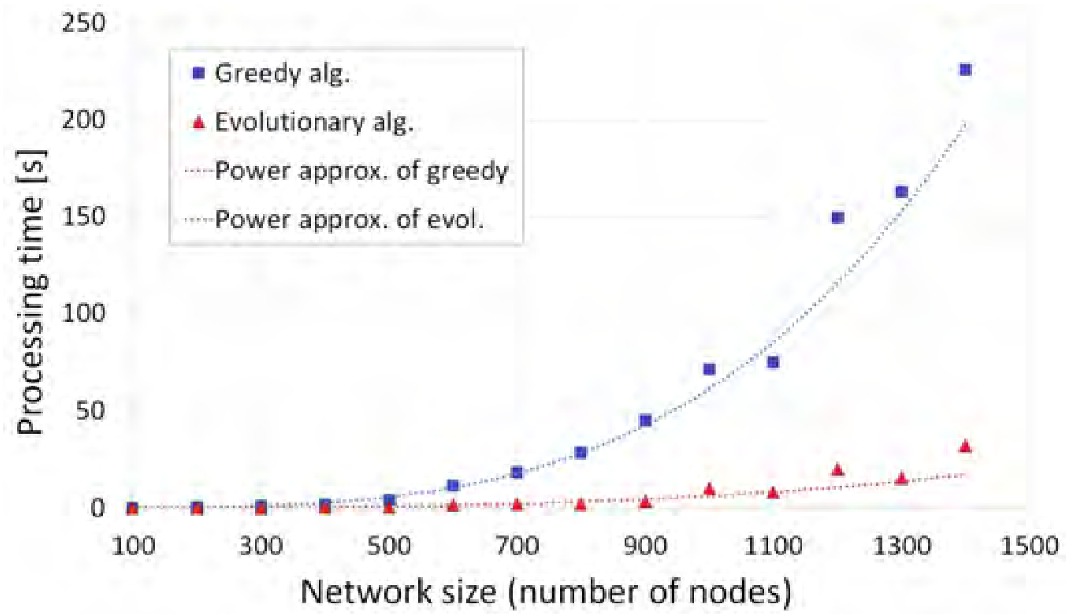 Fig: Comparison of processing time on the Digg dataset shows EA maintaining a much flatter growth curve compared to Greedy.
Critical Analysis & The Memory Wall
While the EA is a clear winner in speed and quality, it hits a "Physical Wall": GPU VRAM. Currently, the network size is limited by what can fit on a single graphic card's memory (e.g., 4GB in their test setup).
Future Outlook: The authors suggest moving toward Compressed Sparse Row (CSR) techniques to handle larger matrices. This work effectively signals the end of the "Greedy-only" era for practical IM applications, suggesting that in time-sensitive marketing or social engineering, evolutionary heuristics are the new SOTA.
Takeaway for Researchers
If you are building influence models, stop evaluating nodes in isolation. The synergy between individuals is the key to global influence, and the combination of Evolutionary Strategies + GPGPU is currently the most efficient way to capture that synergy.