
Evolutionary Rewiring: Using AI to Solve the Green Revolution's Nitrogen Dilemma
Evolutionary Assembly and Future Design of Gibberellin Signaling(科研通-ablesci.com)
This perspective paper delineates the evolutionary assembly of the Gibberellin (GA) signaling pathway, moving from ancestral DELLA-mediated growth repression to the modern GA–GID1–DELLA module. It highlights how AI-driven protein design (e.g., AlphaFold, ESM, RFdiffusion) can now be used to decouple yield-limiting trade-offs, such as the link between semi-dwarfism and low nitrogen use efficiency (NUE).
TL;DR
The landmark "Green Revolution" gave us high-yielding semi-dwarf crops but at a hidden cost: a massive dependency on nitrogen fertilizers. This perspective highlights that Gibberellin (GA) signaling didn't appear overnight—it was assembled step-by-step over millions of years. By understanding this evolutionary logic and applying Generative AI and Protein Language Models, scientists can now "rewire" these signaling circuits to keep the short stems while dramatically boosting nitrogen use efficiency (NUE) and climate resilience.
The Evolution of a Growth Switch
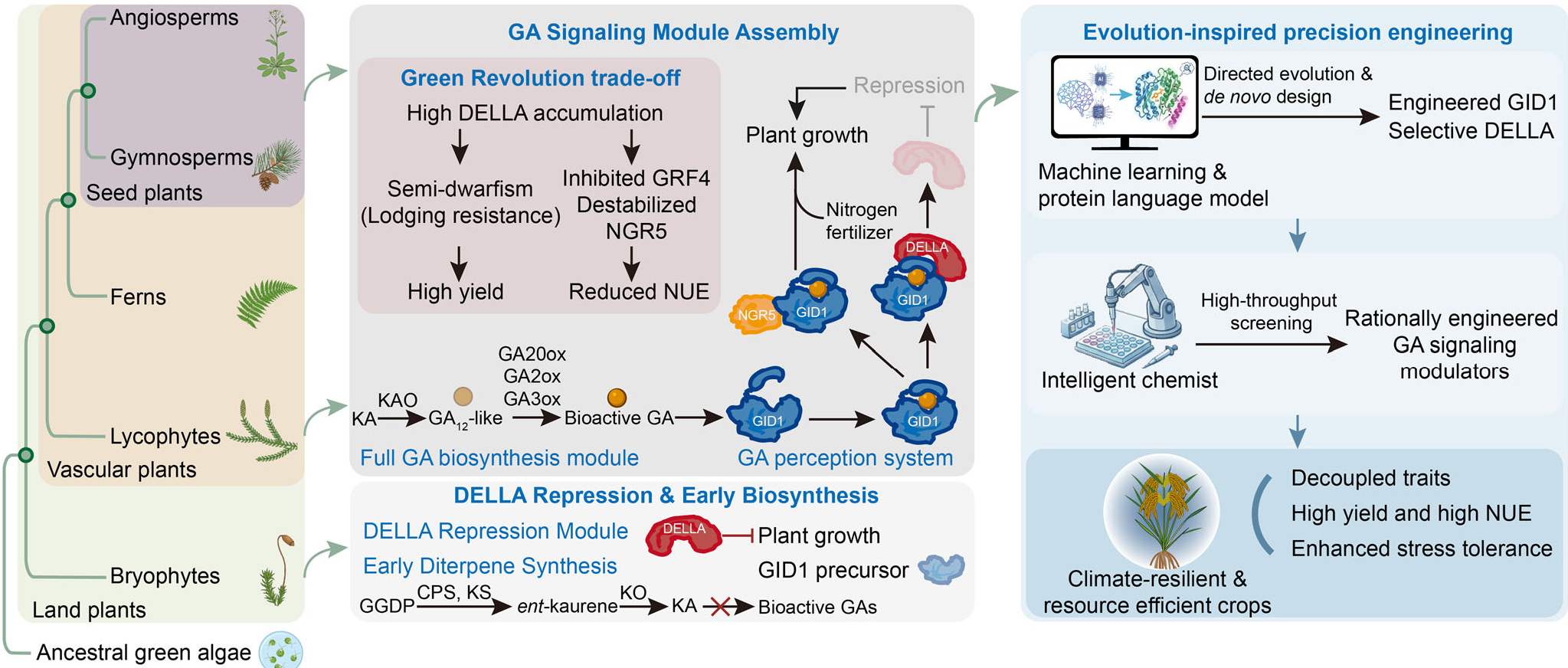
For decades, textbooks depicted Gibberellin signaling as a pre-designed "on/off" switch. However, genomic evidence reveals a fascinating stepwise assembly:
- DELLA Proteins (The Brake): Emerged in early land plants to inhibit growth during stress long before "Gibberellin" existed.
- GA Biosynthesis & Perception (The Release): Evolved later, allowing plants to use hormones to trigger the degradation of DELLA, effectively releasing the growth brake.
- Modern Divergence: In cereal crops, we manipulated this system to create "Green Revolution" varieties that stay short (lodging resistant) but unfortunately become "nitrogen hungry."
The "Green Revolution" Trade-off: Why Nitrogen Fails
Modern semi-dwarf crops work by accumulating DELLA proteins. While this prevents the plant from growing too tall and falling over (lodging), it creates a metabolic bottleneck.
- The Problem: High DELLA levels physically inhibit GRF4, a transcription factor that promotes carbon and nitrogen uptake.
- The Result: To get high yields from these semi-dwarf plants, farmers must apply excessive nitrogen, leading to environmental degradation.

Methodology: Rational Rewiring via AI
The authors argue that we are moving beyond simple gene "knockouts." The future lies in Precision Rewiring. By integrating deep learning with structural biology, we can now perform surgical strikes on the protein interfaces:
1. Structure-Aware Design
Using AlphaFold-Multimer, researchers can model the exact docking interface between the GA receptor (GID1) and its substrates like NGR5 (which regulates nitrogen-responsive chromatin).
2. Generative Protein Engineering
Tools like RFdiffusion and ProteinMPNN allow for the de novo design of protein backbones. Instead of finding a natural variant, we can "build" a DELLA variant that:
- Maintains the semi-dwarf trait.
- Selective Decoupling: Does not inhibit GRF4, ensuring nitrogen uptake remains high.
3. Protein Language Models (PLMs)
Using models like ESM, researchers can scan the "evolutionary sequence space" to find rare or hybrid mutations that stabilize growth-promoting factors under abiotic stress (like high heat or alkali soil), providing a roadmap for climate-resilient crops.
The Path Forward: From Model to Field
The successful computational design of functional enzymes (like serine hydrolases) proves that we are no longer limited by what nature provides. The "Future Design" of GA signaling will likely involve:
- AI-Chemical Synergy: Designing synthetic GA analogs that only activate specific, engineered receptors.
- Epigenetic Fine-tuning: Stabilizing NGR5 to prevent the "energy drain" caused by reactive oxygen species during thermal stress.
Deep Insight & Conclusion
The core takeaway find is that evolutionary history is not just a record of the past, but a design space for the future. By treating GA signaling as a modular system that can be uncoupled and re-linked, we can finally break the correlation between plant height and nutrient inefficiency. The marriage of comparative genomics and Generative AI signals the arrival of "Crop Design 2.0"—where we no longer choose between high yield and environmental sustainability.
Limitations: While AI can predict structure, the "in vivo" behavior of engineered hormones in complex field environments remains the ultimate experimental hurdle.