
Evolutionary Data Purification: Why "Clean" Data Beats "Big" Data in Social Media
Evolutionary data purification for social media classification
The paper introduces an Evolutionary Data Purification (EDP) algorithm designed to improve social media image classification by intelligently selecting a "purified" subset of noisy training data. It combines features from Deep Convolutional Neural Networks (CNN) with Genetic Algorithms (GA) and Support Vector Machines (SVM) to achieve a 67% relative improvement in precision for high-level semantic labeling.
TL;DR
Training AI on millions of social media photos is a nightmare because of "noisy labels" (wrong tags). This paper proposes a Genetic Algorithm (GA) to automatically "purify" training sets. By choosing only the most representative images and discarding the noise, the researchers achieved a 67% improvement in classification accuracy, proving that a curated smaller dataset is often superior to a messy larger one.
The Problem: The Chaos of Social Media Data
In a laboratory setting, datasets like ImageNet are meticulously curated. But in the "wild"—specifically on platforms like Facebook—images are cluttered, low-quality, and capture complex human concepts like "Attitude & Beliefs" or "Personal Style."
Existing supervised learning models face two major hurdles:
- Intra-class Variation: A "Family" photo in the UK looks very different from one in Japan, yet they share the same label.
- Annotation Noise: Massive datasets often rely on "weakly labeled" data (e.g., Google Image Search results), many of which are irrelevant or incorrectly tagged.
The authors argue that simply feeding more noisy data into a CNN doesn't solve the problem—it often makes the classifier more confused.
Methodology: Natural Selection for Data
The core innovation is Evolutionary Data Purification (EDP). Instead of trying to fix the model, the authors fix the data using a Genetic Algorithm.
1. The Genome
The algorithm treats the entire training set as a "genome." Each bit in the genome corresponds to one image:
- 1: Use this image for training.
- 0: Discard this image.
2. The Fitness Function
How do we know if a specific combination of images is good?
- The GA selects a subset of data.
- It trains a Support Vector Machine (SVM) on this subset using CNN-extracted features.
- It tests the SVM on a small, clean validation set.
- The Precision score becomes the "fitness" of that data subset.
3. Evolution
Through Crossover (swapping data subsets between "parent" configurations) and Mutation (randomly flipping bits), the algorithm evolves towards an optimal subset that yields the highest precision.
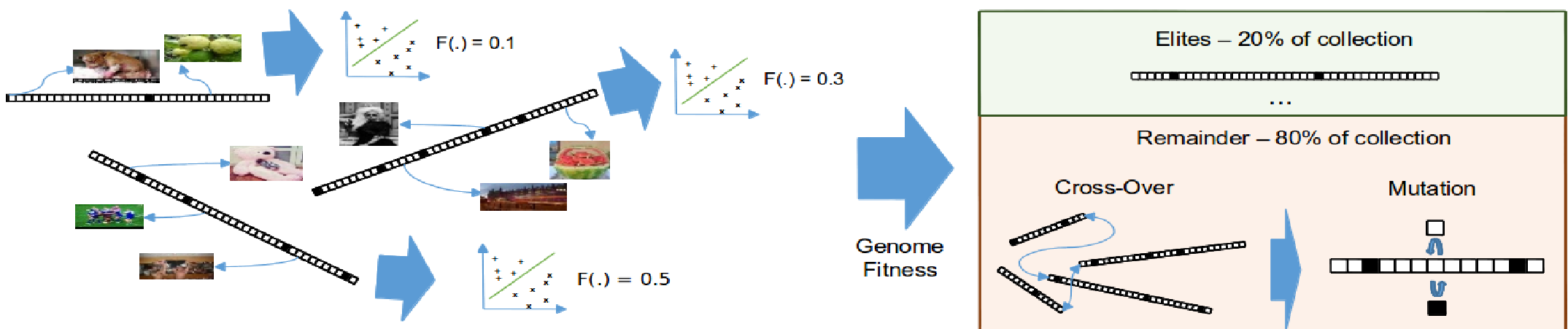 Fig 1: The Evolutionary Loop—breeding better training sets through fitness proportionate selection and mutation.
Experiments: Deep vs. Shallow
The researchers compared four visual representations:
- Standard CNN: Features from a pre-trained ImageNet model.
- Optimized CNN: Fine-tuned on social media data.
- PHOW-Color & SIFT: Traditional "shallow" hand-crafted features.
Key Results
The results were definitive: Purification works across all feature types.
- The Optimized CNN + EDP reached the highest mean precision (32.3%).
- The relative gain from purification was nearly 67%.
- Interestingly, purification allowed traditional SIFT features to perform better than some non-purified deep learning configurations.
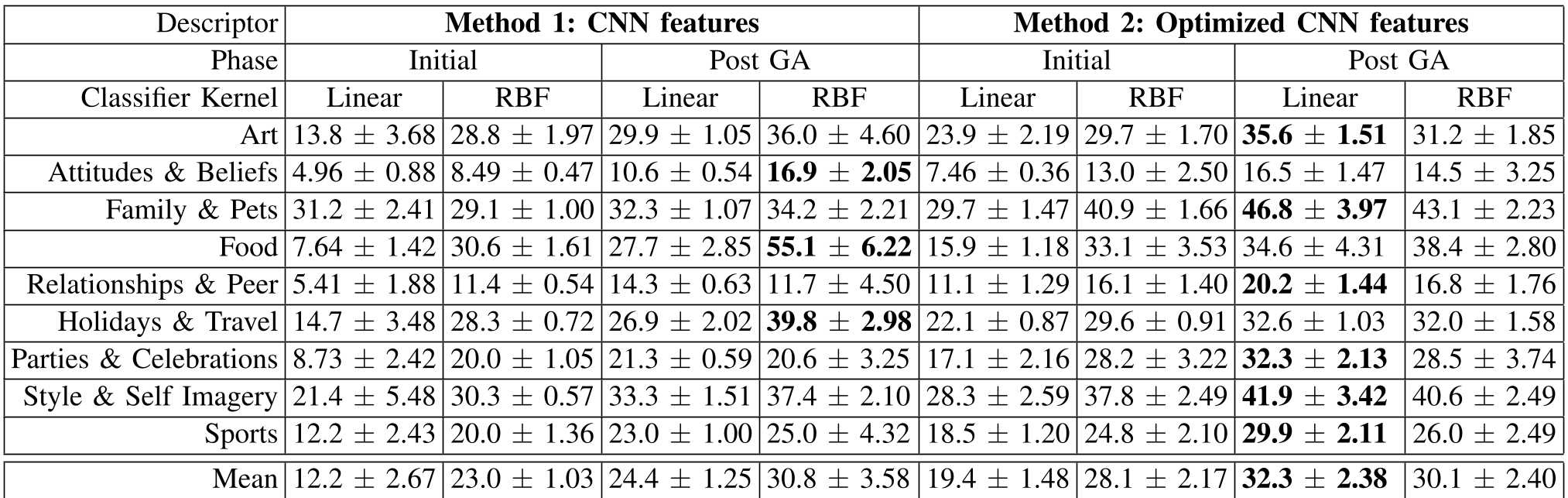 Table 1: Performance comparison showing "Initial" vs. "Post GA" precision. Notice the consistent jump in performance after purification.
Deep Insights: Why Does EDP Work?
The GA acts as a high-level filter that discovers consensus. Social media noise is often random, but the underlying concept (e.g., "Food") has consistent visual patterns. By stripping away images that don't align with the majority, the GA lowers the "entropy" of the training set, allowing the SVM to find a much clearer decision boundary.
Critical Analysis & Conclusion
Takeaway: In an era of "Big Data," this paper is a reminder that Data Quality > Data Quantity. The evolutionary approach is particularly powerful because it doesn't make assumptions about the type of noise—it simply seeks the most performant subset.
Limitations:
- Computational Cost: Running a GA is expensive. Training multiple SVMs for 250 generations took about 20 hours in their setup.
- Validation Dependency: The quality of the "purified" set is heavily dependent on having a small, high-quality validation set to guide the evolution.
Future Work: The authors suggest integrating text metadata (comments/tags) into the purification process. Moving forward, applying this to even larger models like Vision Transformers (ViTs) could redefine how we handle web-scale uncurated datasets.