
The Physics of Social Norms: How Behavior Networks Shape Modern Culture
Evolutionary dynamics of behavior in social networks
This paper introduces "Behavior Networks," a novel framework using evolutionary dynamics to model how social norms and dominant behavioral trends emerge in social networks. By integrating replicator-mutator dynamics with Watts-Strogatz small-world topologies, the author establishes the existence of S-shaped phase transition curves that dictate the diversity of behaviors based on a scalar mutation rate.
TL;DR
Why do a few celebrities, brands, or political ideas dominate the public consciousness while others vanish? This paper treats social behavior as an evolutionary system. By introducing the concept of Behavior Networks, the author uses the mathematics of biology (evolutionary dynamics) and physics (phase transitions) to show how "Behavioral Flocking" emerges from social interactions.
Background Positioning
Moving beyond simple "consensus" models, this work bridges the gap between Evolutionary Game Theory and Network Science. It frames society as a nonlinear system where the "mutation rate" of ideas determines whether we reach a unified social norm or a chaotic collapse of trends.
Problem & Motivation: The Mystery of Dominance
In a world of infinite choices, why does the market share often collapse into just two or three dominant players? Why do certain fashions become "norms"?
The author identifies that existing models often fail to account for the structure of interaction. Whether you're buying an iPod or joining a political party, your "reward" for switching behaviors is influenced by your network. The challenge was to create a model that could mathematically predict the transition from a diverse set of behaviors to a single, "flocking" social trend.
Methodology: The Replicator-Mutator Framework
The core of the paper is the application of Replicator-Mutator Dynamics.
- Behavior Network (): A graph where nodes are behaviors (e.g., Company A, Company B) and edges represent the "reward" for switching between them.
- The Social Choice Model: The author defines a mutation matrix based on the Graph Laplacian. This links the "mutation" (changing one's mind) directly to the network's topology.
- The Dynamic Equation: Here, is the population fraction of a behavior, is its fitness, and is the average fitness of the whole society.
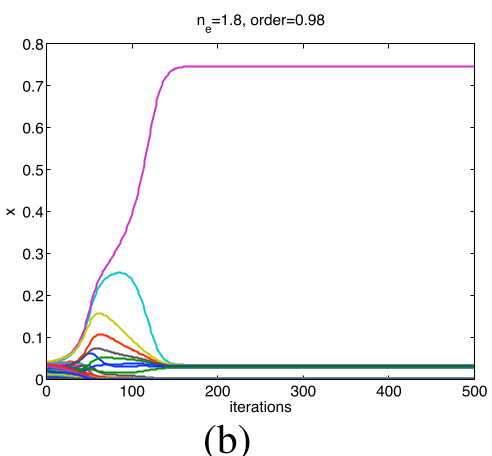 Figure 1: Visual representation of how behaviors evolve over time across different nodes in a lattice structure.
Experimental Results: The S-Curve Phase Transition
The most striking finding is the S-shape diversity-mutation curve. By testing the model on Watts-Strogatz Small-World Networks, the author discovered that as you increase the mutation rate (), the society moves through four phases:
- Behavioral Flocking (): A single "winner-take-all" behavior emerges.
- Cohesion: A few dominant behaviors (e.g., the 2-party political system).
- Collapse: Social norms break down; diversity is high but no trend is "popular."
- Complete Collapse: Every behavior has equal, minimal support.
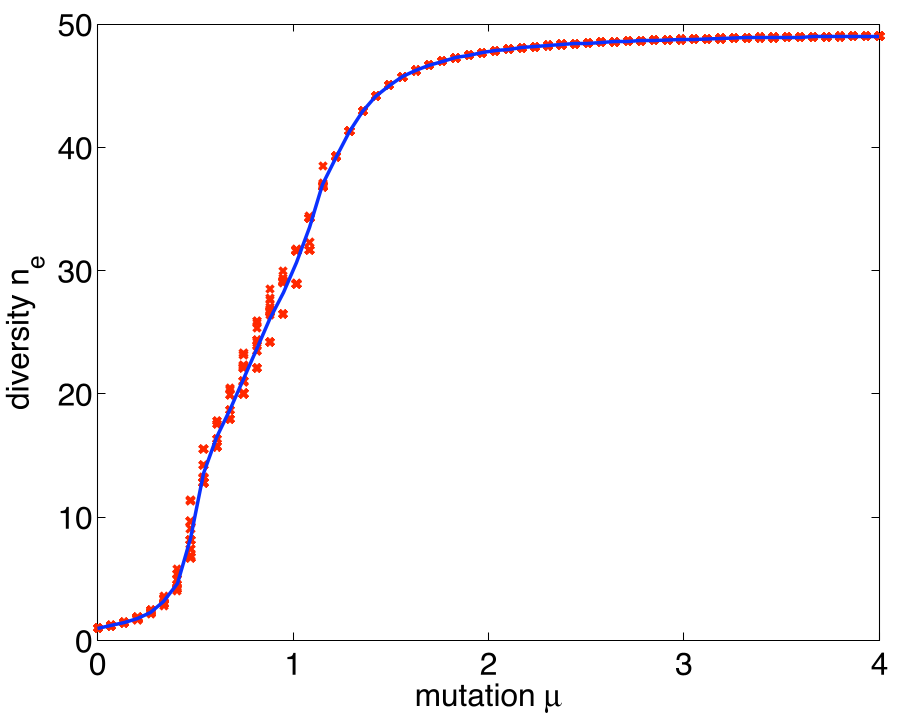 Figure 2: The S-shape curve showing how diversity () explodes as the mutation rate () passes critical thresholds.
Critical Insight & Conclusion
The author concludes that slow mutation rates are the secret sauce for social norms. If individuals change their behaviors too quickly or randomly (high ), the society cannot sustain a "hub" or a dominant culture.
Limitations & Future Work
While the stability analysis (Proposition 1) holds for symmetric rewards, real-world social rewards are often asymmetric. The author notes that future research must explore Scale-Free networks, where "hubs" aren't just behaviors, but the people (nodes) themselves.
Takeaway for the reader: This model suggests that social "hubs" (celebrities/monopolies) are a natural byproduct of low-mutation evolutionary systems. To break a monopoly or a social norm, one must theoretically increase the "mutation rate" or the noise in the network's reward structure.