
Evolutionary Dynamics: Why Information Spreading is a Game of Survival
Evolutionary Dynamics of Information Diffusion Over Social Networks
This paper proposes an Evolutionary Game Theoretic (EGT) framework to model dynamic information diffusion in social networks. By utilizing replicator dynamics and graphical EGT, the authors derive analytical expressions for information spreading across complete, uniform, and non-uniform degree networks (ER and BA models), achieving high predictive accuracy on real-world datasets like Twitter and Facebook.
TL;DR
Why do some hashtags explode overnight while others disappear? This paper shifts the perspective from static data mining to Evolutionary Game Theory (EGT). It demonstrates that information diffusion is driven by users' strategic decisions. By modeling users as "players" in a network-wide game, the authors derive a universal law of diffusion that works across Facebook, Twitter, and synthetic models.
Background: Beyond Data Mining
Standard approaches to information diffusion often treat users as passive nodes or use "black-box" ML models. These fail when the network structure changes. The authors of this paper argue that we must understand the why—the microeconomic motivations of users. They position their work as a bridge between socioeconomic behavior and large-scale network physics.
The Core Logic: Replicator Dynamics
In biology, a mutant survives if it has higher "fitness" than the average population. In social networks, "forwarding a piece of news" is the mutation.
- The Strategy: Users choose between (Forward) and (Not Forward).
- The Payoff: Determined by cost (effort to post) and reward (social capital, interest, popularity).
- The Mechanism: Replicator Dynamics. If forwarding yields a higher payoff than the population average, the proportion of "forwarders" grows exponentially.
Methodology: The Geometry of Influence
The paper meticulously breaks down the math for three network types:
- Complete Networks: Everyone interacts with everyone (e.g., small private groups).
- Uniform Degree Networks: Regular structures where every user has friends.
- Non-Uniform Networks: Real-world "Scale-free" (BA) and "Random" (ER) graphs.
The breakthrough insight is the Separation of Time Scales. Local influence (how you affect your neighbors) converges much faster than the global population state. By solving the local "Influence Dynamics" first, the authors derived a closed-form solution for global information spread.
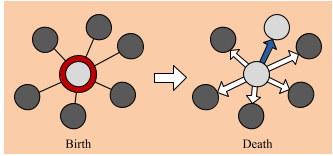 Figure 1: Strategy update rules (Birth-Death, Death-Birth, Imitation) used to simulate how users adopt new behaviors based on neighbor fitness.
Key Finding: The Scale-Free Property
A major theoretical contribution is the proof that in sufficiently large networks, the specific topology (whether it's an ER random graph or a BA scale-free graph) becomes secondary. The Population Dynamics converge to the same mathematical form. This explains why similar viral patterns can be observed across fundamentally different social platforms.
Experimental Evidence: Predicting the Peak
Using a Twitter hashtag dataset, the authors show that their model isn't just descriptive—it’s predictive.
- Twitter/Facebook Fit: The EGT model fits the real-world cumulative mention curves of hashtags like #googlewave and celebrities like David Archuleta significantly better than traditional news-cycle models.
- Early Prediction: By looking at just the first 25% of a hashtag's lifespan, the model can estimate the "payoff matrix" and predict when the peak of the conversation will occur.
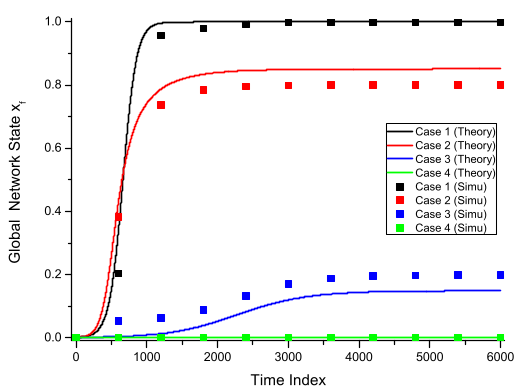 Figure 2: Validation across Complete, Uniform, ER, and BA networks showing near-perfect alignment between theory and simulation.
Critical Analysis & Future Outlook
Takeaway: This work proves that the "viral" nature of information is an emergent property of individual rational (or semi-rational) choices. By quantifying the "payoff" of information, we can categorize hashtags into "popularity levels" even before they reach their peak.
Limitations:
- The model assumes a static network structure during the diffusion process, which may not hold for long-term social trends where users unfollow/follow others dynamically.
- It primarily considers symmetric payoffs, whereas in reality, an "Influencer" might gain more payoff from the same action than a regular user.
Future Work: The convergence of EGT with Reinforcement Learning (RL) could allow for real-time adjustment of these payoff parameters, enabling brands or governments to not just predict, but actively steer information flow.