
SDIGA: Bridging Evolutionary Intelligence and Fuzzy Logic for Insightful Subgroup Discovery
Evolutionary Fuzzy Rule Induction Process for Subgroup Discovery: A Case Study in Marketing
This paper introduces SDIGA (Subgroup Discovery Iterative Genetic Algorithm), a novel genetic fuzzy system designed for descriptive data mining. It extracts high-quality fuzzy rules in Disjunctive Normal Form (DNF) to identify statistically significant patterns in specific population subgroups, achieving SOTA-level performance in coverage and support.
TL;DR
Researchers have developed SDIGA, a Genetic Fuzzy System that redefines how we find "interesting" patterns in data. Instead of generating complex black-box models, SDIGA produces a compact set of Fuzzy DNF rules that are both statistically powerful and linguistically understandable. By outperforming traditional learners like CN2-SD in coverage and support, it proves that "less is more" when it comes to actionable data mining.
Problem & Motivation: The Gap in Descriptive Induction
In fields like marketing and medicine, the goal isn't just to predict an outcome but to understand the conditions that lead to it. Existing methods faced a dual challenge:
- Search Complexity: The search space for rules grows exponentially with the number of variables.
- Hard Boundaries: Conventional "crisp" logic (e.g.,
Age > 30) creates arbitrary splits that don't reflect real-world transitions.
The authors hypothesized that Fuzzy Logic could mitigate these boundaries, while Genetic Algorithms (GAs) could navigate the complex search space more effectively than greedy, local-search algorithms.
Methodology: The Core of SDIGA
SDIGA stands out through its Iterative Rule Learning (IRL) framework. Unlike the "Pittsburgh" approach where a chromosome represents a whole rule set, SDIGA's GA focuses on finding the single best rule per run.
1. The DNF Fuzzy Rule Structure
Rules are expressed in Disjunctive Normal Form (e.g., IF X is (Low OR Medium) AND Y is High THEN Class). This flexibility allows a single rule to cover complex, non-contiguous regions of data while remaining readable.
2. The Hybrid Evolution Strategy
The algorithm employs a Steady-State GA coupled with a Local Search (Hill-Climbing) phase. After the GA identifies a promising region, the local search "prunes" variables to increase the rule's generality without sacrificing confidence.
3. The Penalty Mechanism
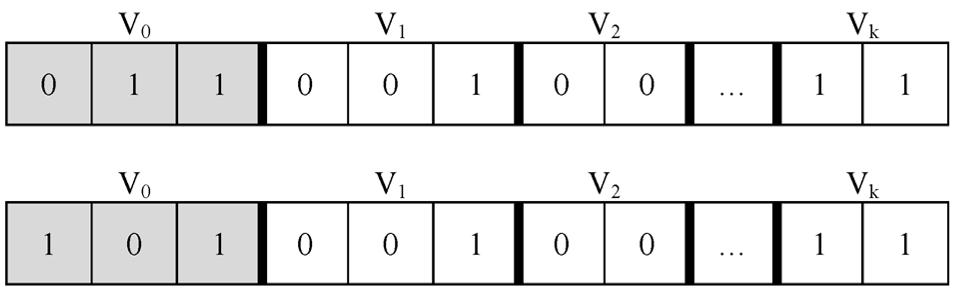
To prevent the algorithm from finding the same "obvious" rule repeatedly, SDIGA uses a Weighted Penalty. Covered examples are marked, lowering their contribution to the "Support" score in the next iteration. This forces the GA to explore "uncovered" areas of the data manifold.
Experiments: Superiority in Coverage and Support
The researchers tested SDIGA against the benchmark CN2-SD algorithm. The results were striking:
| Algorithm | Coverage (COV) | Support (SUP) | Set Size (Siz) |
|---|---|---|---|
| SDIGA (CfMin 0.9) | 0.935 | 0.976 | 2.0 |
| CN2-SD (add.) | 0.381 | 0.870 | 4.6 |
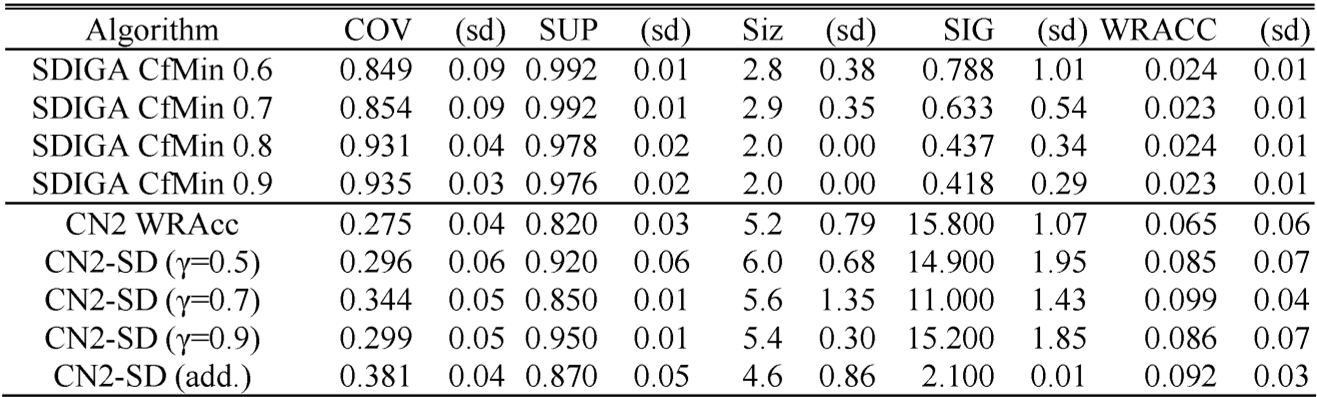
SDIGA consistently produced smaller sets of rules that covered more examples. This is crucial for domain experts who cannot sift through hundreds of micro-rules to find actionable insights.
Real-World Case Study: Trade Fair Efficiency
Applying SDIGA to a marketing problem in Spain, the algorithm identified that:
- High-efficiency exhibitors often came from the central zone and avoided "mass-mailing" (thank-you pamphlets to everyone), focusing instead on quality contacts.
- Low-efficiency exhibitors typically failed to track contacts and were distanced from the fair's home region (North zone).
Crucially, these insights were derived from a massive pool of 104 variables, yet the resulting rules used an average of only 4.3 variables, making them immediately useful for trade fair planning policies.
Critical Analysis & Future Outlook
Takeaway
SDIGA proves that Genetic Fuzzy Systems are not just for control systems; they are high-performance engines for Descriptive Induction. The ability to handle both categorical and numerical data via fuzzy sets provides a massive advantage in "messy" real-world datasets.
Limitations
The current approach relies on manual weight settings () in the fitness function. While the authors achieved great results, the performance is sensitive to these parameters.
Future Work
The logical next step is a Multi-Objective Genetic Algorithm (MOGA). By treating Confidence and Support as separate objectives, researchers could generate a Pareto-optimal front of rules, allowing experts to choose the best trade-off between "certainty" and "generality" without manual weight tuning.