
Evolutionary Game Theory: Why Your Friends' Privacy Settings Matter More Than You Think
Evolutionary Game Based Analysis for User Privacy Protection Behaviors in Social Networks
This paper proposes a Network Evolutionary Game (NEG) model to analyze user privacy-setting behaviors in online social networks. By integrating payoff matrices with network topology, the study identifies a critical benefit-cost ratio threshold that determines whether a population will collectively adopt or abandon privacy protection mechanisms.
TL;DR
Most privacy research assumes that if you build a security feature, users will use it. This paper argues that privacy is actually a social game. Using a Network Evolutionary Game model, the researchers prove that whether a social network becomes secure or "privacy-naked" depends on a mathematical tipping point: the benefit-cost ratio. By adjusting the ease of use (cost) or user incentives (benefit), platform managers can force the entire network to evolve toward a state of total privacy protection.
Background Positioning
In the academic coordinate system, this work sits at the intersection of Cybersecurity and Behavioral Economics. While most arXiv papers focus on the "What" (a better encryption algorithm), this paper focuses on the "Why" and "How" of human adoption. It moves beyond "well-mixed" populations—where everyone interacts with everyone—to a realistic graph-based interaction model that reflects actual social networks like Facebook or LinkedIn.
The Core Motivation: The Hidden Cost of Privacy
Why don't people use privacy settings even when they are available? The authors identify three primary hurdles:
- Complexity Cost (): Navigating deep menus to find "Visibility" settings is a cognitive and time burden.
- Information Correlation (): Your privacy is tied to your friends. If your friend shares a photo you are tagged in, your data leaks regardless of your settings.
- Bounded Rationality: Users aren't perfect; they imitate successful peers. If "exposed" users seem to have more social success without the hassle of settings, others will follow suit.
Methodology: The Death-Birth (DB) Update Mechanism
The heart of the paper is the application of the Death-Birth (DB) rule to social network topology. Instead of a global average, a user's probability of switching to a "Privacy Protected" state () is determined by the fitness (payoff) of their immediate neighbors.
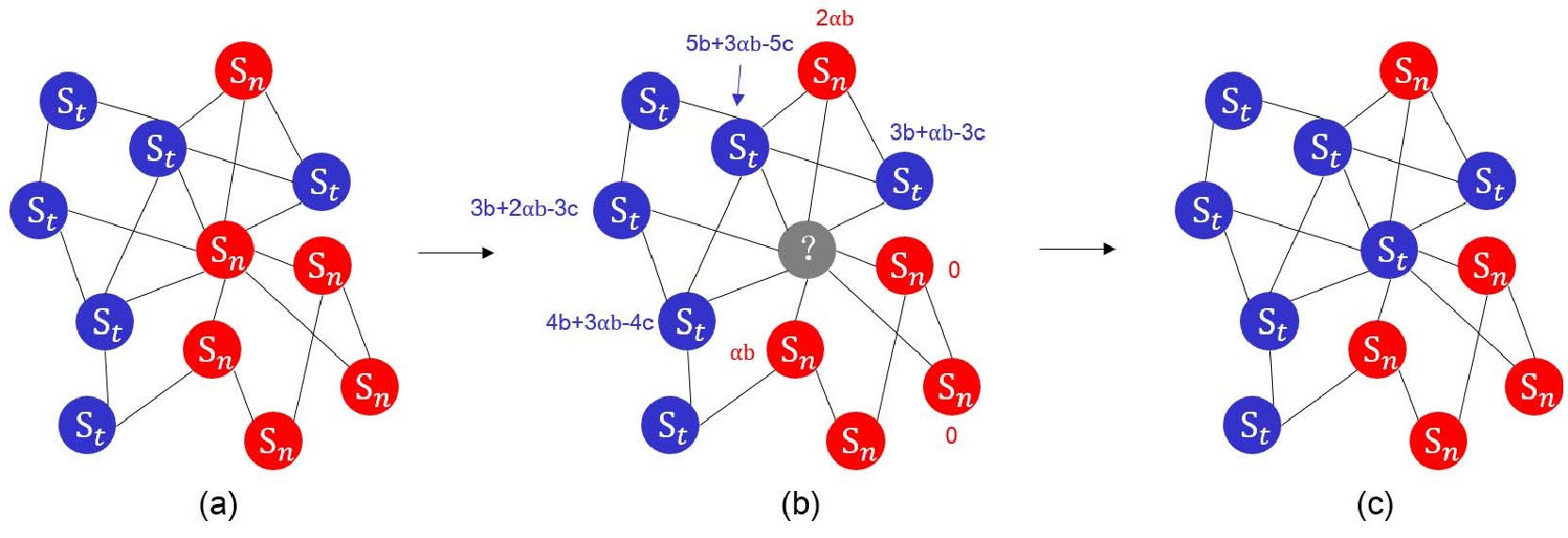
The researchers derived a dynamic equation to predict the proportion of protected users over time:
This formula reveals the Evolutionary Stable State (ESS). If the expression on the right is positive, the network eventually reaches 100% adoption. If negative, adoption collapses to 0%.
Evidence from the Facebook Graph
The authors didn't just stay in the realm of theory. They tested the model using a real-world SNAP Facebook dataset (4,039 nodes, ~88k edges).
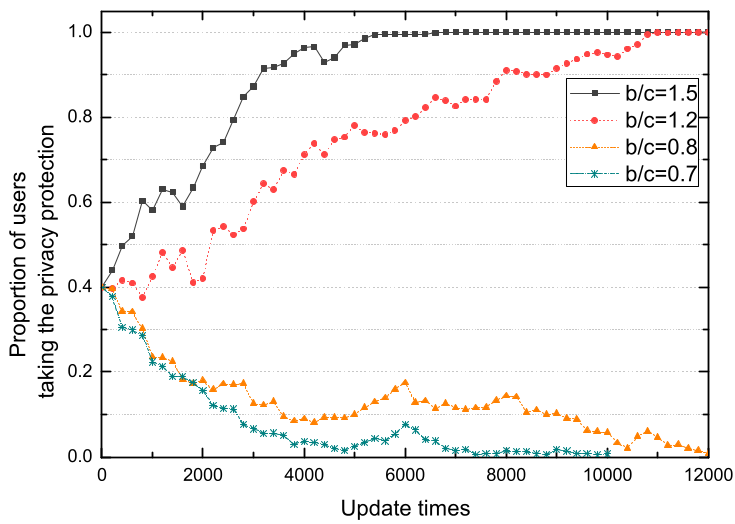
Key Finding: There is a "sharp" transition.
- When the benefit-cost ratio () was above 0.99, the adoption rate () climbed steadily to 1.0.
- When it was below 0.99 (e.g., or ), the network's security effectively "died," with adoption dropping to zero.
- The speed of convergence is proportional to how far the ratio is from the critical threshold.
Critical Analysis & Industry Takeaway
The genius of this paper lies in its policy implications. For years, platforms like Facebook were criticized for making privacy settings "difficult to find." Following the Cambridge Analytica scandal, they simplified the UI. According to this model, this wasn't just a PR move; by reducing the cost (), they shifted the ratio past the critical threshold, theoretically triggering a permanent evolutionary shift toward a more secure network.
Limitations:
- Static Topology: Real social networks are dynamic; friends are added and removed daily. The model assumes a fixed graph.
- Homogeneous Parameters: The model assumes and are the same for all users. In reality, a "tech-savvy" user has a lower than a "low-digital-literacy" user.
Future Work: Applying this to Adversarial Games—where an attacker actively tries to increase the "cost" of defense (e.g., via social engineering)—would be the next logical step in this research lineage.