
Modeling Opinion Dynamics: Why Selfish Users Choose to Cooperate in Social Networks
Model of Opinion Interactions Base on Evolutionary Game in Social Network
This paper proposes an Evolutionary Game Model to simulate opinion interactions under bounded rationality within social networks like Sina Weibo. By categorizing users into Opinion Leaders, Chatters, and General People, the authors utilize replicator dynamics to demonstrate how distinct payoff structures influence the stability and evolution of online consensus or disagreement.
TL;DR
Researchers have developed an Evolutionary Game Model to decode the complex dance of opinion exchange on micro-blogging platforms. By simulating interactions between different types of users—Opinion Leaders, Chatters, and General People—the study reveals that "Agreement" often emerges as a stable strategy, even when individuals act out of self-interest and bounded rationality.
Exploring the Human Element in Social Algorithms
Social networks are more than just nodes and edges; they are battlegrounds for ideas. While prior models used Markov chains or stochastic processes to predict what a user might do next, they often missed the why—the strategic payoff behind every comment and retweet.
The core insight of this paper is that users are boundedly rational. They don't have perfect information, nor are they perfectly logical. Instead, they use a trial-and-error approach, adjusting their stances based on the benefits of persuading others versus the costs of participating in heated debates.
Methodology: The Payoff Matrix of Persuasion
The authors define three distinct personas based on social behavior:
- Opinion Leaders: High influence, high persistence, and deep investigation into events.
- Chatters: High activity but low influence; they participate for the sake of being heard.
- General People: Moderate users who focus on stability and specific sub-groups.
The interaction is modeled as a game where users choose to either Keep their mind or Agree with an opponent. The payoff is calculated using a formula involving (benefit of persuading others), (utility of holding one's ground), and (extra earnings from compromise based on opinion distance).
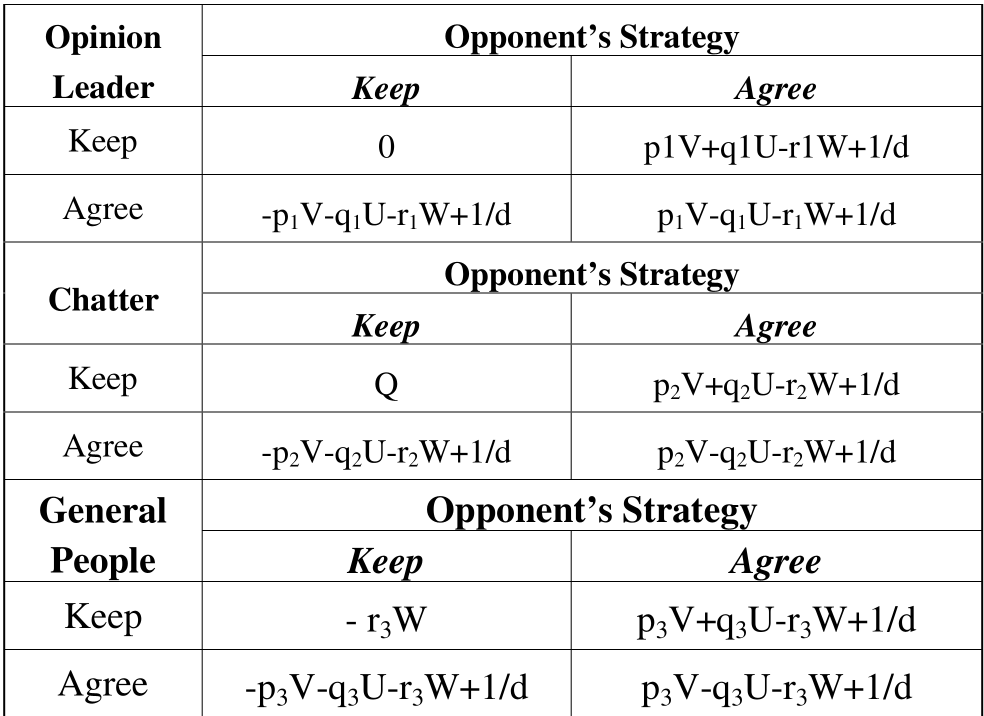 Table 1: The Payoff Matrix for different user types showing how strategic choices yield different benefits.
Replicator Dynamics: The Math of Social Evolution
To find the equilibrium, the paper employs Replicator Dynamics. Unlike a static Nash Equilibrium, this approach uses differential equations to show how a strategy's prevalence in a population grows or shrinks over time based on its relative success.
The equations (e.g., ) describe a world where if "Agreeing" leads to better outcomes, more users will gradually adopt it.
Experimental Insights: The "Trust" Factor
The simulations yielded a fascinating result regarding human nature: The Emergence of Cooperation.
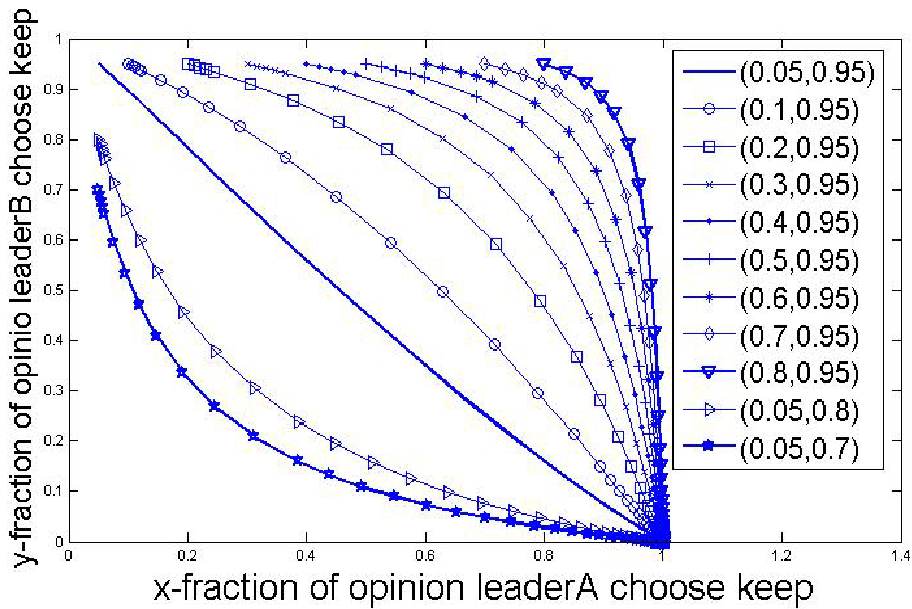 Fig 1: Evolution when Opinion Leaders meet. Notice how initial conditions dictate whether the group moves toward consensus or total disagreement.
Key findings include:
- The Power of Trust: If a user believes their opponent is likely to cooperate (low initial value of ), they are far more likely to compromise themselves.
- Chatter Vulnerability: Chatters are much more easily persuaded, acting as "lubricants" for information flow, whereas Opinion Leaders act as "anchors" that resist change.
- Stability of Agreement: Even when a user could gain a higher temporary payoff by "betraying" an opponent (remaining stubborn while the other compromises), many populations still settle into a state of mutual agreement (Agree, Agree).
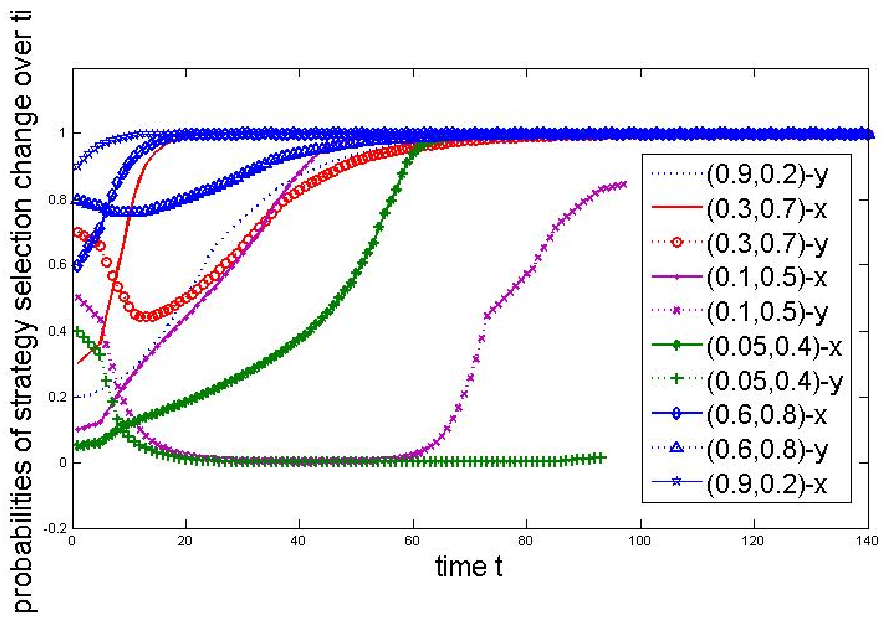 Fig 2: Opinion evolution when Chatters interact, showing a higher tendency towards compromising strategies.
Critical Analysis & Conclusion
This work provides a rigorous mathematical backbone to the phenomenon of "Echo Chambers" and "Social Influence." It proves that the structure of the network—the ratio of Leaders to Chatters—is just as important as the information itself.
Limitations: The model assumes a simplified strategy set (Keep vs. Agree). In reality, social media allows for "Trolling," "Blocking," or "Lurking," which would introduce more complex payoff dynamics.
Future Outlook: Integrating these evolutionary game models with Complex Network Topology (e.g., Scale-free or Small-world networks) will be the next frontier in predicting how public opinion shifts in the face of global events.