
DLCBFO: Redefining Influence Maximization with Bio-Inspired Foraging and Three-Layer Dynamics
Evolutionary Optimization of Three-Degree Influence Spread in Social Networks Based on Discrete Bacterial Foraging Optimization Algorithm
This paper introduces a Discrete Bacterial Foraging Optimization (DBFO) algorithm coupled with a new Complete-Three-Layer-Influence (CTLI) model to solve the Influence Maximization (IM) problem in social networks. By redefining bacterial update and mutation rules, the approach achieves superior influence spread across several real-world social network datasets compared to traditional heuristics.
TL;DR
Pinpointing the most influential users in a social network—the Influence Maximization (IM) problem—is a cornerstone of viral marketing but remains computationally grueling. This paper introduces a Discrete Local Communication Bacterial Foraging Optimization (DLCBFO) algorithm. By combining a refined Complete-Three-Layer-Influence (CTLI) evaluation model with bio-inspired search strategies, the authors achieve high-accuracy influence spread estimates without the crippling overhead of traditional Monte Carlo simulations.
The Bottleneck: Accuracy vs. Efficiency
The IM problem seeks a set of seed nodes that maximize information cascade. Modern approaches generally fall into two camps:
- Greedy Algorithms: Mathematically sound but slow. They rely on thousands of Monte Carlo simulations to estimate spread, making them impractical for networks with millions of nodes.
- Heuristics: Fast but "blind." Methods like Degree or PageRank only look at local topology, often missing the complex multi-hop interactions that define actual social influence.
The authors argue that the "Three-Degree" theory (most influence happens within three hops) is the sweet spot for modeling, provided we can account for the "noise" of intra-layer and backward communication.
Methodology: Bacterial Intelligence meets Graph Theory
1. The CTLI Evaluation Model
Traditional models often look forward. The CTLI model (Equation 4 in the paper) is more sophisticated. It calculates the activation probability by considering:
- Forward Propagation: Layer 0 to 1, 1 to 2, and 2 to 3.
- Intra-layer Communication: Influence between nodes within the same hop distance.
- Backward Inter-layer Effects: How nodes in a deeper layer might influence those closer to the source.
2. The DLCBFO Algorithm
Bacterial Foraging Optimization (BFO) mimics the movement of E. coli seeking nutrients. The authors adapt this for discrete network space:
- Smart Initialization: Instead of random start, they use DegreeDiscount to seed the bacteria in promising regions of the graph.
- Local Communication (LC): Bacteria share info on "nutrient-rich" (high influence) nodes, filtering excellent solutions to accelerate convergence.
- Directed Mutation: Unlike the blind mutations in standard BFO, this algorithm uses a targeted mutation rule to maintain population diversity while keeping the best-performing nodes.
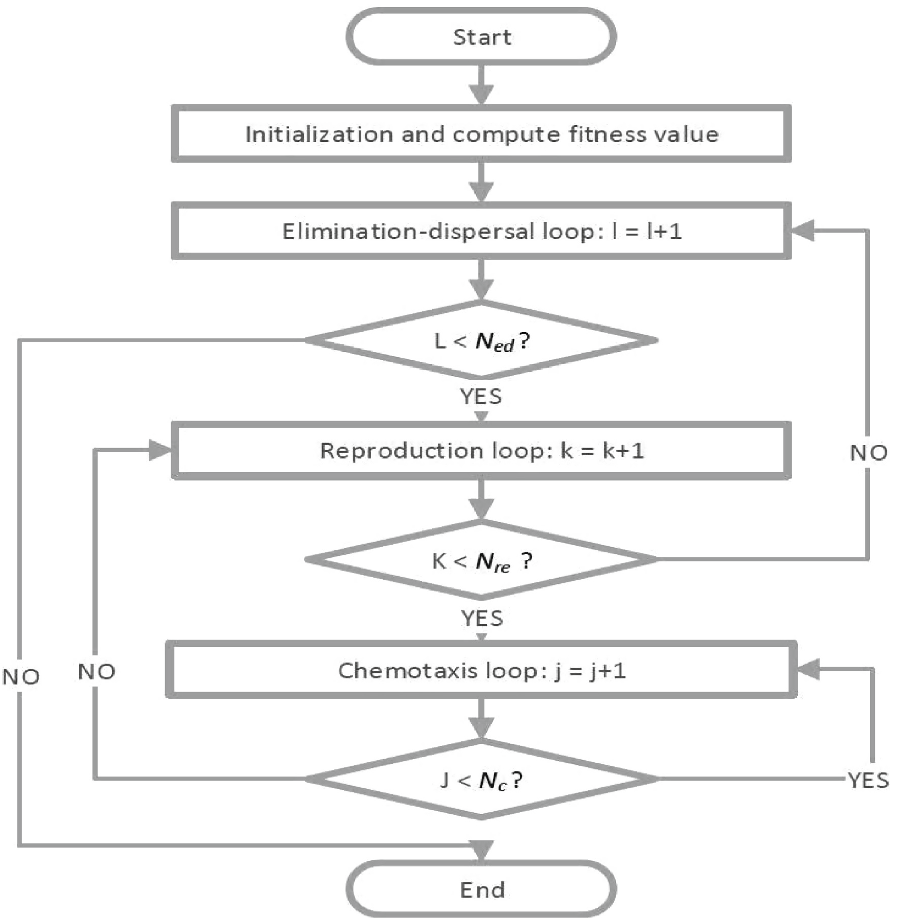 Figure 1: The standard BFO cycle adapted for discrete optimization.
Experimental Validation
The authors tested their approach on four datasets: Football, Polblogs, NetScience, and Power.
- Stability: The CTLI values reached a stable plateau once the population size reached approximately 80 bacteria, indicating robust convergence.
- Superior Spread: In the IC (Independent Cascade) model, DLCBFO consistently outperformed traditional heuristics. On the Netscience network, DLCBFO's influence spread was significantly higher than PageRank and Distance-based methods.
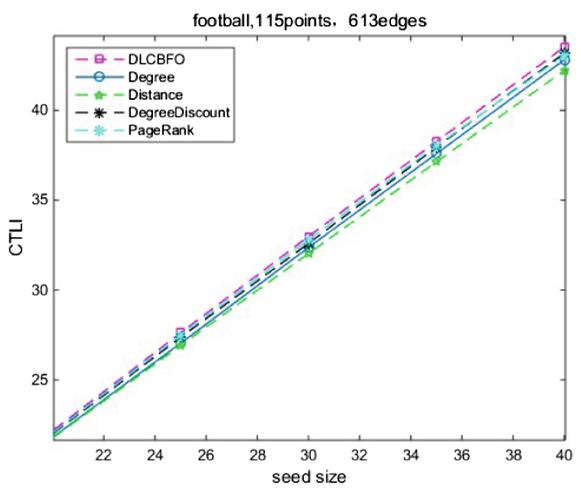 Figure 2: Performance comparison across different social networks. DLCBFO (red line) consistently maintains the lead in influence spread.
Critical Insight: Why it Works
The success of DLCBFO lies in its Inductive Bias. By assuming that influence decays significantly after the third hop (the CTLI model), the search space is effectively pruned. The "Bacterial" search then explores this pruned space much more efficiently than a brute-force greedy search could.
Conclusion
This work demonstrates that we don't need to choose between the speed of heuristics and the accuracy of greedy methods. By modeling the physics of influence (CTLI) and using a population-based search (DLCBFO), we can identify powerful influencers in complex networks with high precision and low computational cost. Future research could extend this logic to dynamic networks where the social graph changes over time.
Takeaway: Effective social modeling requires looking beyond the immediate neighbor—but stop at the third hop to keep the math manageable.