
Evolutionary Regression Machines: Using UAVs and Meta-Heuristics for Precision Agriculture
Evolutionary Regression Machines for Precision Agriculture
The paper introduces an end-to-end biomass estimation system for precision agriculture, utilizing UAV-captured Digital Elevation Models (DEM) and multispectral imagery. It employs an ensemble of Support Vector Regressors (SVR) optimized via evolutionary meta-heuristics, with the Proximity-based Differential Evolution (Prox-DE) achieving the best performance in biomass prediction.
TL;DR
To optimize water and fertilizer use, farmers need to know exactly how much biomass is in their fields. This paper presents a system that uses drones to build 3D models and NIR maps, then feeds that data into an "Evolutionary Regression Machine"—a Support Vector Machine ensemble that finds its own optimal settings using evolutionary algorithms like Prox-DE.
The Problem: Why Current Farming is "Blind"
Modern agriculture has shifted from solar-based to tech-based, yet monitoring intra-field variation remains a bottleneck. Satellites are often obscured by clouds, and ground-based sensors are slow. Prior work often relied on 2D spectral indices (like NDVI) which ignore the volumetric "height" of the crop—a critical component of total dry biomass.
Methodology: The "Evolutionary" Architecture
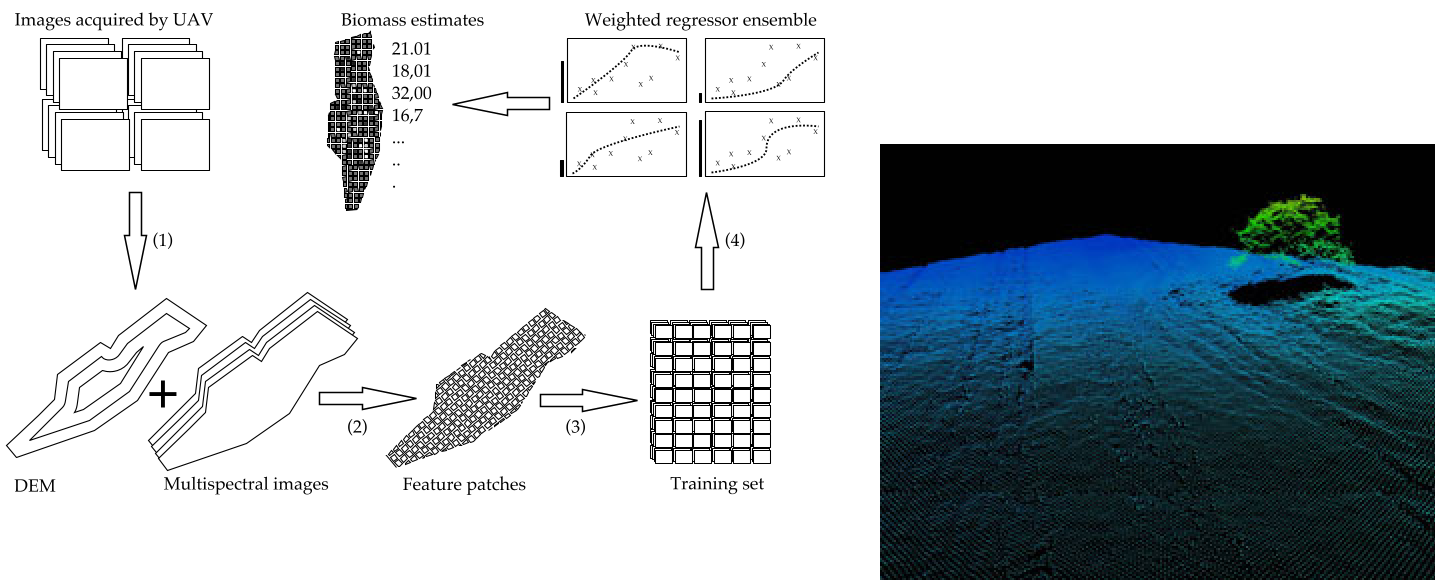
The authors propose a multi-stage pipeline that transforms raw drone photos into actionable data:
- 3D Reconstruction: Using stereoscopic vision to create a Digital Elevation Model (DEM).
- Feature Extraction: Capturing cumulative histograms of elevation and NIR (Near-Infrared) responses.
- The Ensemble SVR: Instead of one SVM, they use an ensemble. To solve the problem of selecting the right kernel (Linear vs. RBF vs. Sigmoid) and the right C/ parameters, they treat the model configuration as an optimization problem.
The Evolutionary Choice
The paper pits three heavyweights of Computational Intelligence against each other to "train" the regressor:
- Prox-DE (Proximity-based Differential Evolution): Focuses on local search neighborhoods.
- F-PSO (Frankenstein Particle Swarm Optimization): A hybrid PSO.
- CMA-ES (Covariance Matrix Adaptation Evolution Strategy): A state-of-the-art strategy for continuous optimization.
Experiments & Results
The study was conducted in a real-world test field in Vihti, Finland. The results show a clear winner in terms of stability and accuracy.
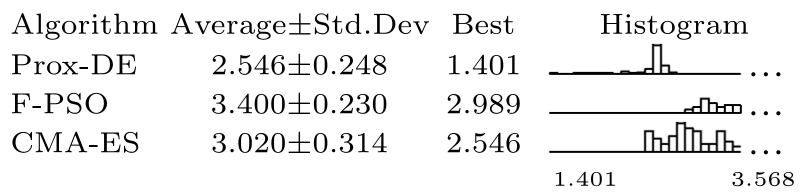
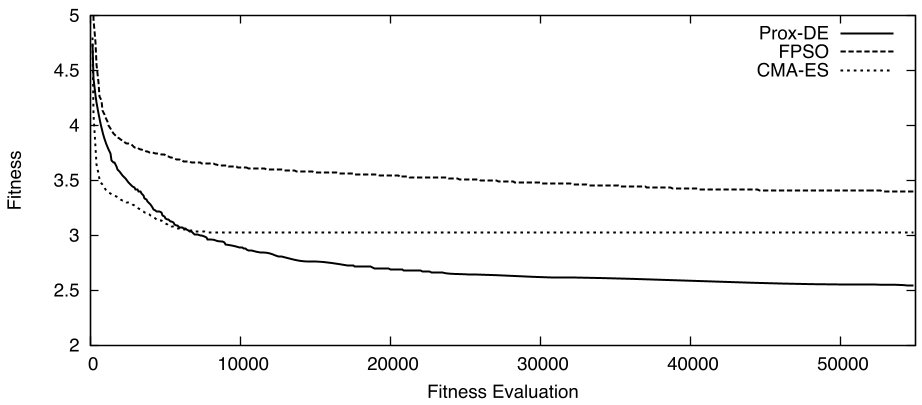
- Prox-DE provided the most stable results (Avg Error 2.546) and found the best overall solution.
- CMA-ES converged faster but was less stable.
- F-PSO struggled to find competitive configurations in this specific search space.
Critical Insight: Why Evolutionary SVR?
The beauty of this approach is its Inductive Bias. By using meta-heuristics to weight different kernels and preprocessing steps (like PCA), the system effectively "searches" for the best way to represent agricultural data. It bypasses the "no free lunch" theorem by allowing the data to dictate whether a linear or non-linear mapping is most appropriate for a specific field's terrain.
Conclusion & Future Outlook
The authors demonstrate that even with relatively small datasets (91 plots), evolutionary-optimized ensembles can achieve the precision required for automated machinery (e.g., controlling fertilizer dispensers).
Future Work: The authors suggest that moving beyond basic DEMs to more complex 3D orthophotographs and expanding the feature set for dimensionality reduction optimization could further push the boundaries of what flying robots can achieve in the field.