
Beyond Connectivity: Modeling Social Media Virality Through Evolutionary Games
Evolutionary social information diffusion analysis
This paper introduces a formal framework based on Graphical Evolutionary Game Theory (EGT) to analyze information diffusion in social networks. By modeling user decisions (forwarding vs. not forwarding) as evolving strategies, the authors derive closed-form expressions for Evolutionarily Stable States (ESS), validated on large-scale Facebook and Memetracker datasets.
TL;DR
Why does some information go viral while others die out? Most researchers look at the "pipes" (network structure), but this paper focuses on the "pumping" (user decisions). By applying Graphical Evolutionary Game Theory (EGT), the authors transform information diffusion from a simple epidemic model into a dynamic socio-economic game. They provide a mathematical proof for the "Evolutionarily Stable State" of information and validated it using massive real-world datasets from Facebook and Memetracker.
The Missing Piece: Rationality in Diffusion
Existing literature on information spread typically falls into two camps:
- Structural Analysis: Finding influential "hubs" like a central traffic controller.
- Data Mining: Observing past patterns to predict future spread.
However, both neglect why a user clicks "share." In reality, information diffusion is a process of individual decision-making. If your friends find a meme exciting, the "utility" of sharing it increases. This interaction creates a feedback loop where the strategy of "forwarding" evolves across the population—much like a beneficial mutation spreads through a biological species.
Methodology: The Evolutionary Framework
The authors map social dynamics onto biological evolution using three core components:
- Players: Users in the network.
- Strategies: (forward) and (not forward).
- Fitness: The utility a user gains, calculated by a payoff matrix and a baseline interest .
The core mechanism relies on the Birth-Death (BD) update rule. In this model, a user's ability to "reproduce" their strategy among neighbors is proportional to their fitness. If forwarding a hot news item yields high social capital (utility), that user is more likely to "convert" neighbors to also forward that information.

The Formalism
The fitness of a user is defined as: Where represents "selection intensity"—how much the game's payoff actually influences the user compared to their inherent interests.
Experimental Validation: Facebook and Memetracker
The researchers tested their framework on the Facebook graph (4,039 users, 88k edges). By manipulating the payoff matrix (e.g., making high for hot topics vs. high for spam), they showed that the theoretical stable states (ESS) perfectly predicted the final percentage of users who would adopt the information.
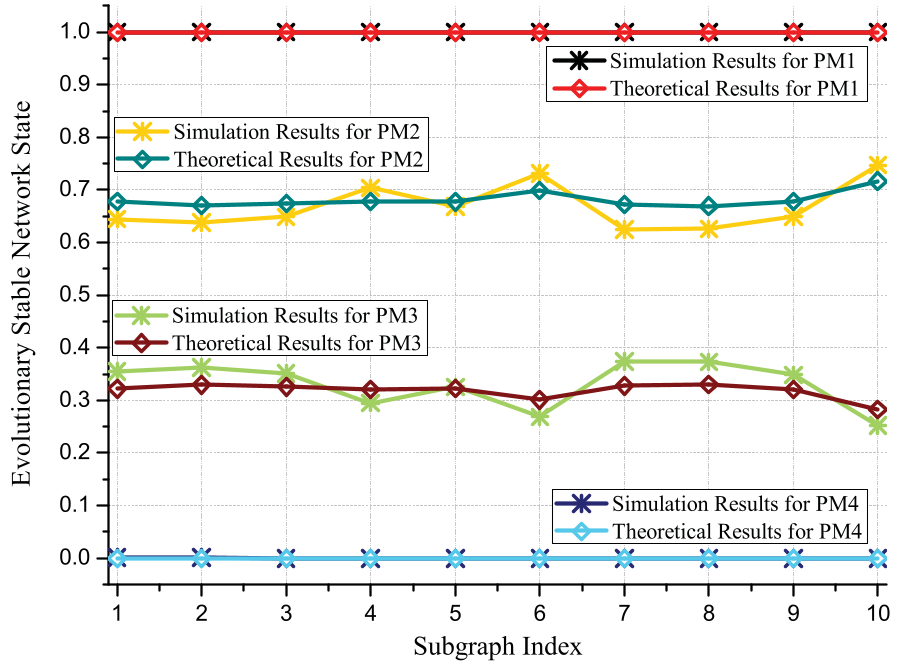
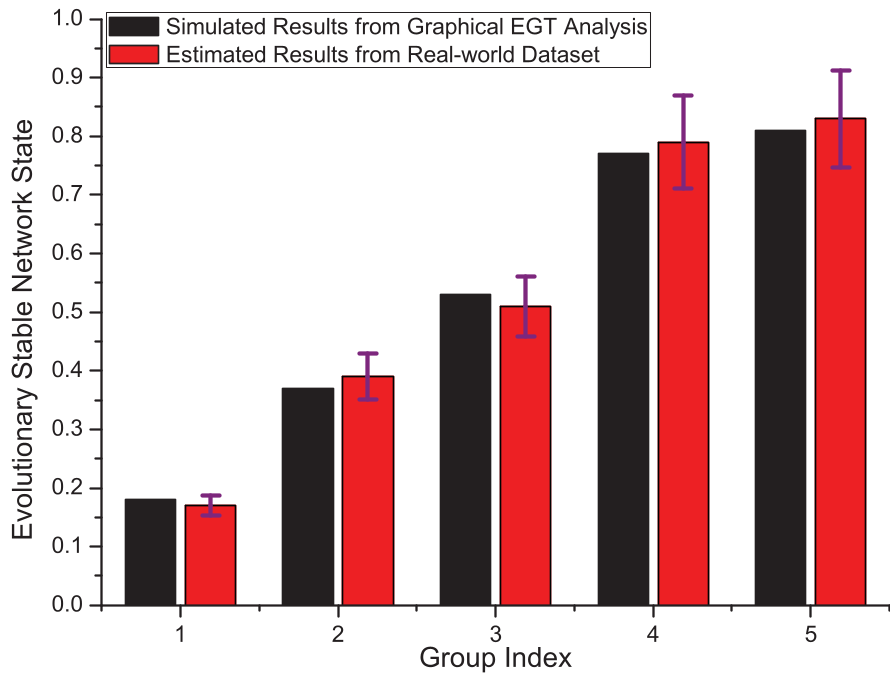
Furthermore, they applied the model to the Memetracker dataset, which tracks 172 million news articles. They performed an "inverse game" analysis: by observing the final spread of a meme, they successfully trained the payoff matrix required to produce that result. The simulated stable states aligned nearly perfectly with real-world observed data.
Deep Insight: Why This Matters
The strategic value of this work lies in its predictive power for marketers and policymakers.
- For Corporations: Instead of just targeting influencers, companies can design "payoffs" (incentives) that make sharing a stable strategy for the average user.
- For Security: Understanding the ESS allows for better "vaccination" strategies against digital viruses or misinformation. If the payoff for not sharing (verification) is higher than sharing, the "outbreak" can be mathematically suppressed.
Conclusion
This paper transcends the "influence maximization" trope by treating social network users as rational actors in an ecosystem. By bridging the gap between graph theory and evolutionary biology, it provides a robust toolkit for understanding the complex dynamics of the modern information age. While the model assumes a degree-independent network state (a slight limitation), its performance on real-world large-scale data confirms its status as a highly practical framework for diffusion analysis.